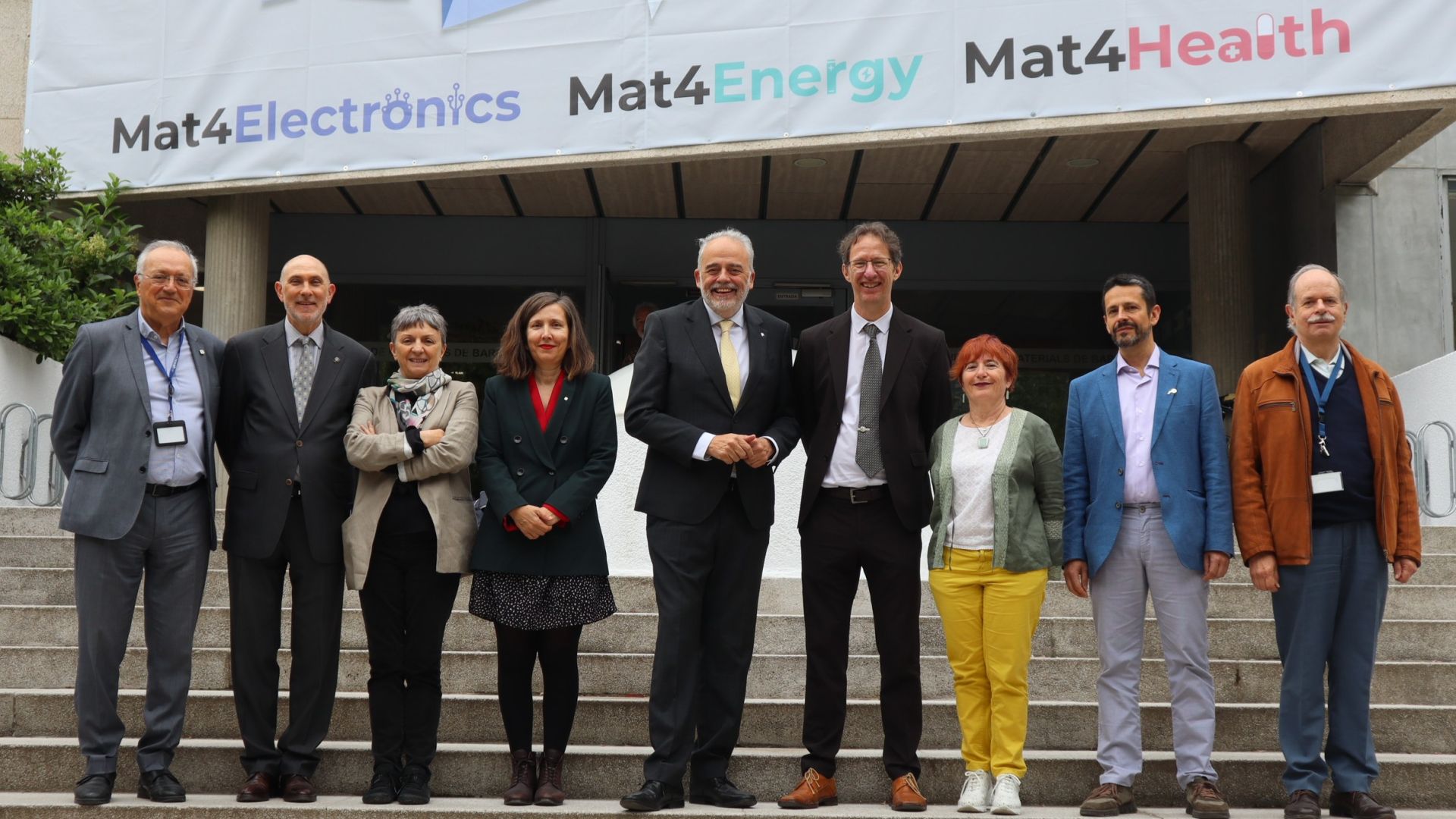
The Institute of Materials Science of Barcelona (ICMAB-CSIC) has celebrated its 40th anniversary with a week of activities that culminated in an institutional event attended by prominent figures from the academic and scientific communities. The event was attended by the Director General for Research of the Government of Catalonia, Teresa Sanchis; the CSIC Delegate in Catalonia, Lluís Calvo; the Rector of the Universitat Autònoma de Barcelona, Javier Lafuente; and the Director of the ALBA Synchrotron, Caterina Biscari.
Founded in May 1986, ICMAB is one of the pioneering centres in materials science in Spain. The Institute was created in the context of a national programme aimed at promoting this strategic field, in which other leading centres were also established, such as the Institute of Materials Science of Madrid, and those of Aragón and Seville. Currently, ICMAB holds the distinction of Severo Ochoa Centre of Excellence, an accreditation it has been awarded three consecutive times.
The entire week from 11 to 15 May was devoted to celebrating all facets of ICMAB: from the scientific dimension to the social one, including a retrospective of the centre’s history; because, beyond the research carried out there, the Institute is also the people who have built it and who continue to drive it forward day by day.
Hosting the Scientific Advisory Board
The week began with the Scientific Advisory Board (SAB) meeting on Tuesday and Wednesday. The SAB is an international committee of renowned experts in materials science that advises the institute on research strategy, scientific progress, and future directions. The sessions focused on the lines of the current Severo Ochoa project: Materials Transition for Tomorrow’s World. These lines are: Materials for Energy, Materials for Electronics, and Materials for Health.
The SAB’s evaluation was very positive, validating the efforts and the major advances being achieved at ICMAB. The experts highlighted the success of structuring such diverse research into three strategic lines, the Institute’s strong scientific output, and its ability to maintain a highly positive working environment to achieve these results.
Celebrating 40 Years
While the first two days focused on the science currently being carried out, the final days of the week turned the spotlight on the centre’s 40-year history. The 14th of May featured a scientific programme with talks, seminars, and a round table, all of which included contributions from international guest speakers, ICMAB researchers, former members of the institution, and both senior and early-stage researchers from the Institute. This combination highlighted the evolution of the research conducted at the Institute over four decades.
On Friday, 15 May, the institutional event marking the 40th anniversary took place, including the official visit, the release of a
commemorative video, and a short concert by the institute’s choir. The day concluded with the traditional ICMAB celebration, organised by staff, students, and predoctoral researchers at the centre. The celebration included various leisure activities that are now traditional at the Institute.
Among these activities was the awards ceremony of the FOTICMAB photography competition, which will help support the Institute’s future project: Materials Inspire. This initiative will be an open-access image library showcasing materials science images generated during research at the institute. It is expected to be available to the public before the end of 2026.
>> Check out the press release in CAT, ESP and ENG