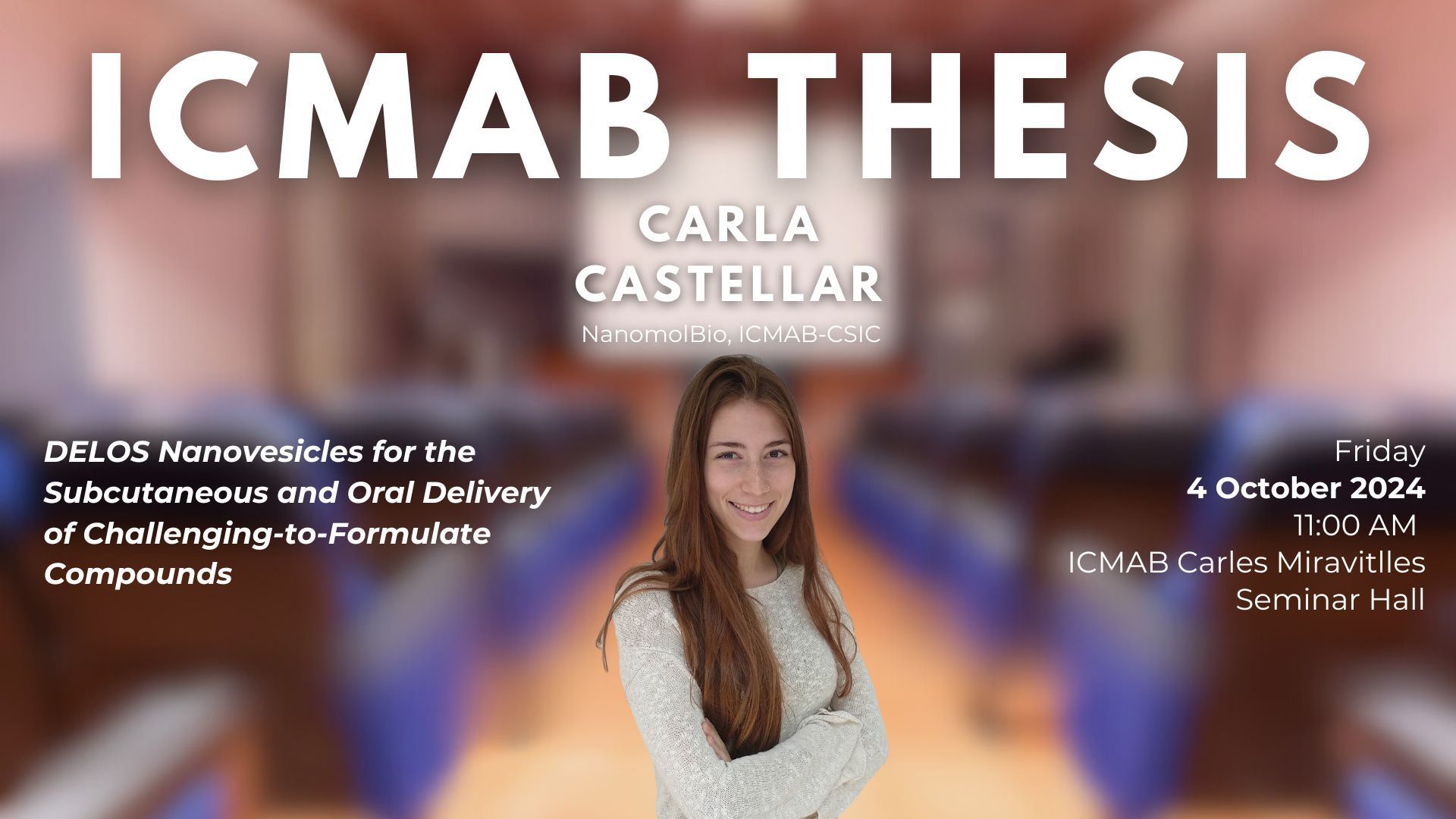
DELOS Nanovesicles for the Subcutaneous and Oral Delivery of Challenging-to-Formulate Compounds
Date: Friday, 4 October 2024
Time: 11AM
Venue: Institut de Ciència de Materials de Barcelona (ICMAB, CSIC) - Sala d'Actes Carles Miravitlles
Abstract
The ongoing shift from traditional orally bioavailable small molecules to novel drug modalities requires more sophisticated and innovative drug delivery strategies. These advanced strategies aim to improve the solubility and stability of challenging-to-formulate drugs while ensuring selective delivery with predictable rates and mechanisms to specific organs, tissues, or cells.
In this context, DELOS nanovesicles, also known as Quatsomes, offer a promising solution to address the complexities associated with novel, challenging-to-formulate drugs. DELOS nanovesicles are a unique class of nanocarriers composed of sterols and ionic surfactants. They are produced using the DELOS technology (Depressurization of an Expanded Liquid Organic Solution), an eco-efficient, scalable, one-step method based on compressed CO2 for producing colloidal systems.
DELOS nanovesicles have shown potential to deliver a variety of drug modalities, ranging from small molecules to biologics, via intravenous and topical administration routes. However, their application for other administration routes remains unexplored, limiting their versatility.
This thesis aims to investigate the potential of DELOS nanovesicles as drug delivery systems specifically formulated for subcutaneous and oral administration routes.
In pursuit of this goal, a systematic design of experiments was conducted to refine DELOS nanovesicles composition, using exclusively excipients listed in the United States Food and Drug Administration (FDA) Inactive Ingredients Database, to pursue the development of a biocompatible and regulatory-oriented formulation for the intended administration routes.
Considering the subcutaneous route, a hybrid in situ-forming subcutaneous depot was developed based on the optimized DELOS nanovesicles and a thermoreversible hydrogel. Different concentrations of the thermoreversible Poloxamer 407 were tested in combination with the DELOS nanovesicles. Through rheological characterization of the obtained hydrogels, the 17% w/w Poloxamer 407 was identified as optimal for subcutaneous administration, being injectable at 22 °C and forming a cohesive in situ depot at 37 °C. In vitro tests showed a consistent release pattern of the DELOS-NV over an 8-hour period, following zero-order kinetics. Additionally, a highly hydrophobic compound, as challenging-to-formulate “beyond the Rule of Five” (bRo5) molecule, was entrapped into the DELOS-NV based thermoreversible hydrogel. This compound was successfully loaded into the DELOS nanovesicles with high entrapment efficiency, and the nanoconjugates demonstrated long-term stability under storage conditions (5 ± 3 °C) and at 40 ± 3 °C. When integrated into the 17% w/w Poloxamer 407 hydrogel, a 10-hour zero-order in vitro release profile of the nanoconjugate was achieved, highlighting the potential of the developed hybrid system for extended subcutaneous drug delivery.
To explore the feasibility of using the DELOS nanovesicles for the oral administration route, the impact of these nanovesicles on the intestinal epithelium was assessed using Caco-2 in vitro models. A nanoconjugate containing a model protein (bovine serum albumin) was prepared, and isothermal titration microcalorimetry characterization confirmed strong hydrophobic binding of the protein to the DELOS nanovesicles, suggesting no premature release of the protein before or during in vitro permeation assays. Besides, two additional model molecules, a small molecule (lucifer yellow) and another protein (insulin), were evaluated by loading them into the DELOS nanovesicles. Permeation assays in Caco-2 monolayers demonstrated that DELOS-NV significantly enhanced the permeation of lucifer yellow, while both proteins (bovine serum albumin and insulin) did not permeate the Caco-2 barrier. These results suggest that DELOS-NV have potential for either systemic or local delivery in the gastrointestinal tract, depending on the integrated molecule.
To further harness their potential for gastrointestinal applications, DELOS-NV were developed into a biosensor incorporating an oligonucleotide as a sensing biomolecule, capable of detecting miR21, a microRNA overexpressed in colorectal cancers. The biosensor exhibited very high sensitivity and specificity, highlighting the potential of DELOS-NV for dual purposes in therapy and diagnosis.
Supervisors
Lidia Priscila Ferrer Tasies
Elisabet González Mira
PhD comitee
President: Dr. Maria José Garcia, UB
Secretary: Dr. Ana Catarina da Silva, Universidad Fernando Pessoa
Vocal: Dr. Adolfo Lopez, Medincell
University: Universitat Autònoma de Barcelona (UAB)
PhD Programme: Material Science