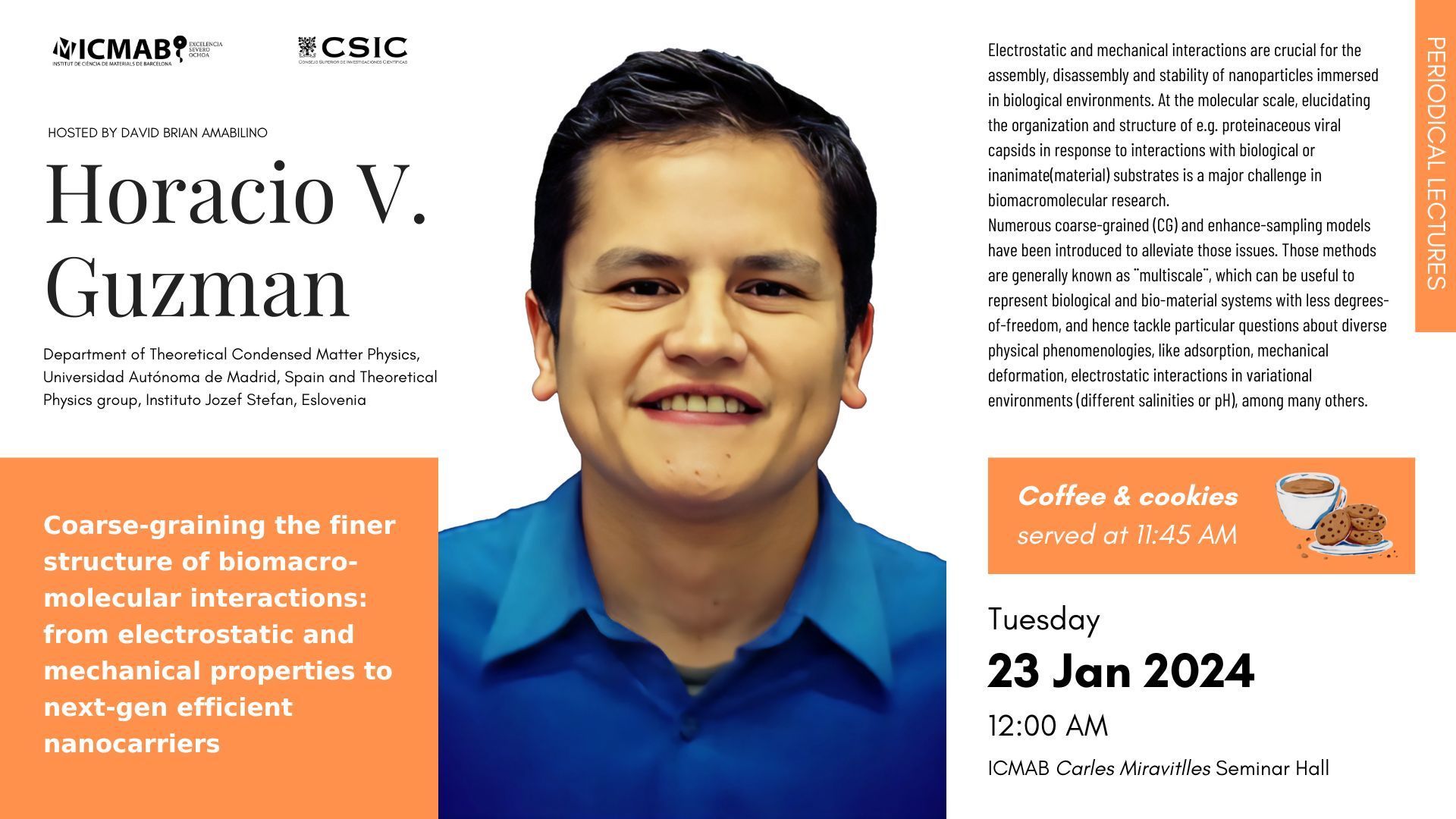
Coarse-graining the finer structure of biomacromolecular interactions: from electrostatic and mechanical properties to next-gen efficient nanocarriers
Horacio V. Guzman
Department of Theoretical Condensed Matter Physics, Universidad Autónoma de Madrid, Spain and Theoretical Physics group, Instituto Jozef Stefan, Eslovenia
Tuesday, 23 Jan 2024
12.00 AM
ICMAB - Sala d'Actes Carles Miravitlles.
Abstract:
Electrostatic and mechanical interactions are crucial for the assembly, disassembly and stability of nanoparticles immersed in biological environments. At the molecular scale, elucidating the organization and structure of e.g. proteinaceous viral capsids in response to interactions with biological or inanimate(material) substrates is a major challenge in biomacromolecular research.
Numerous coarse-grained (CG) and enhance-sampling models have been introduced to alleviate those issues. Those methods are generally known as ¨multiscale¨, which can be useful to represent biological and bio-material systems with less degrees-of-freedom, and hence tackle particular questions about diverse physical phenomenologies, like adsorption, mechanical deformation, electrostatic interactions in variational environments (different salinities or pH), among many others.
In this talk, I will present recent in-house developments of multiscale methods for the interfaces between proteins with material surfaces and RNA interacting with proteins/membranes. The first part is an example of the characterization of hydrophobic and hydrophilic interactions through simplified self-assembled bilayers. The second focuses on models that provide deeper electrostatic and mechanical insights of the RNA-capsid shell interaction and assembly process. Aiming to learn from those viruses and use them as guidelines for the next-generation efficient drug nanocarriers.
I will also briefly present our newest projects and discuss prospects and challenges in these research avenues. In particular, the use of PVA as a biomimetic material for constructing SAMs and possible applications in cell-guidance.
Short bio:
Dr. Horacio Vargas Guzmán, es físico teórico y computacional de profesión con alma mater en la Universidad Mayor de San Simón en Cochabamba, Bolivia. Se doctoró en 2014 por la Universidad Autónoma de Madrid en el área de Física de la Materia Condensada y Nanotecnología. En 2015, obtuvo una posición postdoctoral en el Instituto Max Planck de Polímeros, donde trabajó en el desarrollo de métodos de simulación multiescala enfocados a macromoléculas, como sistemas biológicos y polímeros. Actualmente, lidera un proyecto europeo que estudia el RNA y sus interacciones electrostáticas con cápsides virales y nanopartículas a través de simulaciones moleculares de multiescala, con miras a aplicaciones como next-gen drug delivery systems. Así mismo co-lidera un proyecto ANID para el estudio de propiedades higroscópicas de polímeros biocompatibles. Así mismo, ha sido galardonado con varias distinciones de su alma mater, así como Grants de Atracción de Talento y recientemente la distinción de haber sido escogido como investigador Ramón y Cajal. En su acción científica radican múltiples colaboraciones internacionales, en comunidades como la sociedad de RNA, DPG, APS, y el CECAM, donde el investigador es miembro de equipos de trabajo, así como de proyectos de investigación multinacionales en revisión.
Hosted by David Brian Amabilino, ICMAB-CSIC