


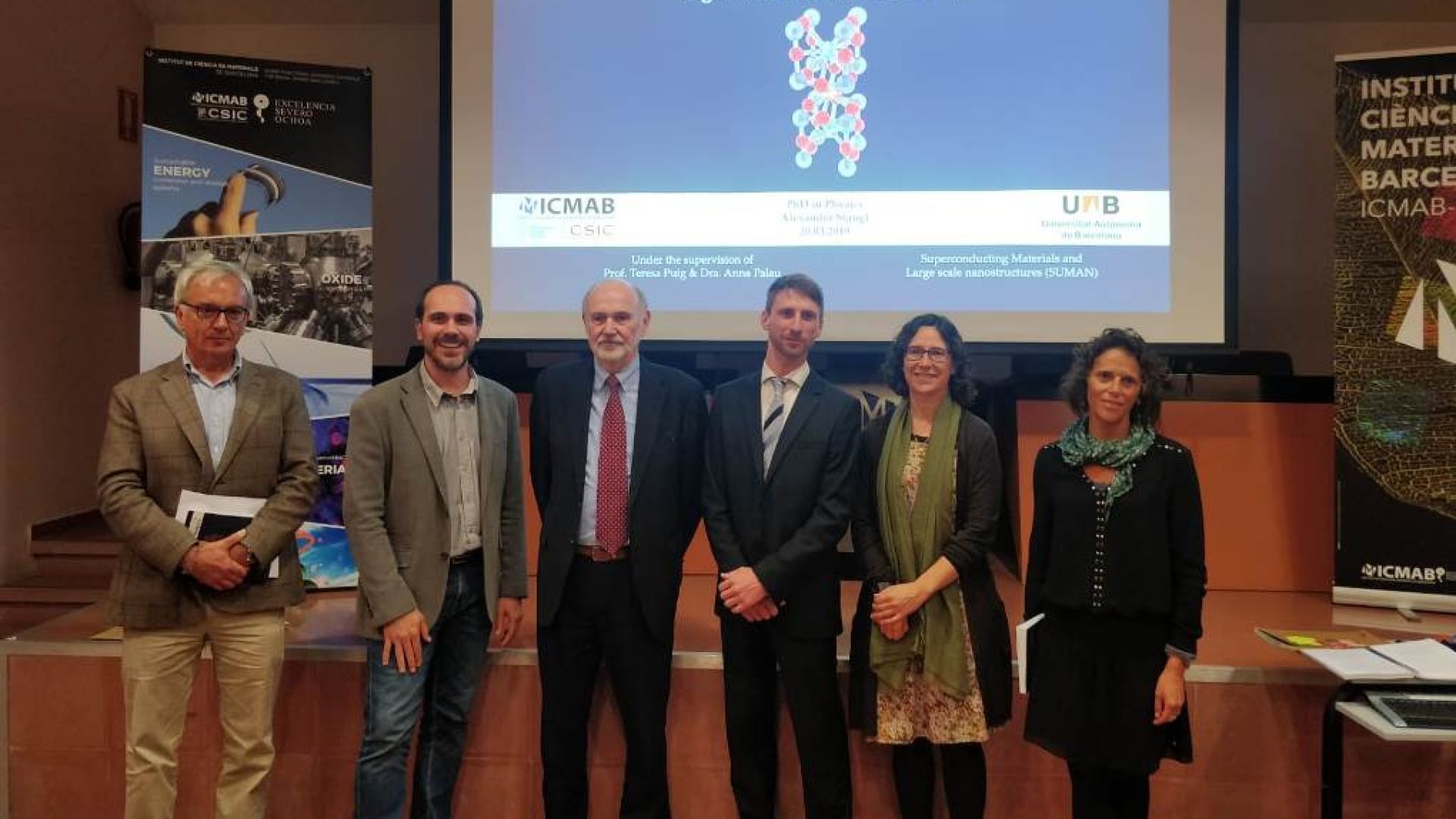

Why did you choose the ICMAB?
ICMAB is an excellent and rewarded research centre. The SUMAN group performs internationally highly recognised research and was leading the biggest European project on superconductivity ever launched, when I was starting my PhD and was therefore highly interesting to me.
How would you explain your research to a non-scientific audience?
I'm investigating how oxygen is incorporated into YBCO, a superconducting ceramic material and how the oxygen influences the materials properties. Superconductors loose their electrical resistance when cooled to low temperatures, which makes them highly attractive for many different applications. As in many oxide materials, the oxygen content in YBCO strongly affects its physical properties, as the temperature where it becomes superconductive and the current it can carry without resistance. By fully understanding the oxygen incorporation we succeeded in strongly improving the material properties.
What are the main applications of your research? Could you give us an example?
In the time you have been here, what have you liked the most about your experience at our Research Center and in the Barcelona area?
How do you think this experience will contribute to your training and to your future?
What are your plans once you finish your PhD?
Future will tell
What do you wish you had known at the beginning of your PhD?
The importance of interdisciplinary and the literature research outside your field.
Why did you become a scientist? Which have been your role models?
I don't really have a role model.
Which is your favourite female scientist?
Lise Meitner, not only for her (too often undervalued) scientific achievements but also her social fight for gender equality, from her early days.
Describe in 3 keywords…
- Your research: oxygen exchange, charge doping, superconductivity
- Barcelona: (Plaça) Sol, Vermut i Festes majors

In this work we have obtained a fundamental understanding of the oxygen incorporation mechanisms into the structure and have identified the rate determining step. Additionally we have demonstrated the influence of heat treatments on the microstructure and the chemical composition of the surface. The thorough understanding of the oxygenation process enabled us to reach the overdoped state of YBCO and to increase the critical current to record high 90MA/cm² at 5K, a third of the depairing current density.