

Why did you choose the ICMAB?
I chose ICMAB because the research group where I performed my master thesis at UAB collaborated with SUMAN at ICMAB, giving me the opportunity to know that ICMAB is a multidisciplinary research environment, which is very interesting to me.
How would you explain your research to a non-scientific audience?
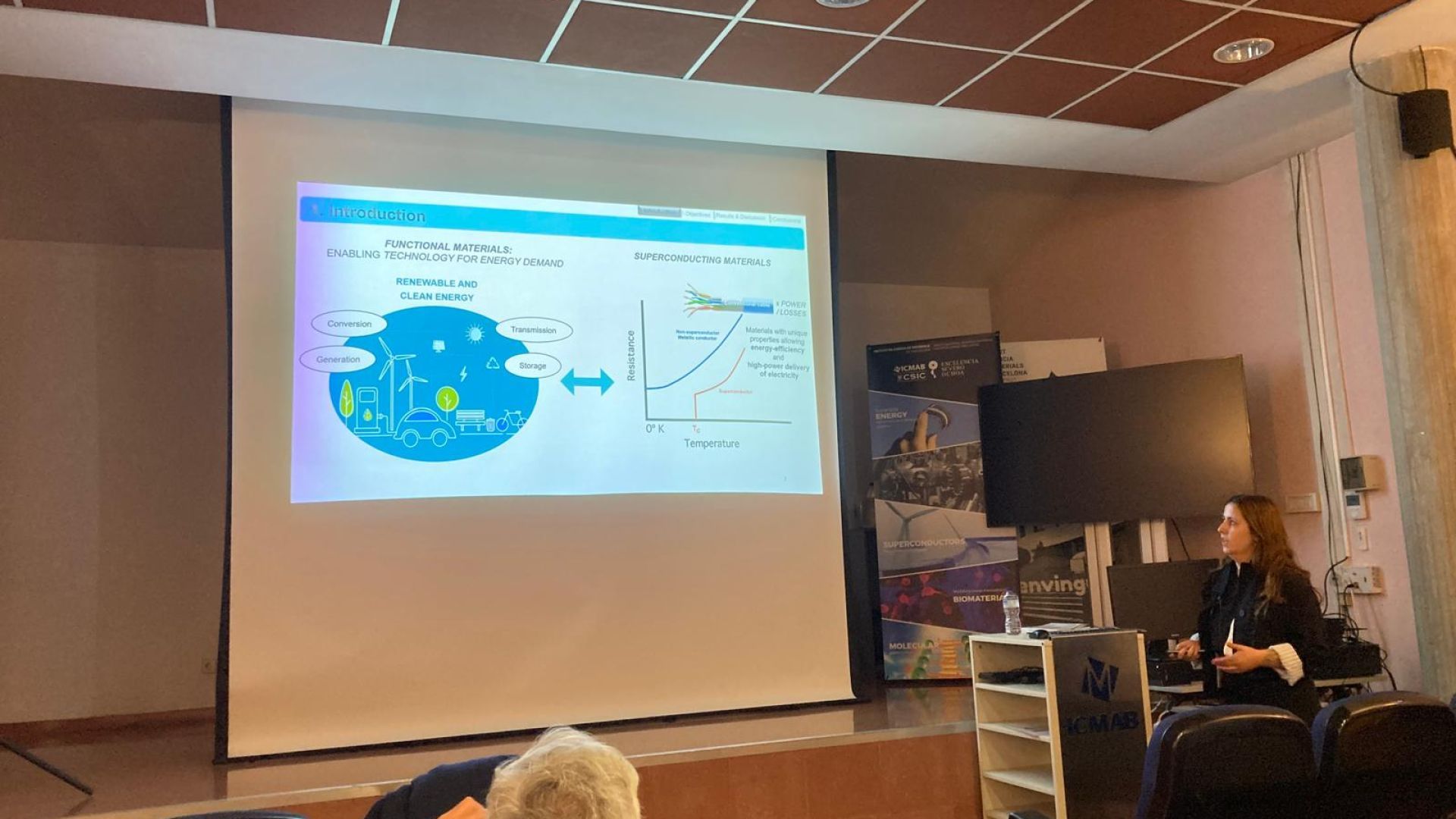
My research was focused on the performance improvement and cost reduction of superconducting technology which allow energy efficiency and high-power delivery of electricity for clean energy transition.
What are the main applications of your research? Could you give us an example?
The unique properties of these superconducting materials make them promising materials for energy production, efficient energy distribution and transportation, and energy consumption. Their capabilities have been demonstrated in several power and magnet applications such as NMR, MRI, particle accelerations and other example of potentially application is electrified transport.
What will you miss the most from ICMAB?
I will miss the opportunity to collaborate with different researchers from diverse backgrounds, which is very enriching. Moreover, the discussions and idea exchanges during coffee breaks or group meetings that gave me new perspectives on my research.
How do you think this experience will contribute to your training and to your future?
This experience allowed me to enhance my personal and professional skills and provided me knowledge and experience in different interdisciplinary fields, which I consider very enriching and relevant for my future career.
What do you wish you had known at the beginning of your PhD?
I wish I had known that it is not only a professional road; it is also a personal road, and a work-life balance is essential.
Why did you become a scientist? Which have been your role models?
I became a scientist due to my curiosity about how things work and my interest in contributing in some way to society's advancements with real-world applications. I don't really have role models. Somehow, I feel that the previously good experiences during the performed research during final degree project and master thesis have been directing me towards this path.
Which is your favourite female scientist?
I don't have a favorite female scientist. I believe that all great scientists, past and present, have made essential contributions to the advancement of science. Their dedication and sacrifices to further our understanding and improve our world make them all admirable.
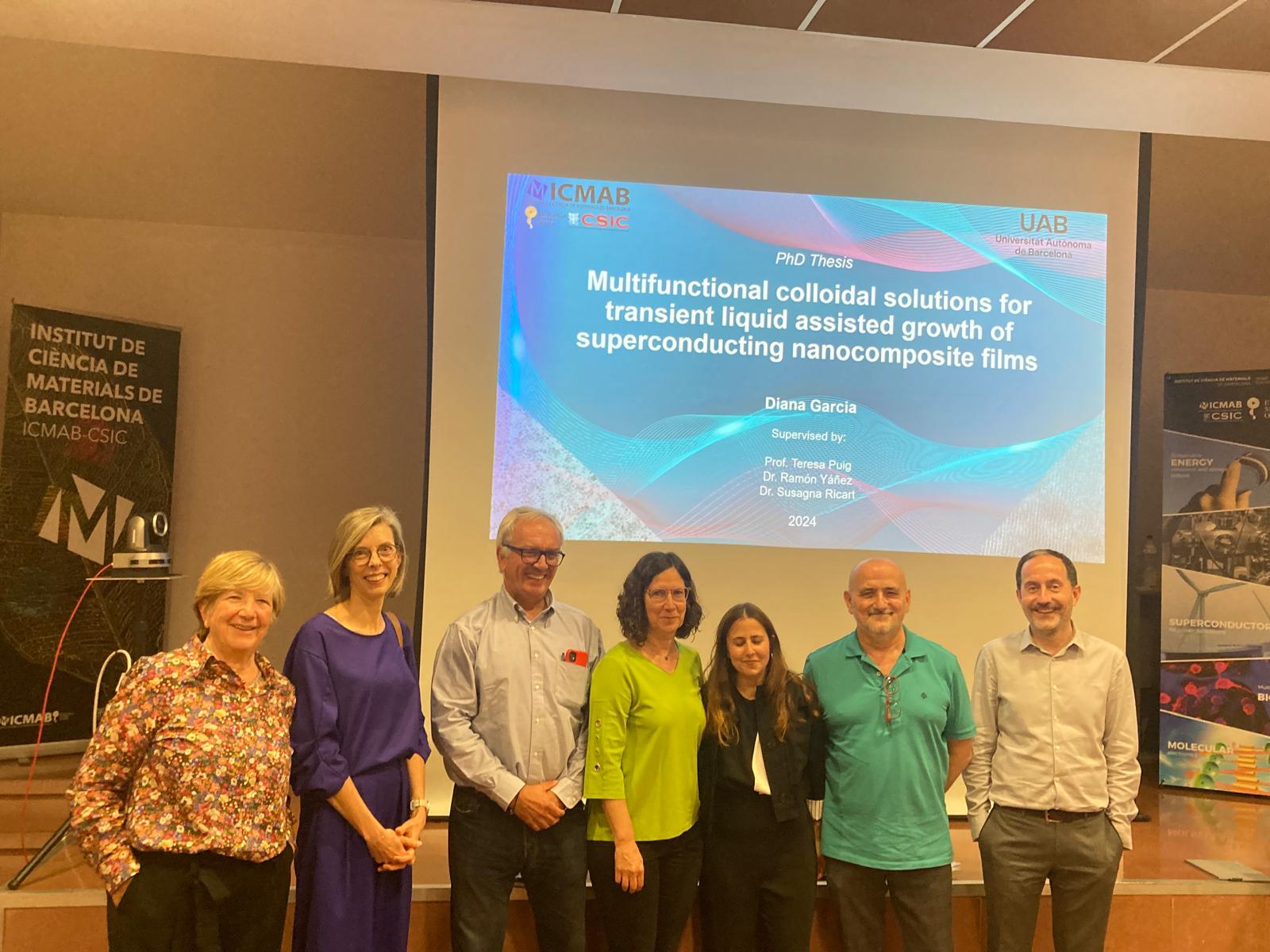
Multifunctional colloidal solutions for transient liquid assisted growth of superconducting nanocomposite films
Diana Garcia, Superconducting Materials and Functional Nanoengineered Structures (SUMAN)
Date: Friday, 10 May 2024
Time: 11AM
Venue: Institut de Ciència de Materials de Barcelona (ICMAB, CSIC) - Sala d'Actes Carles Miravitlles
Abstract:
High-temperature superconducting (HTS) YBa2Cu3O7−δ (YBCO) coated conductors (CCs) are promising materials with exceptional physical properties, such as high electrical currents without dissipation, for renewable and clean energy transition. However, the widespread implementation of HTS CCs requires a reduction in manufacturing costs. This thesis investigates the Transient Liquid Assisted Growth (TLAG) method, which uses Chemical Solution Deposition (CSD) to fabricate high-performance epitaxial YBCO nanocomposite films at ultrafast growth rates. A novel methodology for preparing colloidal precursor solutions has been developed, demonstrating their suitability for low-cost and high-throughput films of high thickness. The developed multifunctional colloidal solutions in the TLAG process have demonstrated outstanding performance, resulting in highly epitaxial nanocomposite films at ultrafast growth rates of 1000-2000 nm/s, 1.5-3 orders of magnitude higher than conventional growth methods, with critical current densities of 1.5-2.6 MA/cm2 at 77 K and an improved vortex pinning scenario. The results reveal the opportunities offered by the TLAG-CSD fabrication method and its impact on industrial technology for the production of low-cost and high-performance superconducting layers, especially at high magnetic fields.
Supervisors:
Teresa Puig
Susagna Ricard
Ramón Yáñez
PhD Committee:
President: Jacobo Santamaría Sánchez-Barriga, Universidad Complutense de Madrid, Spain
Secretary: Jordi García-Antón Aviñó , Universitat Autònoma de Barcelona, Spain
Vocal: Marlies Van Bael , Hasselt University,Belgium
