

What was the focus of your PhD research? Can you explain it to a non-scientific audience?
In the current scenario of accelerating global warming and climate change, the demand for new renewable and clean energy resources is increasing. In this context, superconducting materials are highly relevant because they offer lossless electrical transport. Amongst them, REBCO high-temperature superconductor is of high potential, due to its wide range of applications. However, the cost related to its fabrication limits its widespread use. To address this challenge, in the SUMAN group, we developed a new method called Transient Liquid Assisted Growth (TLAG) for fabricating REBCO-coated conductors. I worked on two strategies to enhance its current carrying capacity to make this process industrially more appealing.
Can you briefly summarize the main findings or contributions of your research? You can give us some examples.
One of the main contributions of my work is the demonstration of critical current density (Jc) enhancement through a process known as overdoping in TLAG YBCO films. The second major achievement was identifying the correlation between critical current density and defects present inside the TLAG films, which is crucial for its future optimization.
Why do you think your research is important, and how could it impact your field or society?
The research I have done during my PhD will accelerate the industrialization of the TLAG process, which will eventually benefit the coated conductor community due to the cost-effectiveness of this process.
What was one of the most challenging aspects of your PhD journey, and how did you overcome it?
There was a type of very long measurement that I did during my PhD. Sometimes, almost towards the end of this measurement, the samples were destroyed, and I had to start the measurement from the beginning. Although I could not solve it completely, over time, the success rate improved by learning what not to do.
Why did you end up at ICMAB? And what do you think you will miss the most from this institute?
The major reason for choosing ICMAB was the research group, because my research interests were well aligned with the PhD position at ICMAB for which I applied. The friendly working atmosphere at ICMAB and the people with whom I shared these last few years are what I will miss the most.
What’s next for you after completing your PhD? Do you have any upcoming projects or goals?
I am interested in continuing my work in the field of superconductivity. In the future, I will look for opportunities in the same field, but mostly focusing on the application side.
How has completing this PhD changed you, either professionally or personally?
I think now I am more aware of my capabilities and limitations. Also, during these years, the opportunity to interact with people from different backgrounds taught me how to look at a problem or an aspect of life in different ways.
What advice would you give to someone just starting their PhD journey?
Do not compare your journey with others. Everyone will have a unique story at the end of their PhD.
Why did you become a scientist? Which have been your role models that inspired you to pursue a PhD?
I do not really have a person as a role model. But right after I joined my undergraduate studies, I attended a science camp in which there was a talk about superconductivity and the demonstration of the magnetic levitation experiment. That was the first time I heard about this phenomenon, and it was really fascinating for me. I was curious about knowing more about it, and that curiosity, together with the opportunities that I received, is what brought me to this point.
Who or what helped you the most during your PhD journey, and is there anyone you'd like to thank?
During the tough times of my PhD, my partner was always there to support me emotionally. And also the help and support from my friends at ICMAB and outside ICMAB was very valuable while navigating the challenges during my PhD.
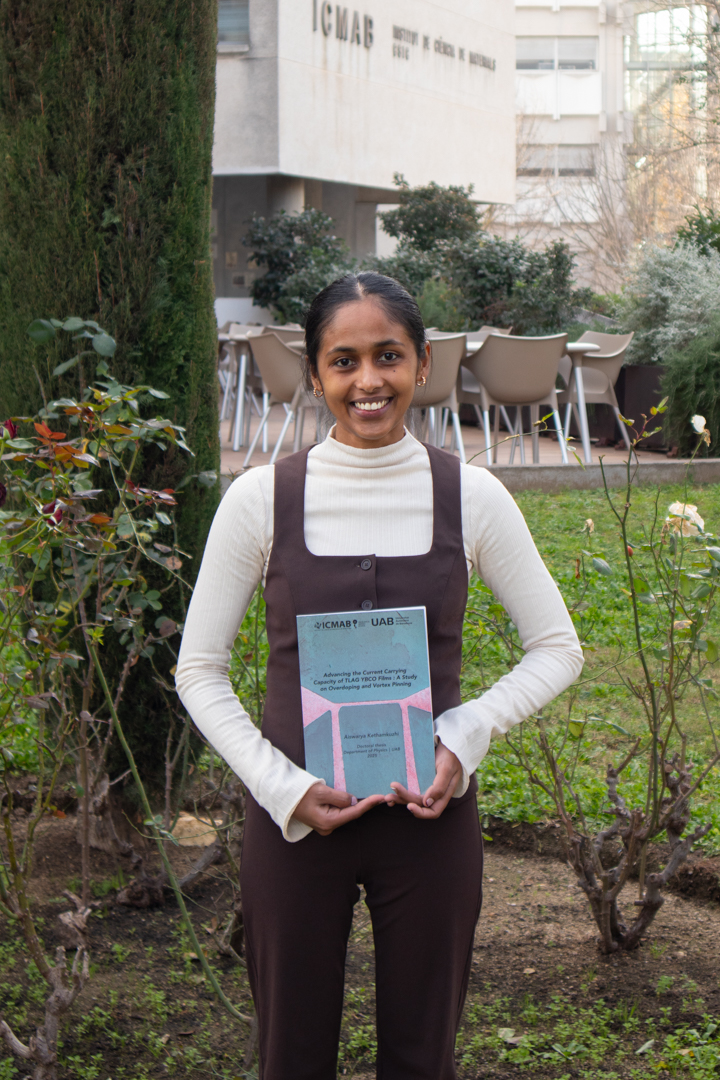
Aiswarya Kethamkuzhi at ICMAB garden on the day of his thesis | ICMAB-CSIC
Abstract
The development of high-temperature superconductors is one of the most ambitious achievements since the discovery of superconductivity, unlocking the vast potential of superconductors in contributing to technological advancements. Especially the high-temperature cuprate superconductors known as REBCO (REBa2Cu3O7−𝛿, RE = Rare Earth elements), in the form of coated conductors, are highly studied materials due to their exceptional superconducting properties, such as high critical current density and irreversibility field, which widen the window for large-scale applications of superconductors. However, there are still some challenges to overcome in the fabrication of high-performance coated conductors, amongst which the high cost/performance ratio is the prominent one.
The novel growth method developed at ICMAB for the fabrication of REBCO films is an ultrafast (growth rates up to 2000 nm/s) and cost-effective technique that combines Chemical Solution Deposition (CSD) with a non-equilibrium Transient Liquid Assisted Growth (TLAG) process. The TLAG method takes advantage of the high growth rate potential of liquid-mediated growth processes and aims to improve the cost/performance ratio for fabricating REBCO-coated conductors. In addition to reducing the manufacturing cost, enhancing the performance of coated conductors under an applied magnetic field is a crucial aspect.
Recently, an approach that is receiving more attention involves strategies to enhance condensation energy through the increase of charge carrier density by reaching the overdoped state in REBCO-coated conductors, where maximum critical current density can be achieved. Efforts are being made to address the challenge of overdoping in TLAG-CSD-grown films by means of different oxygenation methods and thereby modifying the electronic structure. The study highlights the ability of TLAG-grown REBCO films to achieve the overdoped state, and these findings will help lay the groundwork for future development of performance enhanced TLAG-coated conductors.
This thesis also delves into exploring the underlying microstructure generated by the ultrafast growth of TLAG and the mechanism of vortex pinning that gives rise to high critical current density. The nanoengineered TLAG films display greater potential than the pristine films, and we analyze them by correlating their microstructure with their physical properties. The primary outcome of this study is the understanding of the defect landscape of TLAG and how each defect predominates in a specific magnetic field temperature (H-T) regime. These findings imply a step forward in the fabrication of TLAG-coated conductors tailored for high magnetic field applications.
Supervisor
- Teresa Puig, ICMAB-CSIC
- Joffre Gutiérrez, ICMAB-CSIC
PhD Committee
- President: Pietro Massignan, UPC, Spain
- Secretary: Pablo Cayado, Universidad de Oviedo, Spain
- Vocal: Gaia Grimaldi, Institute for Superconductors, Innovative materials and Devices, Italy
Read more
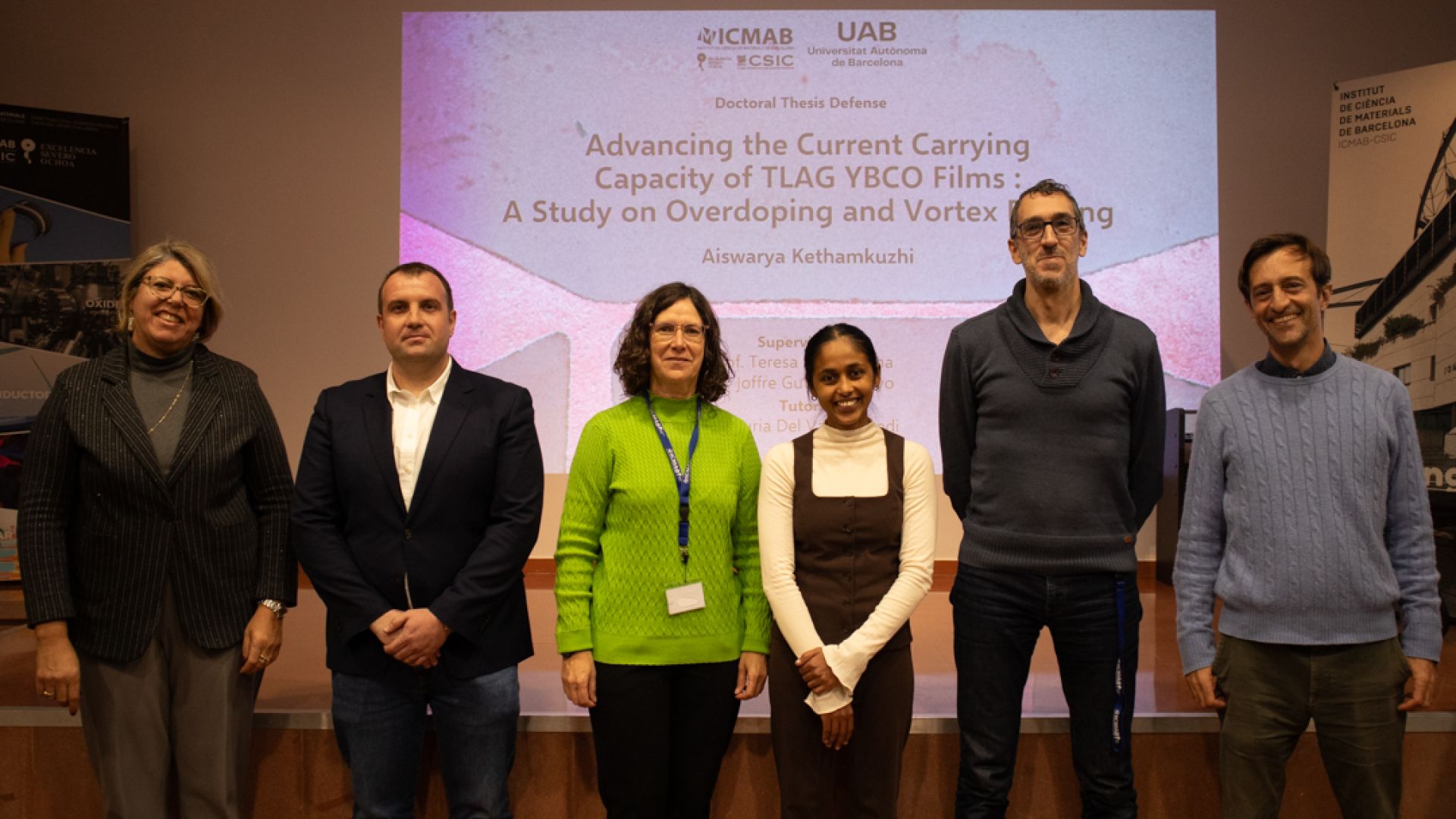
Aiswarya Kethamkuzhi will defend her PhD thesis on 11 December 2025
