

What was the focus of your PhD research? Can you explain it to a non-scientific audience?
My PhD focused on studying the magnetic properties of a particular metastable phase of the iron oxide called epsilon iron oxide, or ε-Fe₂O₃. What makes this material especially interesting is that it has an exceptionally strong preference for pointing its magnetization in a particular direction. This property is known as magnetocrystalline anisotropy.
To explain it in simple terms, you can imagine a tiny compass needle that strongly prefers to point in one particular direction and is very difficult to turn. This is particularly interesting for technologies such as magnetic data storage and high-frequency wireless communications. In magnetic memories, strong magnetic anisotropy can help make stored information more stable, while in wireless communications, it can enable ferromagnetic resonance at very high frequencies (for 5G and 6G applications).
My goal was to understand how we could modify and control the magnetic properties by changing the composition and orientation of this material or by applying strain to it.
Can you briefly summarize the main findings or contributions of your research? You can give us some examples.
My research explored three main strategies to understand and modify the magnetic properties of ε-Fe₂O₃ epitaxial thin films. First, I investigated whether mechanical strain could be used to control their magnetic anisotropy. The idea was to apply strain through flexible or piezoelectric substrates and see whether we could control their magnetic behaviour. Interestingly, unlike other ferrites such as magnetite, we found that ε-Fe₂O₃ did not show the expected response. Our results suggest that the very small size of the structural domains in these films makes it difficult for the strain to be effectively transferred.
Second, I studied how replacing some of the iron atoms with other elements, such as aluminium, chromium, manganese and scandium, affects the material's structure and magnetism. We found that these substitutions can significantly change its properties.
Finally, we explored a different approach for obtaining films with perpendicular magnetic anisotropy, meaning that their preferred magnetization direction is perpendicular to the surface. We successfully grew ε-Fe₂O₃ thin films with this magnetic configuration using specially prepared non-commercially available GaFeO₃ substrates.
Overall, the thesis provides a better understanding of the relationship between the structure, composition and magnetic properties of this material, as well as identifying some of the challenges that need to be overcome for future applications.
Why do you think your research is important, and how could it impact your field or society?
I think this research is important because we are constantly demanding more from our electronic devices. We want to store more information, process it faster and consume less energy. Meeting these demands requires exploring new materials with properties that go beyond those of conventional magnetic materials. ε-Fe₂O₃ is particularly promising because of its exceptionally high magnetic anisotropy, which could make it interesting for next-generation magnetic memories and high-frequency communication technologies.
Although there is still a long way to go before these materials can be incorporated into real devices, understanding how to control their magnetic properties is an important step in that direction. Beyond the potential applications, I also think it is important to understand the fundamental physics of this material, since many aspects of its magnetic behaviour are still not fully understood. Every new piece of knowledge helps us better understand its properties, identify its limitations and guide future research towards developing improved materials and technologies.
What was one of the most challenging aspects of your PhD journey, and how did you overcome it?
One of the biggest challenges was dealing with the complexity of the material itself. ε-Fe₂O₃ is not an easy material to work with. Obtaining high-quality epitaxial thin films requires very precise control of the growth conditions, and even relatively small changes can have a significant impact on their structural and magnetic properties.
Another challenge was that some of the strategies we initially expected to work did not produce the results we anticipated. For example, we spent quite some time investigating whether strain could modify the magnetic anisotropy, but ultimately, we did not observe the expected effect.
I think one of the most important lessons I learned during my PhD was the importance of questioning and validating your results. You should never take a promising result for granted or rely on a single measurement. It's important to approach a problem from different perspectives and use complementary techniques to make sure you really understand what you are observing. Research does not always follow the path you imagine, and sometimes understanding why something does or does not work is just as important as achieving the result you were hoping for. Patience, persistence and collaboration were essential in helping me overcome these challenges.
Why did you end up at ICMAB? And what do you think you will miss the most from this institute?
I ended up at ICMAB because I was interested in exploring the world of solid state physics and materials science, particularly functional materials and their potential applications. The opportunity to work with magnetic materials and thin films, in an environment where different scientific disciplines come together, was very appealing to me. ICMAB has given me the opportunity to learn a lot, not only scientifically but also personally. I've had the chance to work with different experimental techniques, collaborate with researchers from different backgrounds and become part of a very diverse scientific community.
What I think I'll miss the most is definitely the people. Beyond the research itself, a PhD is about the everyday experiences you share with your colleagues: the discussions in the lab, helping each other solve problems, coffee breaks and all those little moments that make the day-to-day work enjoyable.
What’s next for you after completing your PhD? Do you have any upcoming projects or goals?
After completing my PhD, I felt I needed a bit of a break from the academic world, so I decided to explore a different direction within materials science. I'm currently working as a fire testing technician at Applus+ Laboratories, where I work with a wide variety of construction and decorative materials and study their behaviour under fire conditions.
Although this is quite different from my PhD research, I find it very interesting to apply the scientific knowledge and experimental skills I developed during my PhD to a more practical and applied field. It's been a great opportunity to discover a new area of materials science, work with different types of materials and see how experimental testing can contribute directly to people's safety. For now, my goal is to continue learning, gaining experience and developing professionally in this new field. However, I'm not ruling out returning to academic research in the future, and I would also be open to pursuing a postdoctoral position if the right opportunity comes along. I'm excited to see where this new chapter takes me!
How has completing this PhD changed you, either professionally or personally?
I think completing a PhD has changed me in many ways. Professionally, it has taught me how to approach complex problems, think critically and become more independent. I've learned that research requires much more than scientific knowledge: it also involves creativity, patience, resilience and the ability to adapt when things don't go as planned.
On a personal level, I think I've become more patient and confident in my ability to face challenges. A PhD is a long journey with many ups and downs, and you learn to deal with uncertainty, failure and frustration while continuing to move forward. Perhaps one of the biggest changes is that I've learned to appreciate the process rather than focusing exclusively on the final results. Not everything needs to work perfectly for you to learn something valuable.
What advice would you give to someone just starting their PhD journey?
My main advice would be to be curious, patient and, above all, enjoy the process as much as possible. Make the most of every opportunity: go to conferences, enjoy the experiments, meet people, exchange ideas and learn as much as you can from everything around you. A PhD is a marathon, not a sprint. There will be experiments that fail, unexpected results and moments when you question whether you're making progress. That's completely normal, and it doesn't mean you're doing something wrong.
I'd also encourage PhD students to get involved in the institute's community, for example by organizing themselves through the Young Researchers Committee. It's important to create a network where students can support one another, share experiences, raise concerns and help those who might be going through a difficult time. Sometimes, having someone who understands what you're experiencing can make a huge difference.
And perhaps most importantly, don't let your PhD become your entire life. Make time for things outside the lab, spend time with friends and family, and celebrate the small achievements along the way. Those things are just as important for getting through the journey. Looking back, I think a PhD is not only about the research you do or the results you obtain, but also about the experiences you have, the people you meet and everything you learn along the way.
Why did you become a scientist? Which have been your role models that inspired you to pursue a PhD?
I've always been curious about understanding how things work and, more generally, about the big questions in physics and how the universe works. One person who had a particularly important influence on me was a professor I had during my Physics degree at UCM (Complutense University of Madrid), who is now a member of the Royal Academy of Exact, Physical and Natural Sciences of Spain. She really inspired me through the way she taught electromagnetism and helped me understand how electric and magnetic fields interact with matter. I also remember that, thanks to her, I saw atoms through a STEM microscope for the first time. That was a very special experience for me, as it was one of the first times I could connect the fundamental concepts we studied in class with something tangible that I could actually observe.
I think those experiences had a significant influence on my decision to pursue a career in science and eventually a PhD. I believe that having teachers who can transmit not only knowledge but also enthusiasm and curiosity is incredibly important. Sometimes, one person can really change the way you see science and inspire you to follow that path. That's why I think it's so important to have role models and references in the scientific community. Seeing people who are passionate about what they do, and being able to identify with them or look up to them, can make a real difference when you're deciding whether a career in science is the right path for you.
Who or what helped you the most during your PhD journey, and is there anyone you'd like to thank?
First of all, I'd like to thank my supervisors for giving me the opportunity to undertake this PhD and for trusting me with this research project. Their guidance and support were essential throughout these years, and I'm especially grateful for their patience, encouragement and, of course, all the good laughs we shared along the way.
I'd also like to thank all my colleagues and collaborators who helped me throughout this journey. A PhD involves a lot of day-to-day work, and having people around you who are willing to share their knowledge, help you solve problems, discuss results or simply make your working days more enjoyable makes a huge difference.
And, of course, I'd like to thank my friends and family for their support, patience and encouragement, especially during the more difficult moments. Having them by my side made this journey much easier and more enjoyable.
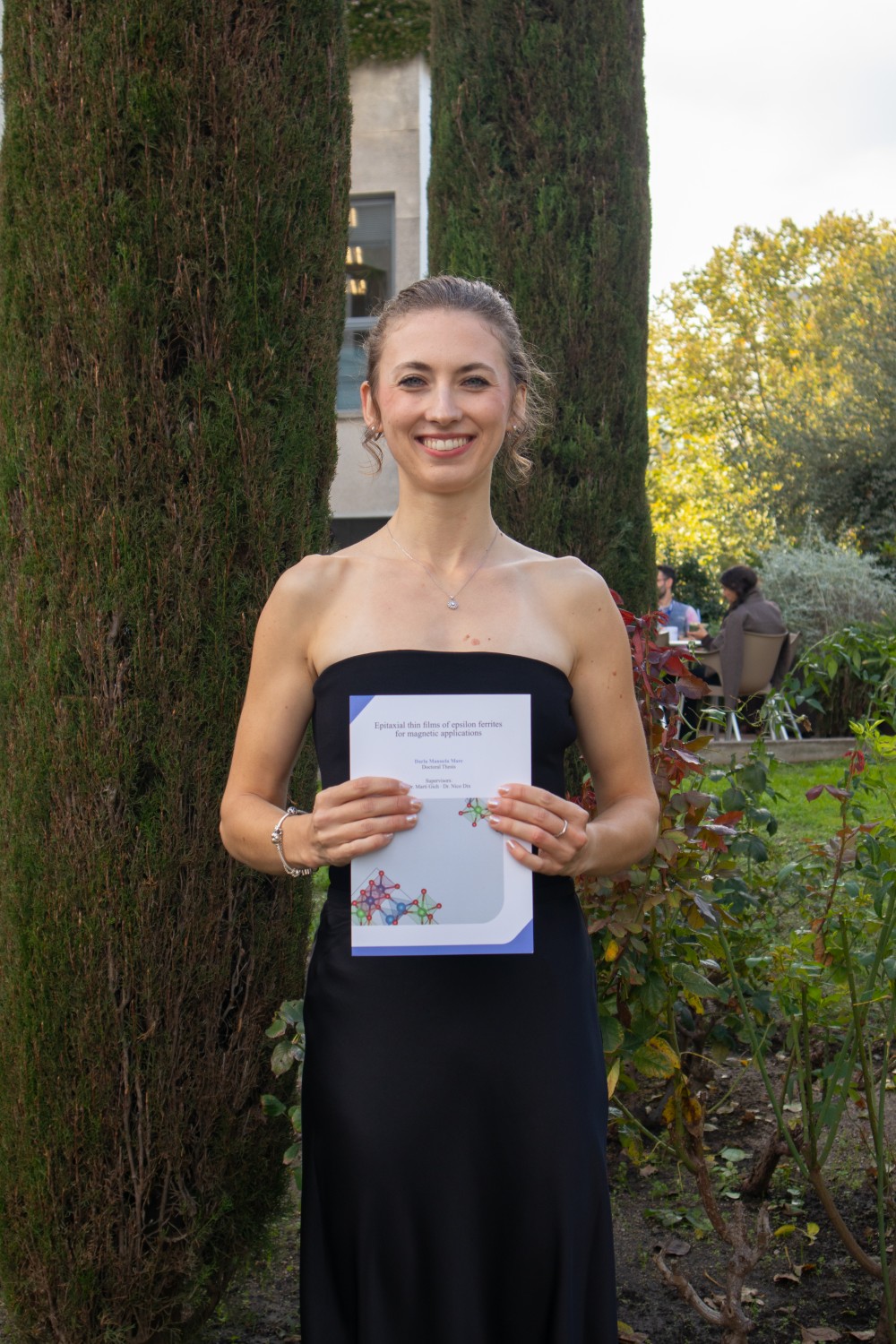 Darla Mare at the ICMAB garden on the day of his thesis | ICMAB-CSIC
Abstract
This doctoral research focusses on the control of magnetic anisotropy of epitaxial films of ε-Fe2O3. It investigates the influence of chemical substitutions, strain and crystallographic orientation in the context of potential applications in data storage and wireless communications.
Supervisors
- Martí Gich, ICMAB-CSIC
- Nico Dix, ICMAB-CSIC
PhD Committee
- President: Rachel Nickel, ESFR, France
- Secretary: José Santiso, ICN2, Spain
- Vocal: César Moreno, Universidad de Cantabria, Spain
Read more
ICMAB - Darla Mare will defend her PhD thesis on 20 October 2026