

What was the focus of your PhD research? Can you explain it to a non-scientific audience?
The focus of my PhD was on the design and synthesis of novel porous functional materials for their use in different fields, including catalysis, drug delivery, gas adsorption and separation and water remediation. The materials design was centered around a particular class of porous material, designated as Metal-organic frameworks (MOFs).
Can you briefly summarize the main findings or contributions of your research? You can give us some examples.
This thesis demonstrated the successful design and synthesis of advanced MOF-based materials with tailored properties for diverse applications, including drug delivery, gas adsorption, catalysis, and water remediation. By focusing on three MOF families—CaSyr-1, HKUST-1, and NU-1000—the work addressed key challenges in the field such as stability, processability, and sustainability. Innovative strategies, including the use of bio-based components, hierarchical structuring, and targeted functionalization, enabled the development of multifunctional materials with promising real-world applicability.
Why do you think your research is important, and how could it impact your field or society?
This research is important because it contributes to the advancement of sustainable and application-ready materials by addressing major limitations that have historically hindered the practical use of MOFs. By improving the environmental friendliness, stability, and scalability of MOF-based systems, the work paves the way for their integration into real-world technologies—ranging from clean energy and environmental remediation to biomedicine. These developments are essential for tackling global challenges such as pollution, climate change, and sustainable healthcare.
What was one of the most challenging aspects of your PhD journey, and how did you overcome it?
The most challenging aspect of my PhD journey was to preserve my mental health during the last three or four months, in which I had nothing but the PhD in my mind. During these period of time, I worked until late the seven days of the week, with no rest.
Why did you end up at ICMAB? And what do you think you will miss the most from this institute?
I did my bachelor’s and master’s thesis at ICMAB. Mainly, I will miss the people: my supervisors, my colleagues, my friends…, and the charming and warm character of this institution.
What’s next for you after completing your PhD? Do you have any upcoming projects or goals?
Yes, I will look for a post-doc position abroad.
How has completing this PhD changed you, either professionally or personally?
I think I am a completely different person after all these years. I have grown as a scientist, and I feel ready to navigate new horizons with more professional responsibilities. Besides, I have met so many people, either here, in congresses or during research stays, that I feel much more mind-opened.
What advice would you give to someone just starting their PhD journey?
I would recommend him/her to make the most of the time in the lab, while not forsaking hobbies and external activities. I believe that a balance between the scientific and personal life is truly important during this period. Apart, I would advise him/her to travel the most he/she can, either to congresses or research stays, and establish scientific connections.
Why did you become a scientist? Which have been your role models that inspired you to pursue a PhD?
I believe I was born a little scientist. From a young age, I was naturally curious about the world around me and had a particular love for mathematics. This passion for understanding how things work only grew stronger as I got older. During high school, I was introduced to chemistry and physics—subjects that immediately fascinated me. It was then that I began to realize how much I enjoyed solving complex problems and exploring scientific concepts, laying the foundation for my future in research.
Who or what helped you the most during your PhD journey, and is there anyone you'd like to thank?
From my academic environment, I would like to thank my supervisors for the opportunities that they provided me to participate in different international congresses and to do several research stays abroad. I believe they have supervised my work in the best possible way, combining a personal approach with scientific professionalism. Additionally, I would like to thank my colleagues for brightening my days throughout this PhD journey. Many of them have become true friends along the way. Beyond ICMAB, I would like to thank my family, friends, and especially my girlfriend, who has patiently endured my occasional moodiness during this time.
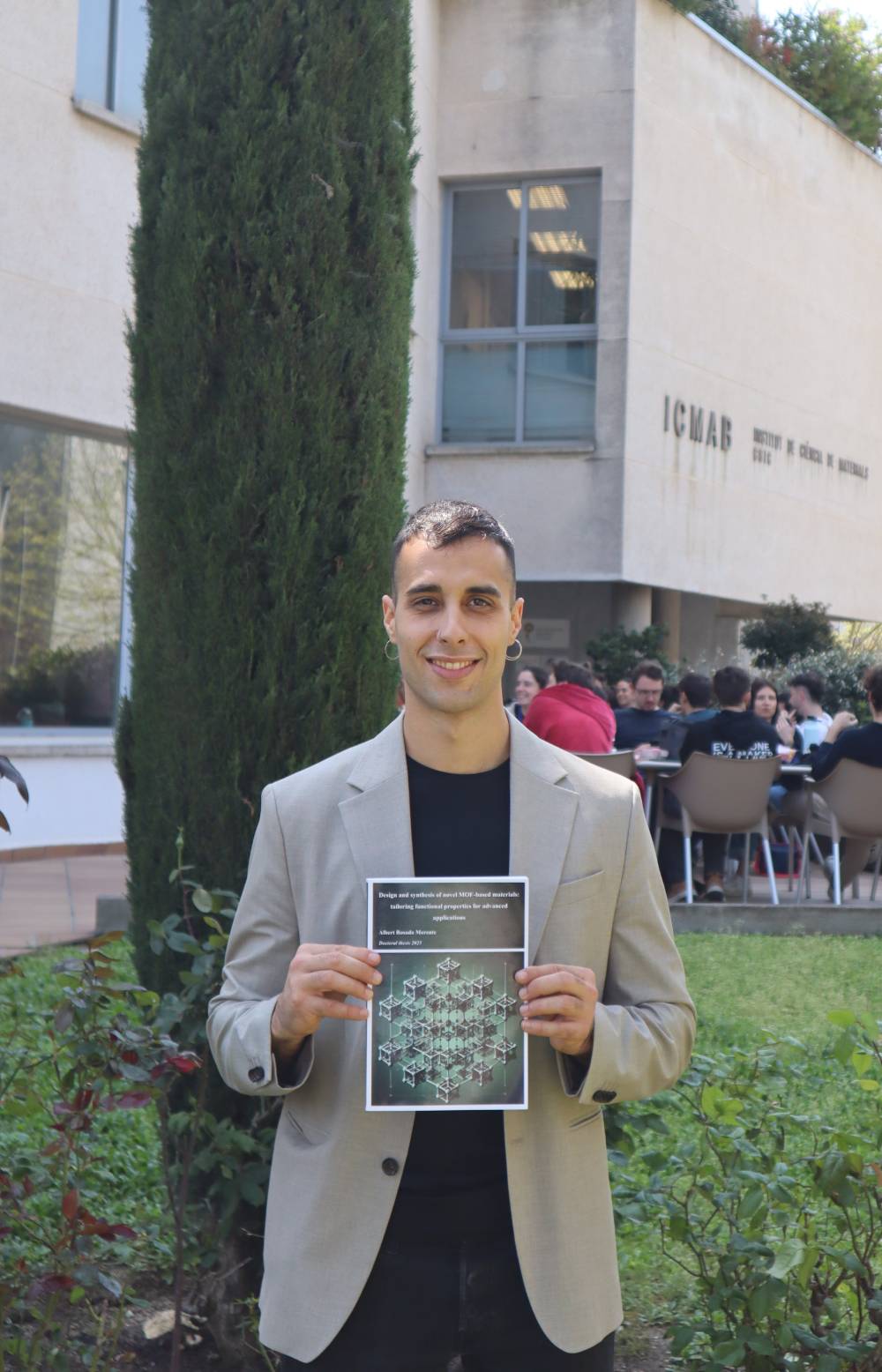 Albert Rosado on the day of his thesis at ICMAB garden | ICMAB-CSIC
Abstract
Since their discovery in the late 1990s, metal-organic frameworks (MOFs) have revolutionized the world of porous materials, driving an exponential research growth that continues today. Due to their exceptional porosity and unique chemical versatility, MOFs have demonstrated significant potential across diverse applications, e.g., gas adsorption and separation, drug delivery, sensing, electronics, catalysis, and water remediation, among others. However, their use remains largely confined to the academic sphere, as their widespread implementation still faces major challenges. Critical parameters hindering MOF commercialization and industrialization include their typical chemical instability, their costly and unsustainable synthetic routes, and their inherently fine powder form.
To address these challenges, this thesis presents different novel MOF-based materials with tailored functional properties to explore key MOF applications, while overcoming barriers that decelerate their broad commercialization and widespread adoption. For this purpose, central strategies involve the rational design of specific MOF structures, as well as their functionalization and structuration into macroscopic systems. Sustainable processing approaches, particularly those leveraging supercritical CO2 (scCO2) technologies, are prioritized. The applications investigated here include: drug delivery, gas adsorption and separation, catalysis and water remediation.
Supervisors
- Concepción Domingo, ICMAB-CSIC, Spain
- Ana M. López-Periago, ICMAB-CSIC, Spain
PhD Committee
- President: Maria José Cocero Alonso, Universidad de Valladolid, Spain
- Secretary: Josep Puigmarti Luis, Universitat de Barcelona, Spain
- Vocal: Luisa Maria Rocha Durães, Universidade de Coimbra, Portugal
