


What was the focus of your PhD research? Can you explain it to a non-scientific audience?
My research focused on batteries; a device familiar to nearly everyone. However, fewer people know that a battery’s operation relies on a chemical reaction between two active materials, one located on the positive electrode and the other on the negative electrode. As technology advances, the demands placed on batteries have grown. Modern batteries used in electric vehicles and other high-performance applications often incorporate multiple active materials within each electrode, forming what are known as “blended electrodes.” Despite being commercially available, these complex systems remain underexplored. During my PhD I studied a variety of such systems using advanced electrochemical and synchrotron-based techniques trying to understand the mechanisms behind their enhanced performance.
Can you briefly summarize the main findings or contributions of your research? You can give us some examples.
The main outcomes of this work included the implementation of a cell design to study blended electrode systems and contributions to making the design more mature. Using a combination of electrochemistry, X-ray absorption spectroscopy, and X-ray diffraction, we observed the differences in electrochemical "stress" experienced by each material within a blended electrode during battery operation. We also made an effort to explain the performance improvements arising from these differences.
Subsequently, we investigated a wide range of commercial materials under both continuous and pulse-like discharge conditions, examining the relaxation process in which materials exchange lithium with one another. This synergistic interaction has been previously shown to enhance the performance of blended electrodes under high-power demands, as those experienced by the cells of an electric vehicle.
We then addressed a specific weakness of a family of pre-commercial materials (Lithium rich oxides), their low first-cycle coulombic efficiency, and resolved it by blending one with another active material that we had been previously modified. Finally, we extended our work from the positive electrode to the negative electrode, aiming to generalize and deepen our understanding of electrode blending.
Why do you think your research is important, and how could it impact your field or society?
With growing concerns about global warming, pollution, and technological advancements, electric mobility has emerged as a key area that aims to help addressing all these challenges. However, batteries often struggle to meet the demands for performance, cost, availability, and resilience. Significant research is needed, and will continue to be needed, in each of these areas. Blended electrodes, the system I studied, offer a promising approach to tailoring and enhancing battery performance to help meet these challenges.
What was one of the most challenging aspects of your PhD journey, and how did you overcome it?
Since my project was conducted between ICMAB and CIC energiGUNE in Vitoria, I had to relocate midway through my PhD, which was socially challenging. While I made new friends in Barcelona and stayed in touch with people in Vitoria, adjusting to the change did take time and effort.
Why did you end up at ICMAB? And what do you think you will miss the most from this institute?
I first arrived in Spain as an Erasmus+ student at CIC energiGUNE in Vitoria, where I learned about the DESTINY PhD program. Through this program, and after a few interviews, I met Prof. Palacin and became very interested in the project. Combined with the fact that I enjoyed my time in the country, this led me to pursue my PhD at ICMAB. In ICMAB, I truly appreciate how people generally try to be helpful whenever possible, creating a very friendly and supportive environment.
What’s next for you after completing your PhD? Do you have any upcoming projects or goals?
I would like to pursue a post-doc and I would like to stay in academia but working close to industry as I think it’s rewarding working on everyday life problems. On top of that I would like to work more on personal projects as well and develop my hobbies and interests.
How has completing this PhD changed you, either professionally or personally?
During these three years, I discovered both strengths that helped me and weaknesses that challenged me. I believe recognizing these aspects of myself is an essential part for my growth. I have worked, and continue to work, on both, investing in my strengths while addressing and overcoming my weaknesses. This process has not only improved my skills and resilience but also given me a better understanding of how to adapt and perform effectively in different situations.
What advice would you give to someone just starting their PhD journey?
First and foremost try to enjoy the trip. People around you are really important for your success. They could be friends, labmates, collaborators or supervisors etc. Help them when you can and don’t hesitate to accept help when you need it. Its through effective collaboration that problems are solved and progress is made.
Why did you become a scientist? Which have been your role models that inspired you to pursue a PhD?
Because at some point people around me stopped having answers to my “why´s” and “how´s”.
Who or what helped you the most during your PhD journey, and is there anyone you'd like to thank?
I would not be where I am today without the help and support of my supervisors, family, and friends in countless ways. I can’t thank them enough. A special thank you also goes out to DESTINY PhD MSCA COFUND for the funding and the countless memories from meetings and trainings.
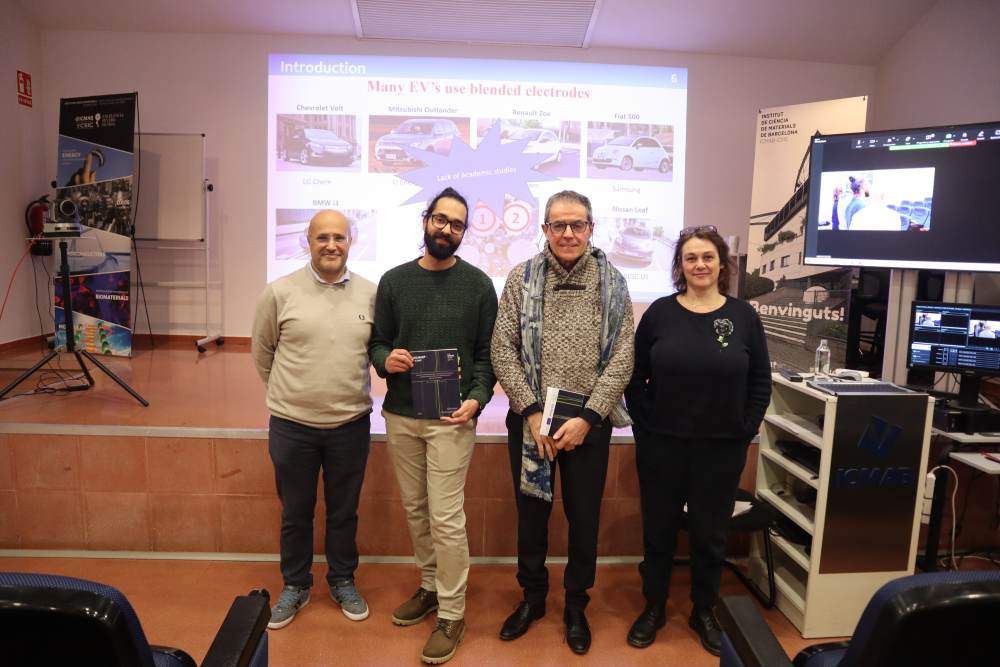 Dimitrios with his thesis defense tribunal | ICMAB-CSIC
Abstract
Blending different active materials in the same electrode is a strategy used in commercial Li-ion batteries for electric vehicles, the aim being achieve better performance than what can be attained with a single component thanks to the so called “synergistic effects”. Yet, fundamental understanding of these synergistic effects has progressed at a slower pace.
The main aim of this thesis has been to get further understanding of interaction between components and specific contributions to the performance of blended electrodes by combining advanced electrochemical methods (“decoupled blend setup” specifically designed which involves the use of three electrode cell, with two short-circuited working electrodes each containing one of the blend component) to operando (mostly synchrotron X-ray diffraction, XRD and absorption, XAS) characterization. The focus has been placed on both the development of methodologies and experimental protocols and the study of a range of materials already present in commercial batteries, mostly at the positive electrode.
Electrodes comprising equivalent amounts of lithium-ion battery active materials, namely LiNi0.5Mn0.3Co0.2O2 (NMC), LiMn2O4 (LMO), LiFe0.35Mn0.65PO4 (LFMP) and LiFePO4 (LFP)) has been studied. The distribution of current between blend components was followed during continuous and pulsed charge and discharge processes. Pulsed decoupled electrochemical testing reveals the exchange of charge between blend components during relaxation, which has also been captured through time-resolved operando XRD. The directionality and magnitude of the charge transfer were found to depend on the nature of the components and the cell SoC, being also influenced by temperature. These findings can be rationalized considering both thermodynamics (voltage profile) and reaction kinetics of the blend constituents and contribute to advancing the understanding of internal dynamics in blended electrodes.
Mixtures of LMO and NMC in different amounts have been also studied in more detail, with the composition with 25% LMO exhibiting the best electrochemical performance. The effective current load on each blend component can be significantly different from the nominal rate and also varies as function of SoC. Operando studies enabled to monitor the evolution of oxidation state and changes in the crystal structure, which are in agreement with the expected behaviour of the individual components considering the material specific electrochemical current loads.
Blends containing lithium rich manganese rich layered oxides (LRO), which exhibits a significant irreversible capacity upon the first cycle, have been also studied. Mixing with delithiated LFP enables to mitigate this aspect while at the same time improving thermal stability.
Finally, the methodology has been also extended to silicon/graphite blends, which are starting to be implemented at the negative electrode in commercial Li-ion cells, and the relative contribution of each component as a function of SoC has been followed at different rates and temperatures (0C to 45C).
Since the blend components have different potential vs. capacity profiles, direct reaction between them to reduce/oxidize to achieve equilibrium is possible. Differences in reaction kinetics can lead to complex situations in which both compounds contribute to the overall capacity at a given potential, especially at high rates, and internal lithium redistribution between components takes place during relaxation periods.
The findings reported in this thesis should contribute to achieve a better understanding of lithium dynamics in blended electrodes and help in its rational design and achieve optimal performance to match application requirements.
Supervisors
- Montse Casas-Cabanas, CIC energi-GUNE, Spain
- Rosa Palacín, ICMAB-CSIC, Spain
PhD Comitte
- President: Carles Frontera, ICMAB-CSIC, Spain
- Secretary: Sandrine Lyonnard, Laboratoire Systèmes Moléculaires et nanoMatériaux pour l'Énergie et la Santé (SyMMES), Commissariat à l’Energie Atomique et aux Energies Alternatives (CEA), France
- Vocal: Jean-MArie Tarascon, Collège de France, France
