

Why did you choose ICMAB?
ICMAB chose me. I applied for this Marie Curie PhD position, and after the interview process, I was selected by my supervisor to join ICMAB.
How would you explain your research to a non-scientific audience?
My research focuses on understanding how the structure of special plastic-like materials, known as conjugated polymers, impacts their ability to convert heat into electricity. These materials can turn waste heat into useful energy, and my work involves studying their internal structure and how they transfer heat, with the goal of improving their efficiency.
What are the main applications of your research? Could you give us an example?
The main application of my research is in thermoelectric generation, which converts waste heat into usable energy. For example, in car engines, thermoelectric devices could be used to capture the heat produced and convert it into electricity, improving the vehicle’s energy efficiency and reducing fuel consumption.
What will you miss the most from ICMAB?
I will mostly miss the people here—the amazing colleagues, friends, and mentors who have made this experience so special.
How do you think this experience will contribute to your training and to your future?
This experience has been invaluable in shaping my career. It has provided me with hands-on research skills, experience in collaborating within an international environment, and exposure to advanced techniques in materials science. It has also taught me resilience and problem-solving, which I believe will be crucial in my future academic and professional endeavors.
What do you wish you had known at the beginning of your PhD?
I wish I had known that setbacks are an integral part of the research process. Embracing failures as opportunities for learning is essential for growth. I also wish I had understood just how critical time management would be—balancing research, writing, and collaborations has been more challenging than I initially anticipated.
Why did you become a scientist? Who have been your role models?
I am still on my journey to becoming a scientist. During my PhD, I have learned to enjoy the process of pursuing answers to questions that don’t yet have solutions. The journey of seeking answers, using different methods, and making new discoveries is incredibly rewarding to me. My role models are those scientists who are fearless in exploring the unknown and challenging established ideas.
Who is your favorite female scientist?
Marie Curie. Her pioneering work and determination, especially at a time when opportunities for women were very limited, is deeply inspiring to me.
Abstract
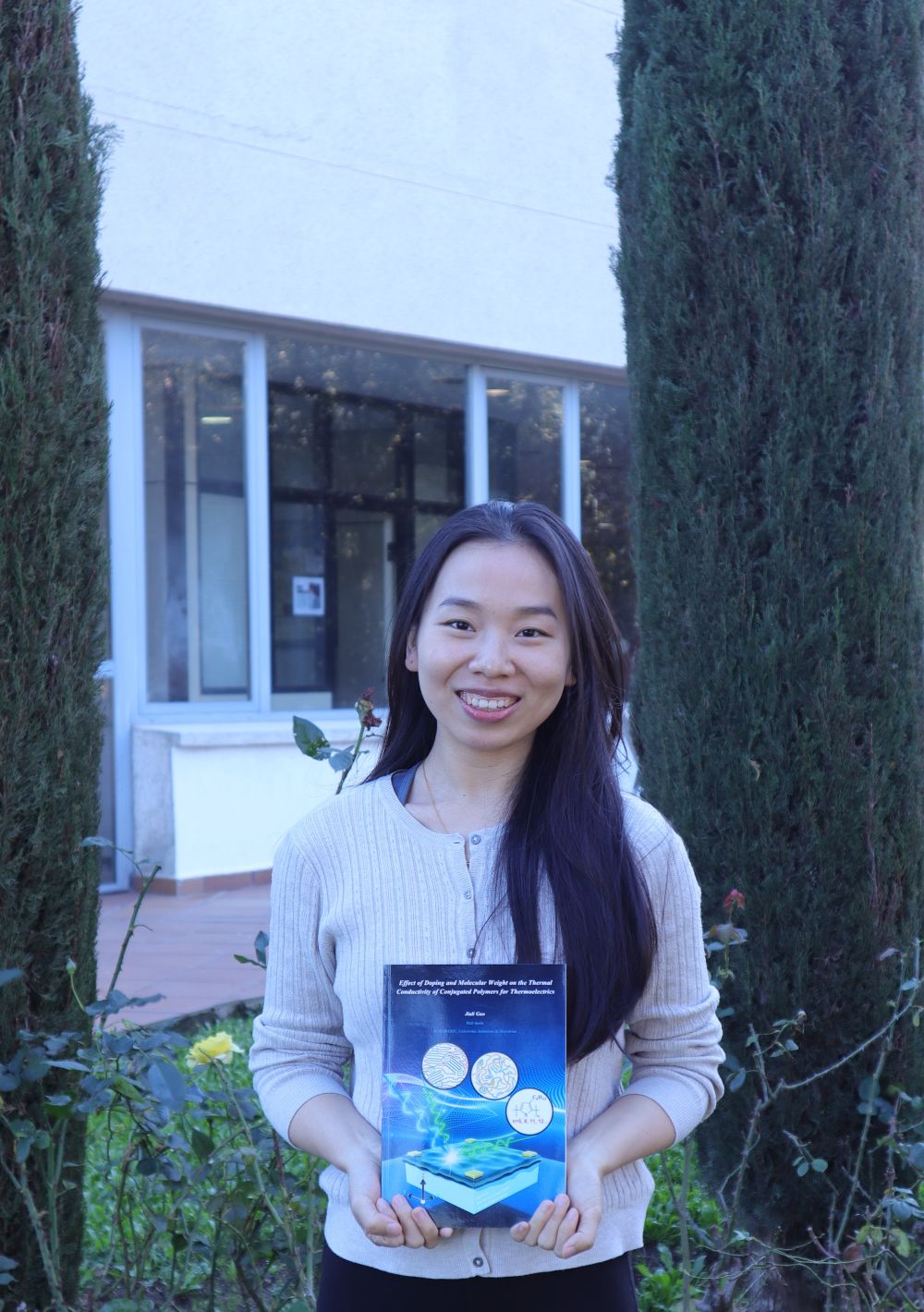
Conjugated polymers are attractive for flexible electronics and organic photovoltaics due to their lightweight and flexible nature. They are also considered promising for thermoelectric applications due to their low thermal conductivity and reasonable Seebeck coefficients. Enhancing their electrical conductivity to improve thermoelectric efficiency has been a major research focus, with efforts involving doping optimization and novel dopants. However, the relationship between doping, morphological changes, and thermoelectric properties, especially thermal conductivity, has received less attention due to the complex microstructures and the influence of factors like processing conditions and molecular weight.
In this thesis, we investigate the impact of doping, molecular weight blending, and polymer length on the morphology and thermoelectric properties of conjugated polymers, focusing on thermal conductivity. Our findings show that doping reduces the out-of-plane thermal conductivity in polymers with high structural order. This is explored through hypotheses such as increased thermal anisotropy, changes in the crystalline-to-amorphous ratio, and alloying effects. Structural analysis using GIWAXS, Raman, and infrared spectroscopy demonstrated the influence of backbone alignment on thermal transport.
Further studies on molecular weight blending in P3HT revealed its impact on both microstructure and thermal/electrical transport in doped and pristine samples. We also analyzed the effect of molecular length using seven synthesized oligomers, correlating morphological changes to thermal and electrical transport. Finally, temperature-dependent measurements provided insights into how molecular weight influences thermal conductivity at different temperatures.
In conclusion, this thesis demonstrates how doping, molecular weight, and morphology intricately affect the thermoelectric properties of conjugated polymers.
Supervisors
Mariano Campoy-Quiles
Juan Sebastián Reparaz
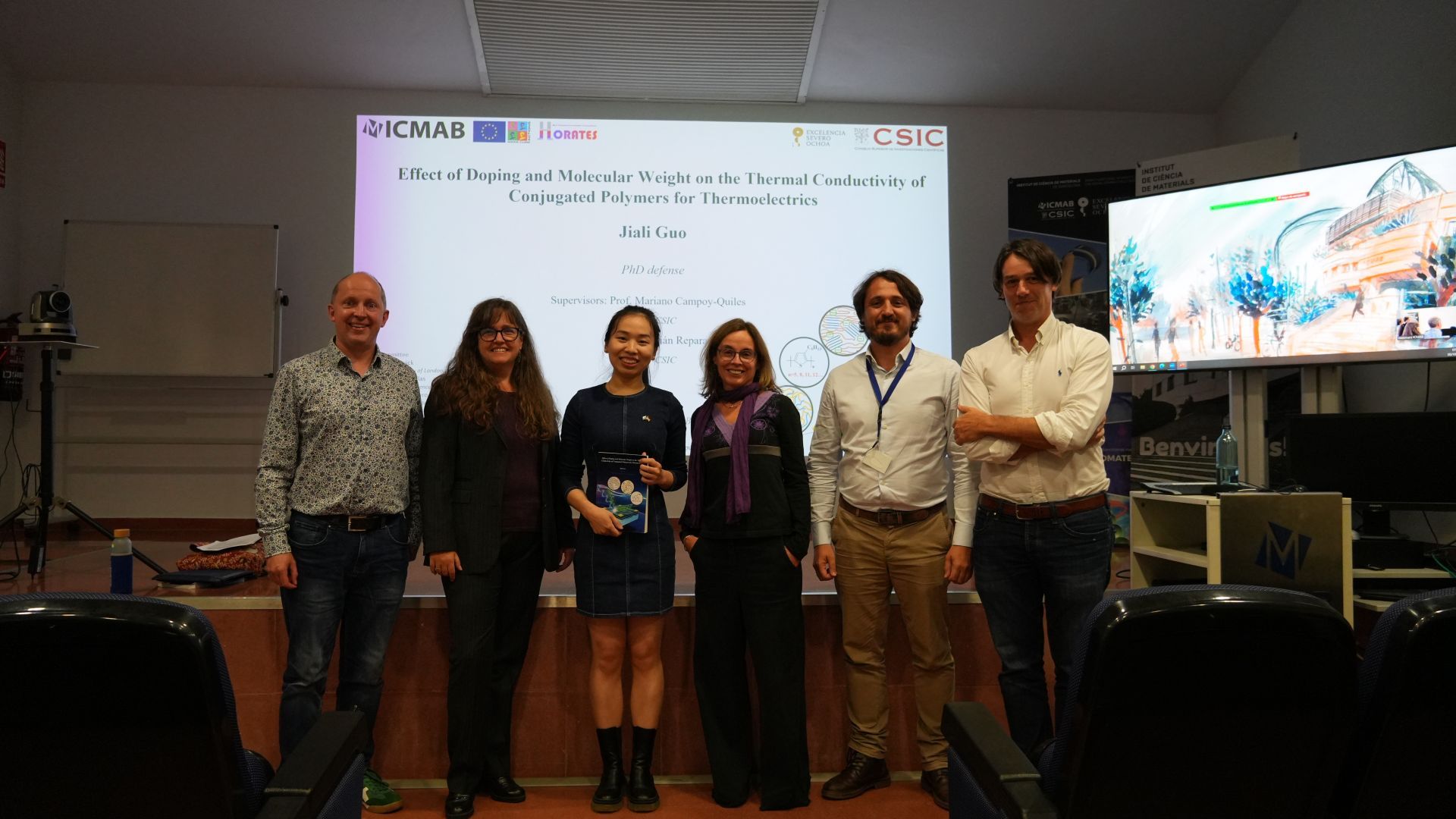
PhD comitee
President: Dr. Olga Caballero Calero, IIMN, Spain
Secretary: Dr. Esther Barrena Villas, ICMAB, Spain
Vocal: Prof. Oliver Fenwick, Queen Mary University of London, UK
