

What was the focus of your PhD research? Can you explain it to a non-scientific audience?
My thesis was focused on using chiral metasurfaces to endow chiral properties to light emission for emitters coupled to them. A chiral object is any geometry that cannot be superimposed to its mirror image, such as our hands or rotating helices. These chiral objects interact differently under circularly polarized light, thus changing the properties of light after the interaction. By arranging these scatterers in a periodic fashion, they can “talk” between them and enhance the effects for the interacting light. Generally, these metasurfaces, or patterned materials, are produced with expensive fabrication techniques, limiting their use in industrial optoelectronic applications.
Furthermore, emitting materials can modify their radiated light properties when placed in close vicinity to these patterned materials, enabling the direct emission of circularly polarized light. In comparison to other strategies, such as using chemical modifications or bulky optical components, chiral metasurfaces enable the miniaturization of polarized light sources, which pave the way for small footprint telecommunications and imaging technologies.
In my thesis, we show a new nanofabrication approach, compatible with industrial processes that could potentially open up the production of high quality chiral metasurfaces coupled with conventional emitting materials for chiral emission optoelectronic applications.
Can you briefly summarize the main findings or contributions of your research? You can give us some examples.
From a general point of view, we have demonstrated a cost-effective nanofabrication approach to produce large area (in the order of millimeters) chiral metasurfaces, which was yet elusive in the literature.
From a more specific perspective, we have obtained larger circular emission differences for both circular polarizations from conventional efficient materials. We have increased this maximum dissymmetric emission in all the different colloidal nanoemitting materials used in our research compared to the state of the art.
Specifically, we have shown the production of circularly polarized white light emission using various emitters using a single platform, which was never reported in the visible spectrum. Moreover, we have also showed purely circularly polarized lasing emission (>97% degree of polarization) from an organic dye molecule coupled to our chiral metasurface.
Why do you think your research is important, and how could it impact your field or society?
Polarized light is currently present in many display applications, such as our phone or TV screens. Polarized light combined with external optical components can add colour purity and increase the brightness of our displays technologies. However, usually these optic components filter a large part of the emitted energy, thus increasing the energy consumption. Inducing directly polarized light emission at the nanoscale could address these limitations hence increasing the efficiency of our display systems towards a more sustainable technology.
What was one of the most challenging aspects of your PhD journey, and how did you overcome it?
The transversality of my research topic, including the chemical, physical and technological components. This has allowed me to learn new strategies to confront the different problems during my PhD journey. Problem solving usually includes understanding concepts that you already know from a different perspective. It has been a really enriching experience.
Why did you end up at ICMAB? And what do you think you will miss the most from this institute?
A few weeks after finishing my Master’s degree in Photonics, I received a communication email from the Master coordinator, announcing a PhD offer in Dr. Agustin Mihi’s group, who is an expert in scalable nanofabrication of photonic architectures. The PhD offer was very appealing to me, as it aligned perfectly with my academic background of Physics and Photonics, studying light-matter interaction at the nanoscale for these type of photonic architectures in the nanoscale regime.
The thing that I will miss the most is the good friends that I made in this journey. Our group is like a big family plenty of kind and welcoming people.
What’s next for you after completing your PhD? Do you have any upcoming projects or goals?
I would like to finish what I started and go from the proof of concept obtained in this thesis to real integration of our nanofabrication techniques into optoelectronic applications. I do believe this could potentially reduce electrical consumption and could be a big step towards more sustainable display technologies.
How has completing this PhD changed you, either professionally or personally?
A PhD is much more than obtaining a title. I see it more as a tool for problem solving. I think I have gained experience in addressing obstacles, not only from a professional perspective, but also in my personal life. It is true that while you are in, you can feel stressed about all the new knowledge and concepts that you need to learn and consider for your research. However, it all pays off in the end when you look back and compare yourself at the beginning and at the end of your PhD and you see the long way you have gone.
What advice would you give to someone just starting their PhD journey?
Believe in the process. Few people are born with all the necessary tools, most of us just learn them along the way. Don’t stress, be curious, and do not be afraid of asking questions. But also, test your limits and see how far you can go to solve any obstacles you may find. Problem solving is one of the most grateful sensations one can experience.
Moreover, I know the PhD is very important for everyone, but combine your research with some extra-professional activities. Work-out, do some outdoor activities, take time for yourself to breath outside of your research, as it sometimes can be stressful and frustrating.
Why did you become a scientist? Which have been your role models that inspired you to pursue a PhD?
I do love science since I was a kid. Being able to contribute to global knowledge is a real honour. I believe science is the way to unravel the fundamental questions that drive the evolution of society. Science pursues the answering of questions by following a method to understand, eventually controlling and taking profit from that knowledge. I love the idea that there are many things we do not know and that there’s still room to grow and learn. Scientific research is hand to hand with the development of a competitive society.
Who or what helped you the most during your PhD journey, and is there anyone you'd like to thank?
From a professional perspective, my PhD supervisor has inspired and guided my career towards the excellence. Without his help, I would not have achieved my goals. I believe it is crucial to have great counseling and someone with empathy to guide your steps while developing your research career.
From a more personal perspective, my wife has been my pillar even before starting the PhD. She has always motivated me to keep pushing forward towards professional excellence, and it was never an option to let her down. For being by my side during this journey, I will always be grateful to her.
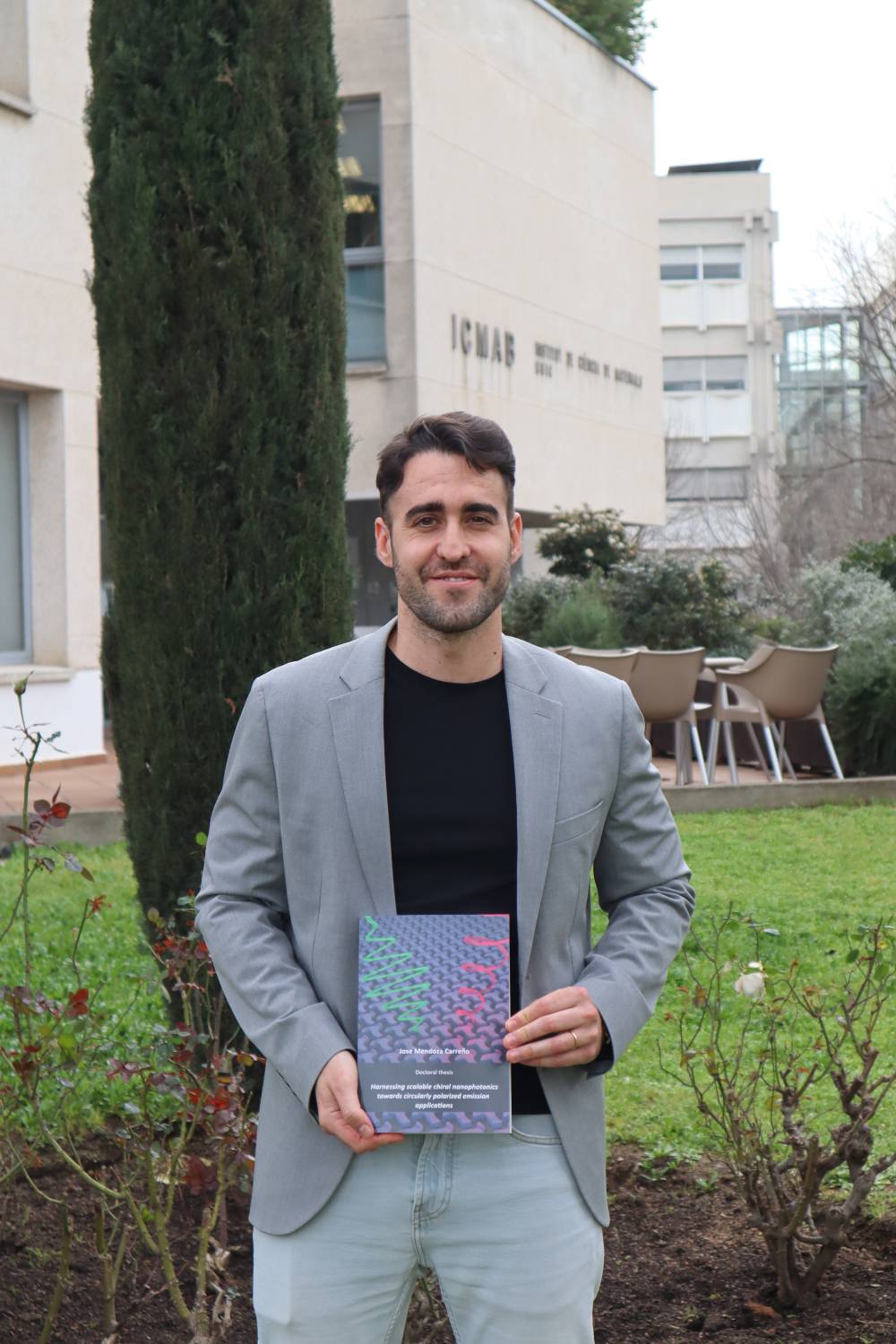
Abstract
Advancements in nanotechnology fabrication have introduced new methods for studying material properties, often using either directly or indirectly light as a key tool. The polarization state of light, in particular, reveals structural and compositional details, making precise polarization control essential. In situ characterization requires miniaturized light sources with controllable polarization. For circularly polarized light, chiral nanoantenna arrays effectively control both polarization and radiation patterns. Unlike bulky optics, chiral metasurfaces offer a compact solution for electromagnetic control. However, while they can be produced with high-resolution techniques like electron beam or focused ion beam lithography, these methods are costly and slow, limiting large-scale, cost-effective production for industrial applications.
Alternatively, Nanoimprint lithography (NIL) is a great candidate for the production of large-area metasurfaces. NIL, compatible with industrial roll2roll fabrication methods, has proved excellent results in metasurface nanofabrication implemented in optoelectronic devices. However, the implementation of NIL into the production of large-area chiral metasurfaces remains yet elusive. In this thesis, we propose the pioneering combination of unconventional Nanoimprint lithography for the nanofabrication of large-area chiral metasurfaces. These metasurfaces endow chiral properties to light-emitting nanomaterials deposited on top, coupling the emission processes to the chiral collective modes sustained by the 2D-chiral arrays.
First, we initiate the experimental phase of this thesis by nanoimprinting achiral emitters into chiral gammadion patterns. This process demonstrates that achiral emitters produce circularly polarized light when arranged directly in chiral architectures. This effect is tested for two different perovskite inks, achieving a dissymmetric circular emission glum of 0.15, a two-order-of-magnitude improvement compared to chemical methods. Additionally, we experimentally demonstrate the polarization inversion characteristic of 2D-chiral metasurfaces, with preferential emission switching across emitted half-spaces. Moreover, we show an enhanced out-coupling efficiency through the addition of a TiO2 layer, which doubled the circular emission dissymmetry (0.3) via collective resonances.
Second, we decouple the emitters from the metasurface and examine the role of chiral lattice resonances in producing circularly polarized emissions. We analyze the dependence of glum when overlapping the emission band and the metasurface's chiroptical response. When these overlap, experimental glum values reached up to 0.56 for green perovskite nanocrystals. We test various functional coatings (TiO2, Si, and Au) on gammadion metasurfaces to spectrally adjust the chiroptical response across the visible spectrum. We further examine the origins of chiral dissymmetry based on absorption and scattering, experimentally and computationally for dielectric (TiO2) and plasmonic (Au) coatings. Finally, we propose a hybrid architecture with a double-imprinted metasurface to enable experimental simultaneous chiral emission at two different wavelengths.
Third, we introduce the hexagonal triskelion array, a new chiral structure capable of sustaining lattice resonances across the visible spectrum. Building on previous work, we test various achiral emitting materials on these metasurfaces to impart chiral emissive properties. By utilizing materials of different compositions and characteristics, we demonstrate the versatility of this approach, achieving glum >0.5 across a broadband range when coupled with diffractive modes. We then propose a "white mixture" solution combining blue (CdSe/CdS nanoplatelets), green (CsPbBr3 perovskites), and red (CdSe/CdS quantum dots) emissive materials for potential white chiral light applications.
In the fourth and last part of this thesis, we conduct an in-depth investigation of this new chiral metasurface. For this structure, we experimentally and computationally characterize the resonances' angular dispersion, examining the origins of the chiral response in both linear and circular polarization space. Benefitting from extrinsic chirality, we achieve tunable circular polarization emission in different spatial directions, obtaining adaptable emissions from a static metasurface. We conclude this chapter by examining the metasurface response under higher excitation power densities, demonstrating high-purity circularly polarized lasing emission with a glum > 1.9, which was tunable via the TiO2 coating.
Supervisors
- Agustín Mihi, ICMAB-CSIC, Spain
- María Isabel Alonso, ICMAB-CSIC, Spain
PhD Comitte
- President: Wiktor Lewandowski, University of Warsaw, Poland
- Secretary: Irene Estévez, UAB, Spain
- Vocal: Dmitry Baranov, University of Lund, Sweden
