


I created scaffolds to culture cells in more physiomimetic conditions in vitro. As there use would be mainly for basic research, their interest for a non-scientific audience might be low.
Can you briefly summarize the main findings or contributions of your research? You can give us some examples.
By focusing on the pulmonary tissue, I developed matrices containing bacterial cellulose which reproduce distinct aspects of the lungs such as their composition or mechanical properties. These matrices allow to culture cells in more physiomimetic conditions to, for instance, preserve better the therapeutic potential of mesenchymal stem cells.
Why do you think your research is important, and how could it impact your field or society?
My work mixed material science and cell biology and investigate on the future roles of bacterial cellulose in biomedicine.
What was one of the most challenging aspects of your PhD journey, and how did you overcome it?
One of the most challenging aspects was to discover material sciences that was a completely new field for me. Thanks to ICMAB and my lab, I learn several technics and I have now interdisciplinary skills (material science and cell biology). But the fact of being far from my hometown was undoubtedly a challenge too.
Why did you end up at ICMAB? And what do you think you will miss the most from this institute?
I ended up at ICMAB by applying to a PhD offer focusing on the development of biomaterials for cell biology and biomedicine. I am now leaving, and I will miss all the energy and the activities of this institute that make it an amazing place for scientific discussions and collaborations!
What’s next for you after completing your PhD? Do you have any upcoming projects or goals?
I will continue in the lab where I realized half of my PhD, so at the Universitat de Barcelona for a Post-doc, where I will be working in cell biology.
How has completing this PhD changed you, either professionally or personally?
It has been a big adventure! It has changed me professionally and personally. I am now highly more autonomous, with a critical point of view and strong technical skills, but I am also tired of stress and pressure.
What advice would you give to someone just starting their PhD journey?
Be trained on time management, prepare well your work/life balance, do not be too frustrated and impatient during the first year.
Why did you become a scientist? Which have been your role models that inspired you to pursue a PhD?
I always have been fascinated by life science, physiology, and molecular pathways. However, during my master I discovered the fields of biotechnology and biomaterials.
Who or what helped you the most during your PhD journey, and is there anyone you'd like to thank?
My biggest thank go to my partner who supported me at all PhD steps. I also thank my colleagues without who I would never have energy to finish the PhD.
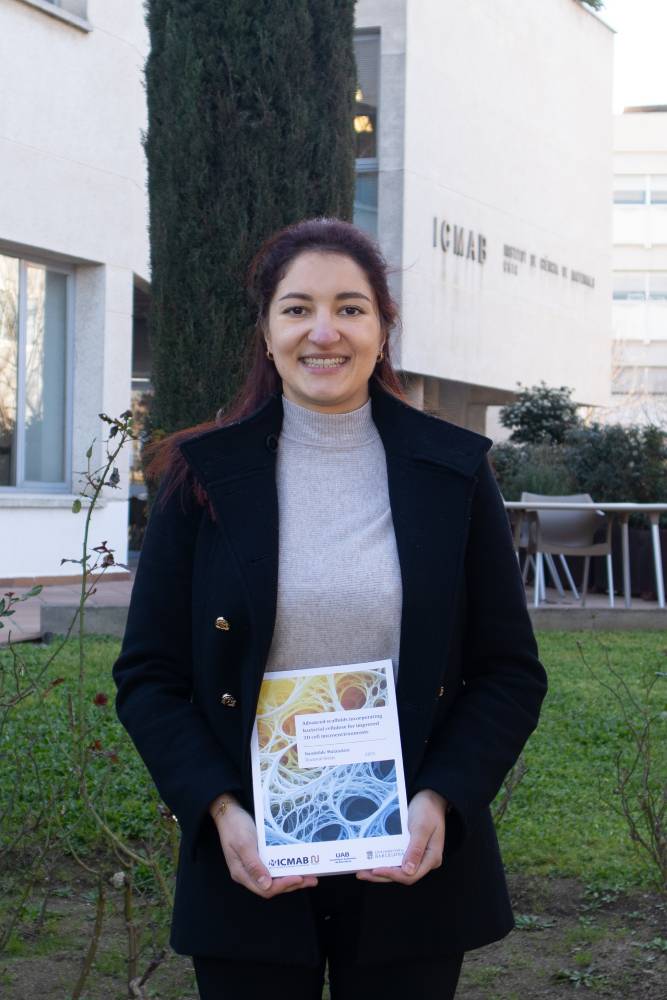
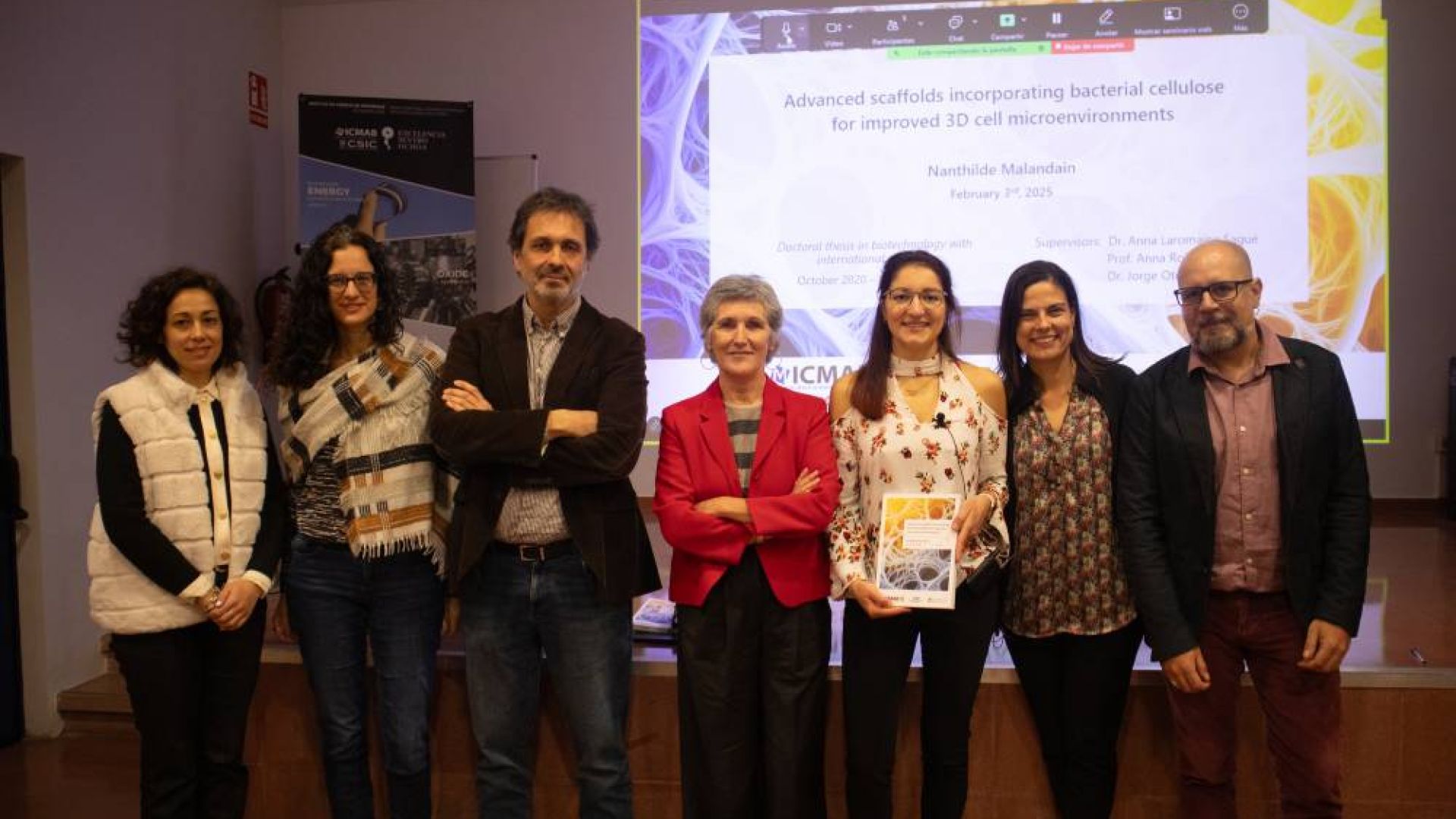
Nanthilde on the day of her thesis at ICMAB garden | ICMAB-CSIC
Abstract
This thesis explores the development of advanced scaffolds for 3D cell culture with the ultimate vision of contributing to enhancing the therapeutic potential of mesenchymal stromal cells (MSCs) in regenerative medicine. MSC-based therapies hold significant promise for diseases and disorders that have yet to be treated thanks to their anti-inflammatory and regenerative capabilities. However, clinical translation is hindered by some limitations related to their in vitro expansion. To overcome these challenges, cell priming, or preconditioning, has emerged as a promising strategy which consists in culturing cells in a 3D native-like microenvironment before transplantation. Biocompatible hydrogels, especially those derived from the extracellular matrix (ECM), are suitable scaffolds for 3D cell culture, as they provide a high degree of resemblance to the native cellular environments. Taking advantage of the bacterial cellulose’s (BC) fibrous and nanoscale structure similar to that of collagen, as well as its high purity, mechanical strength, and biocompatibility; this work produced hydrogels that mimic the ECM for 3D in vitro cell culture. Various scaffolds were explored based on a) native BC fibers, b) BC fibers functionalized with bioactive peptides that enhanced cell adhesion, and c) BC fibers combined with ECM-derived components from rat tail tendons or pig lungs, yielding 3D scaffolds that support cell growth and mimic the physico-chemical properties of native tissues. Additionally, MSC priming within these physiomimetic environments was evaluated by studying key cell characteristics, such as morphology, traction forces, and motility, which are critical for effective therapeutic actions. The findings indicate that BC-based scaffolds, particularly in combination with ECM components, create a suitable microenvironment for MSC priming, influencing cell migratory behavior. This work highlights the potential of BC in developing tailorable 3D cell-laden scaffolds to advance the field of 3D cell culture and regenerative medicine.
Supervisors
- Anna Laromaine, ICMAB-CSIC, Spain
- Anna Roig, ICMAB-CSIC, Spain
- Jorge Otero, UB, Spain
PhD Comitte
- President: Manuel Salmeron Sánchez, University of Glasgow, United Kingdom
- Secretary: Cristina Castells Sala, Banc de Sang i Teixits, Spain
- Vocal: Carla Andreia Cunha Vilela, CICECO - Aveiro Institute of Materials, Portugal
