

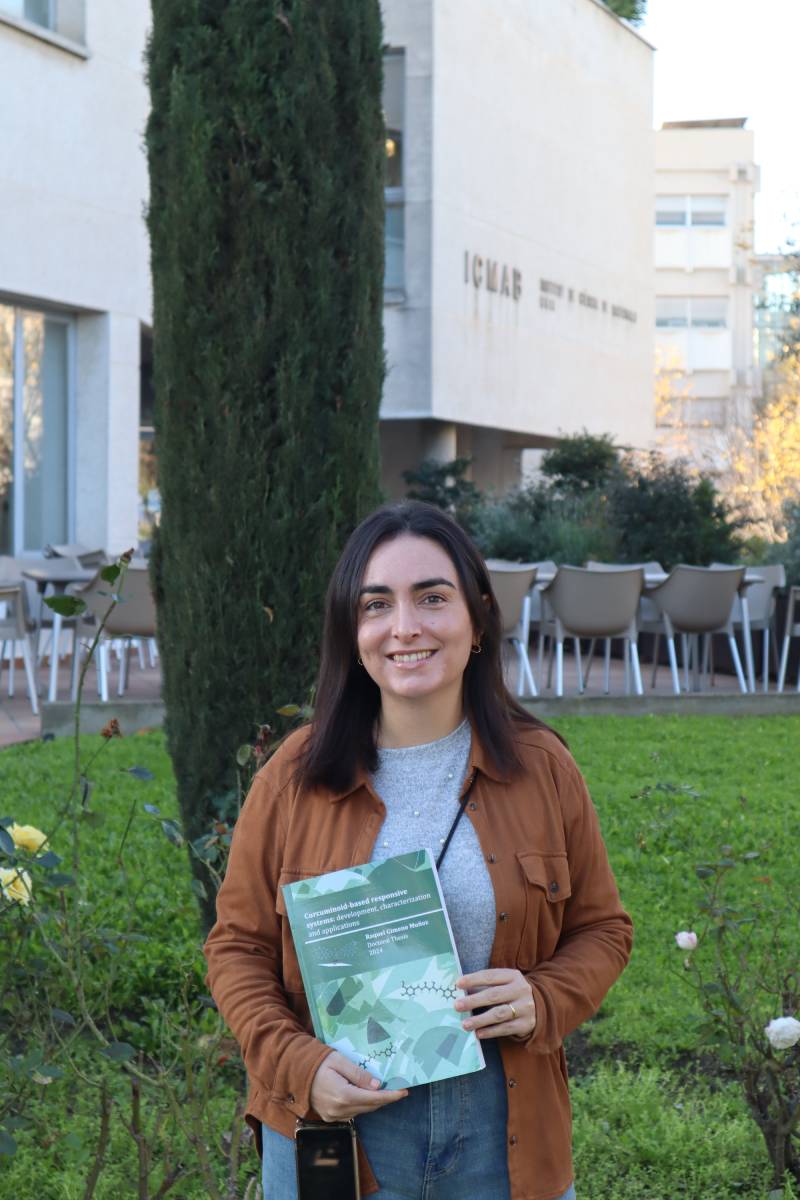
What was the focus of your PhD research? Can you explain it to a non-scientific audience?
My PhD research focused on the synthesis and immobilization of curcuminoids (organic molecules that can act as chemosensors) on different substrates (glass, nanoparticles, and polymers). These systems allow for the detection of metals and metalloids through changes in their optical properties.
Can you briefly summarize the main findings or contributions of your research? You can give us some examples.
These systems mainly contribute to the development of new responsive surfaces, for example, for the detection of BF3 BF3 is a toxic compound used in the electronics and synthesis industries.
Why do you think your research is important, and how could it impact your field or society?
The results obtained in this thesis could allow the direct detection of BF3 in industry, as current systems only detect compounds formed by its degradation. This thesis has also led to the start of other projects dedicated to the removal of heavy metals from wastewater or the synthesis of polymeric films for the detection of BF3.
What was one of the most challenging aspects of your PhD journey, and how did you overcome it?
One of the biggest challenges was working in a completely unknown field. Even so, training courses and the help of the research group and ICMAB technicians were essential to overcome this and continue learning.
Why did you end up at ICMAB? And what do you think you will miss the most from this institute?
A professor at UB introduced me to the FunNanoSurf group, which is how this adventure began.
What’s next for you after completing your PhD? Do you have any upcoming projects or goals?
I am currently working at the ICMAB in the MATIce group of Dr. Albert Verdaguer. In addition to working in the laboratory, fieldwork was conducted in the Catalan Pyrenees. The objective of this project is to produce snow at high temperatures while saving energy and water using feldspars.
How has completing this PhD changed you, either professionally or personally?
The doctoral thesis is a constant test of endurance, which once passed, has provided me with positive personal and professional development.
What advice would you give to someone just starting their PhD journey?
If I had to give any advice, it would be perseverance and confidence in yourself and what you do. Poor results did not exist. All the information we provide is important.
Why did you become a scientist?Which have been your role models that inspired you to pursue a PhD?
I am curious about science from a very young age, and thanks to my family, I have maintained it over the years. I have never had a role model in science, but my mother has always inspired me to keep working and achieve my goals.
Who or what helped you the most during your PhD journey, and is there anyone you'd like to thank?
During my PhD, both my supervisors and my colleagues helped me a lot, plus the technicians from the different services, as well as those in charge of personnel, administration, cleaning and maintenance, were also essential. You are all part of this thesis. Thank you all!
Abstract
Curcumin (CCM) and natural curcuminoids (CCMoids), such as demethoxycurcumin (DMC) and bisdemethoxycurcumin (BDMC), are organic molecules found in the rhizomes of Curcuma longa. These molecules were discovered between 1815 and 1953 and have been used especially as textile or food dyes. Subsequently, their antioxidant and antibacterial properties, among others, were demonstrated, which has led to an increase in scientific interest in their study.
Over the years, the exploration of new CCMoid structures has led to the development of the Pabon method, which provides a relatively simple synthetic route for producing new molecules with improved properties. The structural versatility of CCMoids allows the provision of molecular designs with the ability to modify various optical properties of coordinates with metal ions, metalloids, and neutral molecules or biomolecules. This makes them ideal molecules for use as fluorescent chemosensors. In addition, they can be designed with specific groups to facilitate their anchoring on different substrates and develop useful devices in the field of detectors, both for analyte in solution and in vapor phase. The wide variety of substrates that exist to prepare this type of detector, together with the possibility of immobilizing chemosensors on them, provides the possibility of designing new multifunctional platforms for rapid, selective, and easy-to-handle detection.
This thesis presents the synthesis of CCMoids and the study of their immobilization on previously functionalized substrates of different natures (rigid surfaces, nanoparticles, and biopolymeric films), with the aim of proposing new systems that can be used as detectors through changes in fluorescence.
Supervisors
- Núria Aliaga Alcalde
- Arántzazu González Campo
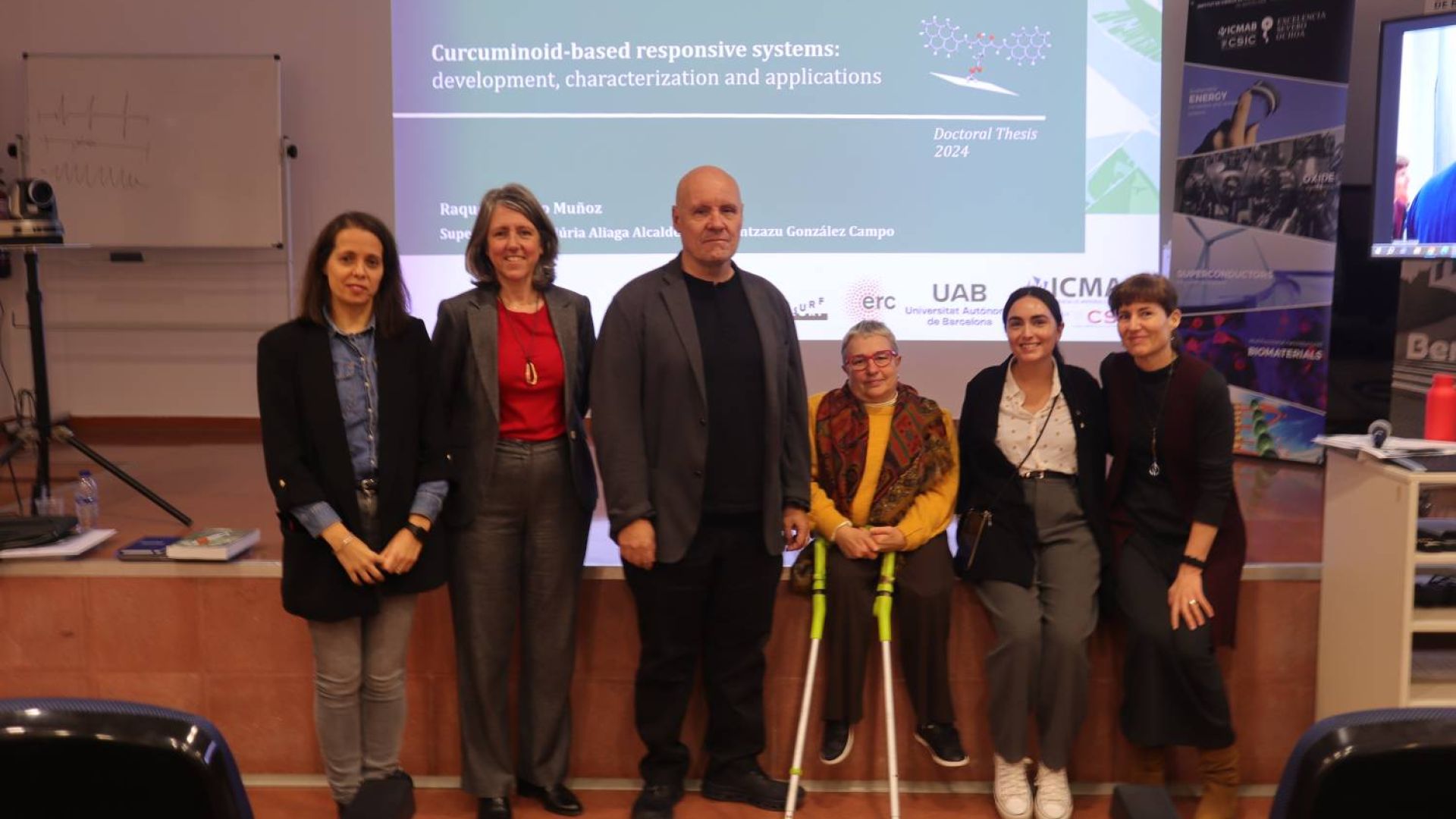
PhD Comitee
- President: Prof. Concepción Domingo Pascual, ICMAB-CSIC, Spain
- Secretary: Prof. Eliseo Ruíz Sabín, ICREA, Spain
- Vocal: Dr. Lourdes Basabe Desmonts, UPV-EHU, Spain
