

What was the focus of your PhD research? Can you explain it to a non-scientific audience?
My PhD investigated how the arrangement of molecules influences the properties of materials that interact with light, particularly those used in organic solar cells. Both the choice of molecular building blocks and the way they organise themselves play an important role in determining how a material behaves.
This work was inspired by natural light-harvesting systems, where molecular organisation is closely linked to function. I focused on molecular alignment, where molecules adopt a preferred orientation, and chirality, where structures have a particular “handedness”, like our left and right hands.
My aim was to understand how these features influence light absorption, light emission and the generation of electrical charges.
Can you briefly summarize the main findings or contributions of your research? You can give us some examples.
One finding was that adding a small amount of a chiral molecule to an organic solar-cell material could promote molecular alignment. This alignment changed how the films absorbed polarized light and, in thin active layers, increased the electrical current generated under illumination.
I also investigated pairs of light-absorbing molecules connected by bridges of different lengths. Their connection and surrounding environment strongly influenced their light emission and the processes that followed light absorption, including charge separation under specific conditions.
Together, these studies showed how molecular design and organization offer complementary ways to control a material’s optical and electronic properties.
Why do you think your research is important, and how could it impact your field or society?
Understanding how molecules interact and organize themselves is essential for designing materials with specific properties. This is particularly important for organic semiconductors, which offer opportunities for lightweight, flexible solar cells whose performance depends strongly on their internal organization.
In my research, I used synchrotron-based techniques to characterize molecular organization and relate it to the electrical current generated under polarized light. This approach helps connect the microscopic arrangement of molecules with the behaviour of a working device.
My work contributes to identifying which molecular arrangements favour particular optical and electronic properties, and how these arrangements can be controlled. It also highlights the importance of distinguishing chirality from molecular alignment when interpreting optical measurements. These insights can guide the design of future materials and devices that harness light more effectively.
What was one of the most challenging aspects of your PhD journey, and how did you overcome it?
One of the most challenging aspects of my PhD was doing the synthesis of the semiconductors. I was more accustomed to taking measurements, where results often come much faster, so I initially found the slower pace of synthesis discouraging.
Over time, I learned to adjust my expectations and appreciate that synthesis is an art requiring patience, practice and persistence. Every step takes time, and an unsuccessful attempt is also an opportunity to learn. I wish I had understood this earlier, as I would have been kinder to myself at the beginning. Learning to respect the time a process needs was one of the most valuable lessons of my PhD.
Why did you end up at ICMAB? And what do you think you will miss the most from this institute?
Before joining David Amabilino’s group, I had already spent a few months at ICMAB in the NANOMOL group. During that time, I got to know the institute and made connections with people here. Through those connections, I learned about an open PhD position on organic photovoltaics and chiral materials—two topics that already interested me.
What I will miss most (after the ping-pong tournament) is the warm, welcoming atmosphere at ICMAB, where I have felt safe and at home. I’m especially fond of our lunch breaks and the friendly environment in the second-floor labs.
What’s next for you after completing your PhD? Do you have any upcoming projects or goals?
In November, I will start a postdoctoral position in Florence with Alberto Privitera, studying chirality-induced spin selectivity, or CISS, in photovoltaic devices.
During my PhD, I focused on molecular organization and photophysical processes. Now I will explore how chiral materials can influence electron spin, a quantum property related to magnetism. This will allow me to connect my previous experience with a new field. My goal is to develop expertise at the intersection of molecular materials, photophysics and spin-dependent processes.
How has completing this PhD changed you, either professionally or personally?
Professionally, my PhD made me feel that science was truly my profession. As a student, I sometimes felt more detached from the research I was doing. Taking ownership of a project changed that: I had to plan experiments, manage time and resources, organize work across laboratories and understand how my results fitted into a broader scientific context. It gave me a stronger sense of responsibility and helped me see myself as a scientist.
Personally, it has deepened my appreciation of other people’s work. Having experienced the patience, uncertainty and persistence that research requires, I now recognize more clearly how much effort can lie behind a single result. It has taught me to value that effort, including the work that is not immediately visible.
What advice would you give to someone just starting their PhD journey?
Good things take time. During a PhD, I believe learning is more important than the results themselves. Experiments involve so many variables, and things can easily go wrong, so your results alone do not define your progress.
My advice is to learn as much as you can: collaborate, ask questions and pay attention to how others work. There is so much you can pick up simply by observing the people around you. Above all, never compare yourself to others. Every PhD journey is different, and everyone progresses at their own pace.
And, of course, save your data carefully. Over time, I’ve come to appreciate that good data management is an essential part of good science. It is a something I wish I knew from the beginning.
Why did you become a scientist? Which have been your role models that inspired you to pursue a PhD?
I think I became a scientist partly because I was afraid I might get bored doing something else. I love the research environment, the people and the opportunity to explore different questions and move between projects. There is always something new to learn, and that variety keeps me curious.
My photochemistry professor, Paola Ceroni, was an important role model for me. She was a wonderful example of the kind of scientist I aspired to become.
Who or what helped you the most during your PhD journey, and is there anyone you'd like to thank?
I would first like to thank my supervisor, David Amabilino, for his constructive approach to mistakes. When something went wrong, he took the time to explain what had happened and why, helping me understand and learn from the experience. I really appreciated that supportive approach.
I would also like to thank everyone working in the second-floor labs, especially Rosario’s and Pepe’s group. I am particularly grateful to Mariano Campoy-Quiles and Sergi Riera-Galindo for their guidance in fabricating organic photovoltaic devices, and to everyone in their group for always being kind, and willing to help.
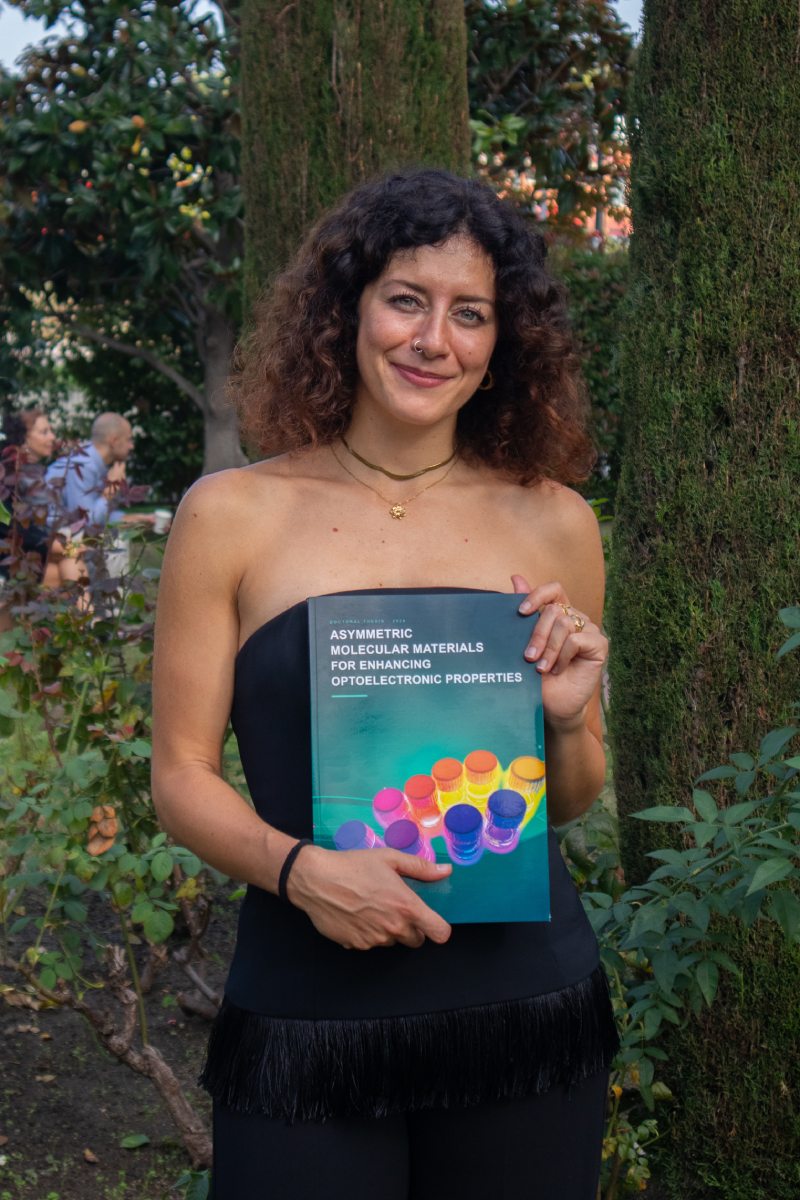
Giulia Pancotti at ICMAB garden on the day of his thesis | ICMAB-CSIC
Abstract
This thesis investigates how chirality, molecular packing and chromophore orientation influence the optical and electronic properties of organic semiconductors. Combining spectroscopic characterization, Mueller matrix polarimetry and device studies, it explores the relationship between molecular organization, polarized-light interactions and optoelectronic function, with particular emphasis on organic photovoltaics and light-emitting diodes.
Supervisor
- David Amabilino, ICMAB-CSIC
PhD committee
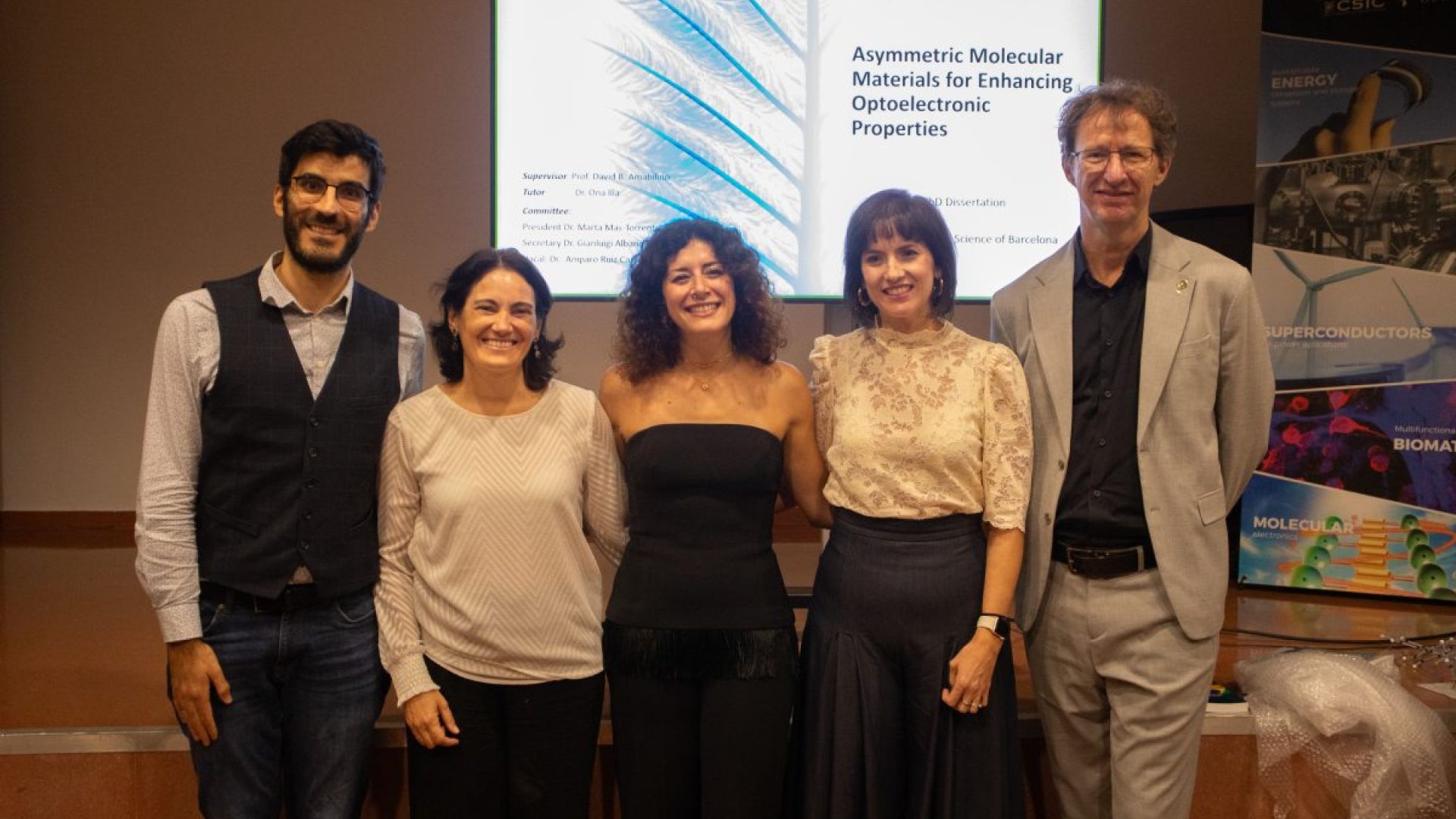
- President: Marta Mas, ICMAB-CSIC, Spain
- Secretary: Gianluigi Albano, Parma University, Italy
- Vocal: Amparo Ruiz, ICMM, Spain
Read more
ICMAB - Giulia Pancotti will defend her PhD thesis on 16 October 2026
