

What was the focus of your PhD research? Can you explain it to a non-scientific audience?
For my PhD, I studied how viruses interact with different materials using simulations. This is important for understanding virus transmission and developing clinical applications. I focused specifically on SARS-CoV-2, the virus that caused the global pandemic five years ago.
Can you briefly summarize the main findings or contributions of your research? You can give us some examples.
We found that a type of disinfecting agent (ionic surfactants) are able to block the function of the spike protein, the protein of the SARS-CoV-2 that triggers the infection in our body.
We also found that the Omicron variant of the SARS-CoV-2 is attracted towards negatively charged surfaces, which is a distinct behaviour from other variants.
We made studies of the stability of the SARS-CoV-2 virus on human skin and mucus, which is important for understanding how it spreads.
Finally, our results also show that electrostatic interactions play an important role in how the virus interacts with materials, which could help in developing clinical applications.
Why do you think your research is important, and how could it impact your field or society?
This thesis suggests strategies to tackle the spread of viruses, like the use of ionic surfactants to inactivate the viruses.
Our studies also show that modeling and simulation techniques are helpful for developing clinical applications.
What was one of the most challenging aspects of your PhD journey, and how did you overcome it?
In general, designing and interpreting simulations that could be directly related to experimental studies was the most challenging situation. Scientific discussions with my director and collaborators were key to keep advancing.
Why did you end up at ICMAB? And what do you think you will miss the most from this institute?
I contacted for the first time my director when I did the Bachelor’s degree project (TFG) in Physics and Chemistry at UAB.
The people and friends in ICMAB is what I will miss the most.
What’s next for you after completing your PhD? Do you have any upcoming projects or goals?
I would like to continue being involved in research. Soon I will start a new position as a postdoc abroad.
How has completing this PhD changed you, either professionally or personally?
I am able to make better and more mature decisions when I do research.
What advice would you give to someone just starting their PhD journey?
Doing a PhD is like running a marathon, so take it easy. Take the initiative to solve problems when things don't go as planned. Socializing and going to SAF is as important as the daily research.
Why did you become a scientist? Which have been your role models that inspired you to pursue a PhD?
Some of my high school teachers sparked my passion and curiosity for physics and science.
Who or what helped you the most during your PhD journey, and is there anyone you'd like to thank?
My director was very supportive during all the PhD period. I would also like to thank all my colleagues and friends at ICMAB for making my PhD journey so wonderful.
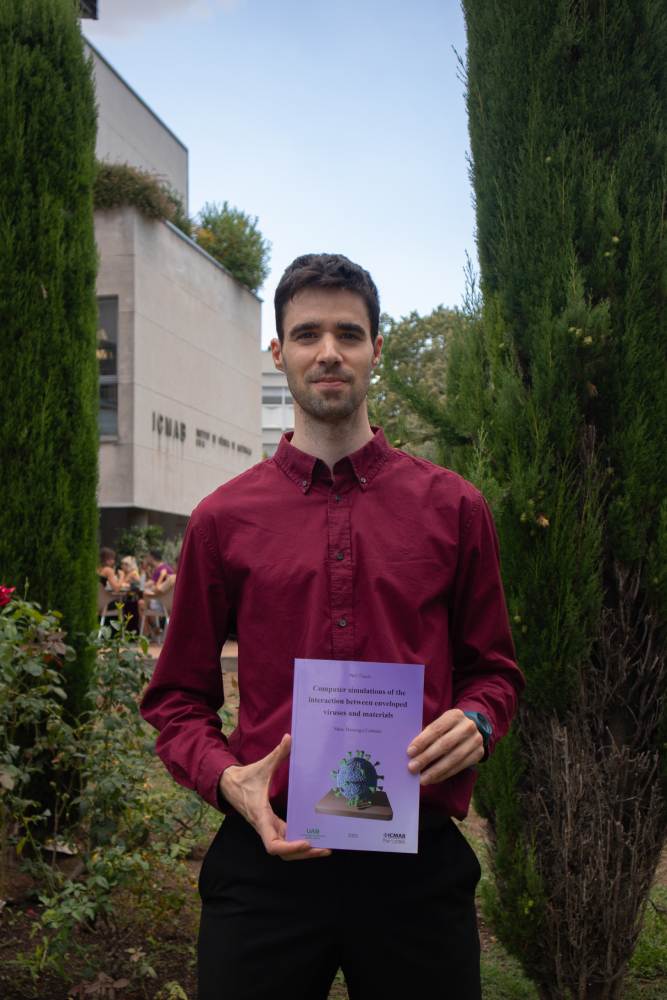
Marc Domingo on the day of his thesis at ICMAB garden | ICMAB-CSIC
Abstract
The COVID-19 pandemic, caused by the SARS-CoV-2 virus, brought much pain and suffering to human society. Millions of people died from the disease and the majority of the world’s population experienced periods of confinement. This thesis investigates how the SARS-CoV-2 virus interacts with surfaces and disinfectants, with a focus on understanding its transmission. The possibility that surfaces play a role in spreading the disease led scientists to study how viruses interact with different materials. Experimental studies have primarily investigated how long viruses can survive on different surfaces and how effectively various disinfectants can neutralize or inactivate the virus. However, the microscopic mechanisms behind the interaction between the coronavirus, materials, and disinfectants are still not well understood. To help address this gap, I carried out computer simulations of various systems to explore these interactions in detail. To carry out this thesis, I have used several computational techniques: molecular dynamics, electrostatic calculations at the level of Poisson-Boltzmann and molecular docking.
Supervisors
- Jordi Faraudo, ICMAB-CSIC, Spain
PhD Committee
- President: Eva González, Instituto de Química Física Blas Cabrera (CSIC), Spain
- Secretary: David Reguera, UB, Spain
- Vocal: Chris Lorenz, King’s College London, United Kingdom
