

What was the focus of your PhD research? Can you explain it to a non-scientific audience?
My PhD focused on developing highly sensitive biosensors based on Electrolyte-Gated Organic Field-Effect Transistors (EGOFETs). The goal was to create portable diagnostic tools capable of detecting disease biomarkers quickly and without the need for complex laboratory tests. In particular, I investigated how these organic electronic devices could be integrated into point-of-care platforms, such as lateral flow assays, and optimized their performance for sensitive and reliable biomarker detection.
Can you briefly summarize the main findings or contributions of your research? You can give us some examples.
A key achievement of this work is the design and validation of an electrically readable LF assay enabled by EGOFET integration. The optimization of both surface and paper-based biofunctionalization strategies has resulted in a sensitive, label-free, and quantitative detection platform, overcoming key limitations of conventional LF tests such as limited sensitivity and reliance on optical labels. At the same time, intrinsic limitations of EGOFETs, including challenges in miniaturization, were identified and addressed. This work demonstrates the potential of organic bioelectronic devices integrated with lateral flow assays for sensitive, portable, and scalable point-of-care diagnostics, paving the way for future applications in personalized healthcare.
Why do you think your research is important, and how could it impact your field or society?
I believe the main motivation behind my research is the opportunity to bring advanced diagnostic technologies closer to everyday healthcare. By combining organic bioelectronics with simple and user-friendly testing platforms, I aim to develop devices that are fast, sensitive, and easy to use. Ultimately, I hope this work will contribute to earlier disease detection and make high-quality diagnostics more accessible, particularly in settings where laboratory infrastructure is limited.
What was one of the most challenging aspects of your PhD journey, and how did you overcome it?
One of the most challenging aspects of my PhD was dealing with the inherent variability of my devices. In the early stages of my research, obtaining reproducible and reliable electrical responses was difficult due to the multiple factors involved. To overcome this challenge, I adopted a highly structured approach, carefully designing control experiments and analysing the contribution of each parameter to device performance. Through persistence and iterative optimization and the advices offered by my supervisors, I was able to significantly improve device reproducibility and generate results that ultimately led to publications.
Why did you end up at ICMAB? And what do you think you will miss the most from this institute?
I ended up at ICMAB because, during my undergraduate and master's studies, I realized that I was particularly fascinated by research and I would like to pursue a PhD related to nanoscience and sensors development. ICMAB offered the opportunity to work on research that combined fundamental science with real-world healthcare applications, which was exactly what I was looking for. What I will miss the most is the people. ICMAB has a very supportive and collaborative environment. Throughout my PhD, I have learned a great deal not only from my supervisors but also from colleagues with different expertise, and those interactions have been invaluable. I believe that environment has been one of the key factors in my growth as a researcher.
What’s next for you after completing your PhD? Do you have any upcoming projects or goals?
To be honest, I do not have everything planned out yet. What I do know is that I would like to continue doing research through a postdoctoral position, where I can broaden my expertise and explore new research directions.
How has completing this PhD changed you, either professionally or personally?
I think my PhD has completely transformed me, both professionally and personally. It has made me much more independent and resilient. Professionally, I have learned how to tackle complex research problems and communicate my work effectively. Personally, I have gained confidence and learned how to deal with uncertainty, which are part of research almost every day. Overall, the experience has helped me grow not only as a scientist, but also as a person.
What advice would you give to someone just starting their PhD journey?
Trust the process and be confident in your abilities. Don't let imposter syndrome hold you back. Some things simply take time, so be patient, listen to advice from those around you, and stay resilient when facing hard times. In the end, persistence is just as important as talent.
Why did you become a scientist? Which have been your role models that inspired you to pursue a PhD?
I became a scientist because I have always been curious about understanding how things work and how scientific knowledge can be used to solve real-world problems. Throughout my studies, I met researchers who taught me that science is not only about making discoveries, but also about continuous learning, collaboration, and contributing to society. These values inspired me to pursue a PhD and continue developing my career as a scientist.
Who or what helped you the most during your PhD journey, and is there anyone you'd like to thank?
Generally, this PhD was an individual journey in many ways, but I consider myself that this achievement would not have been possible without the support of many people around me. People who helped me the most were my supervisors, who provided not only scientific guidance but also encouragement during challenging moments. I am also deeply grateful to my colleagues. Research can sometimes be frustrating, especially when experiments do not work as expected, and having people to discuss ideas with, troubleshoot problems, and share success made a huge difference throughout my PhD. Last but not least, I would also thank my family and friends, whose encouragement, understanding and support helped me maintain perspective and motivation throughout these years.
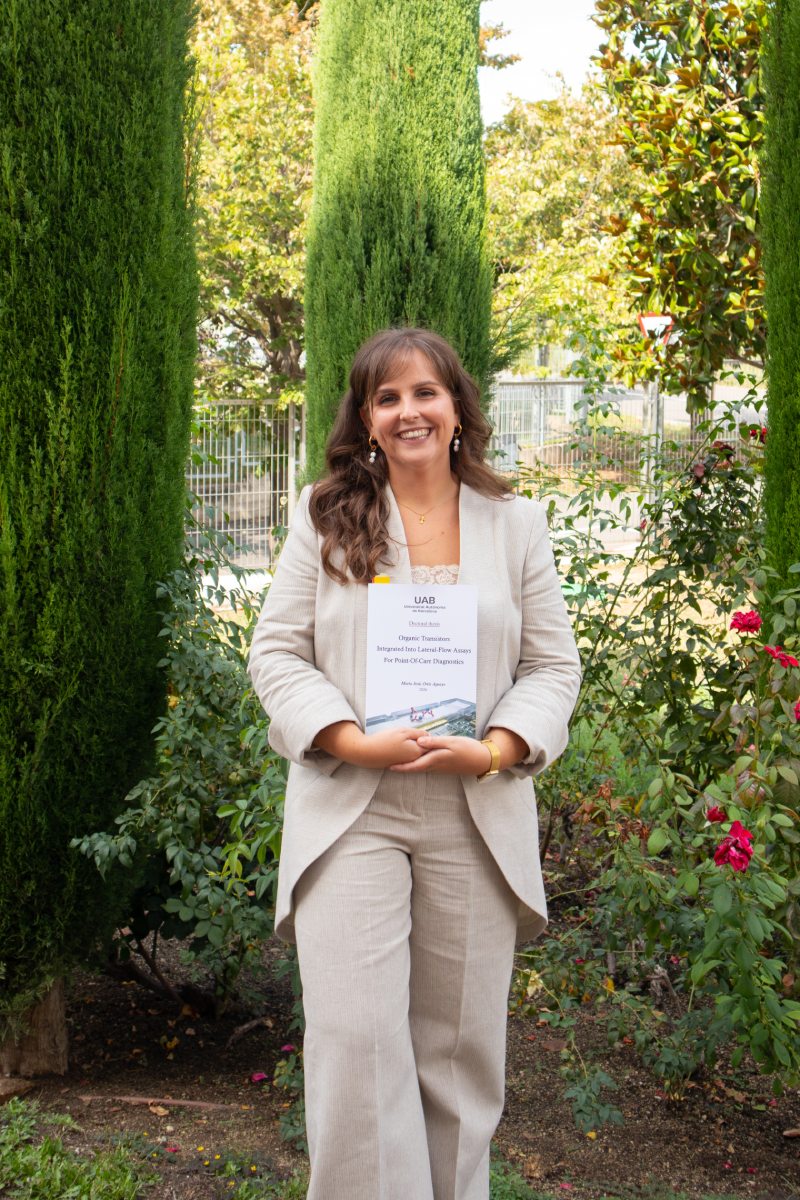
María Jesús Ortiz at ICMAB garden on the day of his thesis | ICMAB-CSIC
Abstract
This thesis exploits the use of Electrolyte – Gated Organic Field Effect Transistors (EGOFETs) for the development of ultrasensitive, label – free biosensing platforms and their translation into portable diagnostics. Hybrid sensing architectures integrating simple EGOFET devices with LF paper fluidics have been developed, enabling reusable, highly portable, and cost‑effective point‑of‑care (POC) tests. The synergy between organic electronics and capillary driven paper microfluidics thus establishes a robust foundation for the next generation of digital, low cost POC diagnostic technologies, expanding their applicability from clinical biomarker detection to fundamental studies of molecular recognition.
Supervisors
- Marta Mas, ICMAB-CSIC
- Carme Martínez, IMB-CNM-CSIC
PhD Committee
- President: Francesca Leonardi, IMEC, The Netherlands
- Secretary: Sergi Brosel Oliu, IMB-CNM-CSIC, Spain
- Vocal: Giulio Rosati, Eurecat, Spain
Read more
ICMAB - María Jesús Ortiz will defend her PhD thesis on 18 September 2026

Oriol
22 September 2026