

What was the focus of your PhD research? Can you explain it to a non-scientific audience?
My PhD focused on developing better ferroelectric materials based on hafnium oxide, a material already used in modern microelectronics. Ferroelectric materials can store information using electric polarization, making them promising for future non-volatile memories and low-power electronic devices. I investigated how chemical doping and interface engineering can improve their performance, reliability, and scalability for next-generation electronic applications.
Can you briefly summarize the main findings or contributions of your research? You can give us some examples.
My research demonstrated that yttrium is a highly effective dopant for stabilizing ferroelectric hafnium oxide in high-quality epitaxial thin films, enabling robust ferroelectricity over a wide thickness range. I also showed that interface engineering using nanolaminate architectures and ultrathin oxide layers can significantly influence polarization switching, retention, leakage current, and device reliability. These studies provided a better understanding of how interfaces and material design control ferroelectric behavior.
Why do you think your research is important, and how could it impact your field or society?
Ferroelectric hafnium oxide is considered one of the most promising materials for future memory and computing technologies because it is compatible with current semiconductor manufacturing. Improving its reliability and understanding its fundamental behavior are essential steps toward developing faster, more energy-efficient electronic devices, including memories, sensors, and neuromorphic computing systems.
What was one of the most challenging aspects of your PhD journey, and how did you overcome it?
One of the biggest challenges was understanding the complex relationship between crystal structure, interfaces, and electrical properties. Many experiments required careful optimization over long periods, and unexpected results often led to new questions. I learned to be patient, systematic, and persistent, relying on discussions with my supervisors and collaborators to gradually solve these challenges.
Why did you end up at ICMAB? And what do you think you will miss the most from this institute?
I joined ICMAB because of its strong reputation in materials science and its excellent research on functional oxide thin films. It provided an ideal environment to work on cutting-edge ferroelectric materials using advanced thin-film growth and characterization techniques. What I will miss the most is the collaborative atmosphere, the supportive colleagues, and the opportunity to interact with researchers from different scientific backgrounds.
What’s next for you after completing your PhD? Do you have any upcoming projects or goals?
I plan to continue my research as a postdoctoral researcher, focusing on advanced electronic materials and devices. My goal is to further develop innovative materials for future low-power electronics while expanding my expertise in device physics and reliability. I am also interested in strengthening collaborations between academia and industry.
How has completing this PhD changed you, either professionally or personally?
Professionally, it has strengthened my ability to think critically, solve complex scientific problems, and work independently while collaborating with multidisciplinary teams. Personally, it has taught me resilience, patience, and adaptability. The PhD has been a challenging but rewarding journey that has helped me grow both as a researcher and as a person.
What advice would you give to someone just starting their PhD journey?
Live as a human first, and be a researcher second. A healthy work-life balance doesn't hold you back—it actually helps you become a more creative, productive, and successful researcher. Stay curious, be patient, ask questions, and don't be discouraged by setbacks. Persistence matters more than perfection, and the PhD is a marathon, not a sprint.
Why did you become a scientist? Which have been your role models that inspired you to pursue a PhD?
I have always been fascinated by understanding how materials work and how scientific discoveries can lead to technological innovation. This curiosity motivated me to pursue research in materials science. Throughout my academic journey, I have been inspired by dedicated professors, mentors, and researchers whose passion for science and commitment to discovery encouraged me to continue toward a PhD.
Who or what helped you the most during your PhD journey, and is there anyone you'd like to thank?
I am deeply grateful to my supervisors, Dr. Ignasi Fina and Prof. Florencio Sánchez, for their guidance, encouragement, and continuous support throughout my PhD. I would also like to thank all my collaborators and colleagues at ICMAB and our partner institutions for their valuable discussions and teamwork. Finally, I am especially grateful to my family for their unconditional love, encouragement, and support during this journey.
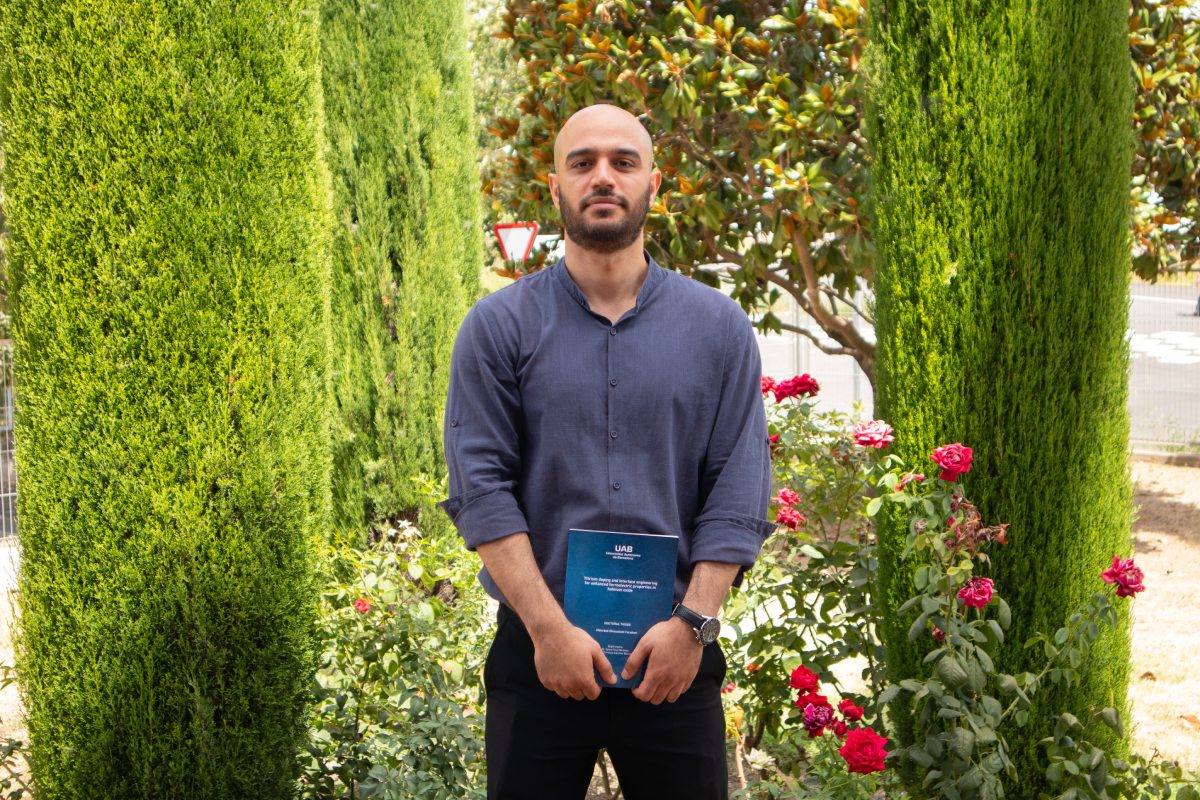
Mehrdad Ghiasabadi at ICMAB garden on the day of his thesis | ICMAB-CSIC
Abstract
Stabilizing the metastable orthorhombic ferroelectric phase of HfO2 is critically dependent on both chemical doping and material’s architecture. This thesis explores three complementary strategies to achieve robust and reliable ferroelectricity in epitaxial HfO2 based films, namely, doping, interface engineering, and hybrid nanolamination. First, yttrium is investigated as a dopant alternative to Zr to enhance phase stability and polarization retention, in particular for in thick films. Epitaxial Hf0.93Y0.07O2-x films grown on SrTiO3(001) and SrTiO3(110) substrates exhibit strong remanent polarization across the entire explored thickness range (5.3−108 nm), in contrast to films doped with alternative dopants, which show decreased polarization for increasing thickness. Transmission electron microscopy reveals a columnar structure and coexistence of ferroelectric orthorhombic and non-ferroelectric monoclinic phases. These results demonstrate that yttrium is intrinsically an effective dopant for stabilizing the orthorhombic ferroelectric phase and achieving robust polarization, independently of film thickness. Second, interface engineering is employed as a complementary to doping strategy to control the ferroelectric response of La-doped HfO2 (LHO) films. ZrO2 bottom layers and top layers are introduced. In particular, it is observed that ZrO2 top capping effectively suppresses leakage current, indicating a reduced density of interface-related defects. ZrO2-capped LHO samples show lower coercive fields, faster switching down to 90 ns, and markedly improved endurance compared to uncapped films. These results demonstrate the positive role of ZrO2 capping layer in improving the reliability of HfO2 based ferroelectric films. Third, nanolamination is explored. Wake-up-free Hf0.5Zr0.5O2 (HZO)/HfO2 nanolaminates with 1 nm HfO2 interlayers exhibit enhanced remanent polarization and higher dielectric permittivity compared to single-layer HZO films, although they show slightly slower switching and more severe fatigue. Further performance improvements are achieved by incorporating subnanometer La-doped HfO2 layers as interlayers in LHO/HZO nanolaminates. These samples retain a continuous columnar structure, show high endurance and retention, and maintain rapid switching dynamics compared to single layer and HZO/HfO2 nanolaminates. Moreover, they exhibit reduced leakage and large iii non-ferroelectric resistive switching up to 108%, making them attractive candidates for multifunctional memory architectures. Together, these three approaches—doping, interface engineering, and nanolamination— offer a comprehensive framework for tuning the functional and reliability properties of epitaxial HfO2-based ferroelectrics. The findings, achieved with epitaxial films, provide crucial insights into the fundamental mechanisms governing phase stability and domain dynamics and can guide new strategies for the development of advanced complementary metal-oxide semiconductor (CMOS)-compatible memory and neuromorphic computing devices.
Supervisors
- Florencio Sánchez, ICMAB-CSIC
- Ignasi Fina, ICMAB-CSIC
PhD committee
- President: José P. B. Silva, University of Minho, Portugal
- Secretary: Carlos Frontera, ICMAB-CSIC, Spain
- Vocal: Suzzane Lancaster, CICnanoGUNE, Spain
Read more
ICMAB - Mehrdad Ghiasabadi will defend his PhD thesis on 24 July 2026
