

What was the focus of your PhD research? Can you explain it to a non-scientific audience?
Current computer architectures are reaching their limits in terms of energy efficiency. My work focused on the investigation of a certain material combination that could help to overcome these limitations by increased data storage density and applications in novel computing architectures that are inspired by the most energy efficient computer we know to date: the human brain.
Can you briefly summarize the main findings or contributions of your research? You can give us some examples.
The work can be divided into three main parts. First, we observed non-volatile changes in the resistance states of YBCO/LSMO heterostructures. Following this initial phenomenological observation, we investigated the current–voltage characteristics to gain insight into the underlying physics of the heterostructure. Finally, this improved understanding enabled us to develop a mathematical model that reproduces key experimental findings and could facilitate the design of more complex circuits through LTspice-compatible simulations.
Why do you think your research is important, and how could it impact your field or society?
On the one hand, the devices developed in this work hold potential for cryogenic neuromorphic circuits, which could eventually intersect with quantum computing by providing a means of controlling quantum processors. On the other hand, the pairing mechanism in high-temperature superconductors remains one of the major open questions in condensed matter physics. The ability to precisely control the different electronic phases of a high-temperature superconductor simply by applying a voltage could provide new opportunities to investigate its phase diagram across a broad range of doping levels.
What was one of the most challenging aspects of your PhD journey, and how did you overcome it?
It would be easier to answer this question if it were asked the other way around. The PhD journey was a complex experience, with numerous obstacles at every stage. From developing the initial idea and giving my first talk at a major conference to navigating the final bureaucratic hurdles, there were plenty of challenges along the way. The amazing people I met here in Barcelona, especially at ICMAB and UAB, coming from all over the world, helped me get through these difficulties without getting overwhelmed.
Why did you end up at ICMAB? And what do you think you will miss the most from this institute?
I wanted to leave Germany and get to know a new culture. Spain was my grandpa’s favourite holiday destination, so Barcelona seemed like a great place to go. Therefore, I contacted Anna by E-mail and fortunately she gave me the chance to come here and to learn from her and the Spanish/Catalan culture. I am going to miss my friends. :’)
What’s next for you after completing your PhD? Do you have any upcoming projects or goals?
Currently I am searching for new positions, but I don’t want to rush for the next step. There are more important things in live then to constantly increase its velocity. Because the journey has been exhausting, for the moment a short break seems to be just perfect. I would love to start a new chapter with fully recovered energy in the beginning of next year.
How has completing this PhD changed you, either professionally or personally?
It has changed me a lot in every way.
What advice would you give to someone just starting their PhD journey?
Believe in yourself, trust your intuition, and stand up for your opinions. At the same time, remain open to listening to others. Sometimes, I believe, the world is trying to tell you something, so stay aware of your surroundings and be open to the signs along the way.
Why did you become a scientist? Which have been your role models that inspired you to pursue a PhD?
Science is simply fascinating. I am driven by curiosity and consider learning one of the most important things in life, so science seems like a natural fit for me. There is always something new to discover and understand. What I find particularly beautiful is that the laws and phenomena we study are not man-made, as in economics or politics, but are part of something much bigger than humanity itself. My high-school chemistry teacher, Mr Wax, and my master's thesis supervisors, Daniel Bothner and Reinhold Kleiner, inspired me to pursue this path.
Who or what helped you the most during your PhD journey, and is there anyone you'd like to thank?
I refer to the acknowledgements of my thesis for this matter, and I hope I have not forgotten anybody! Anyhow, a special thanks goes to Ferran Valles and Aleix Barrera, without whom I might have left Spain after the first year, and, during the later stages of my stay, to Karla Mena.
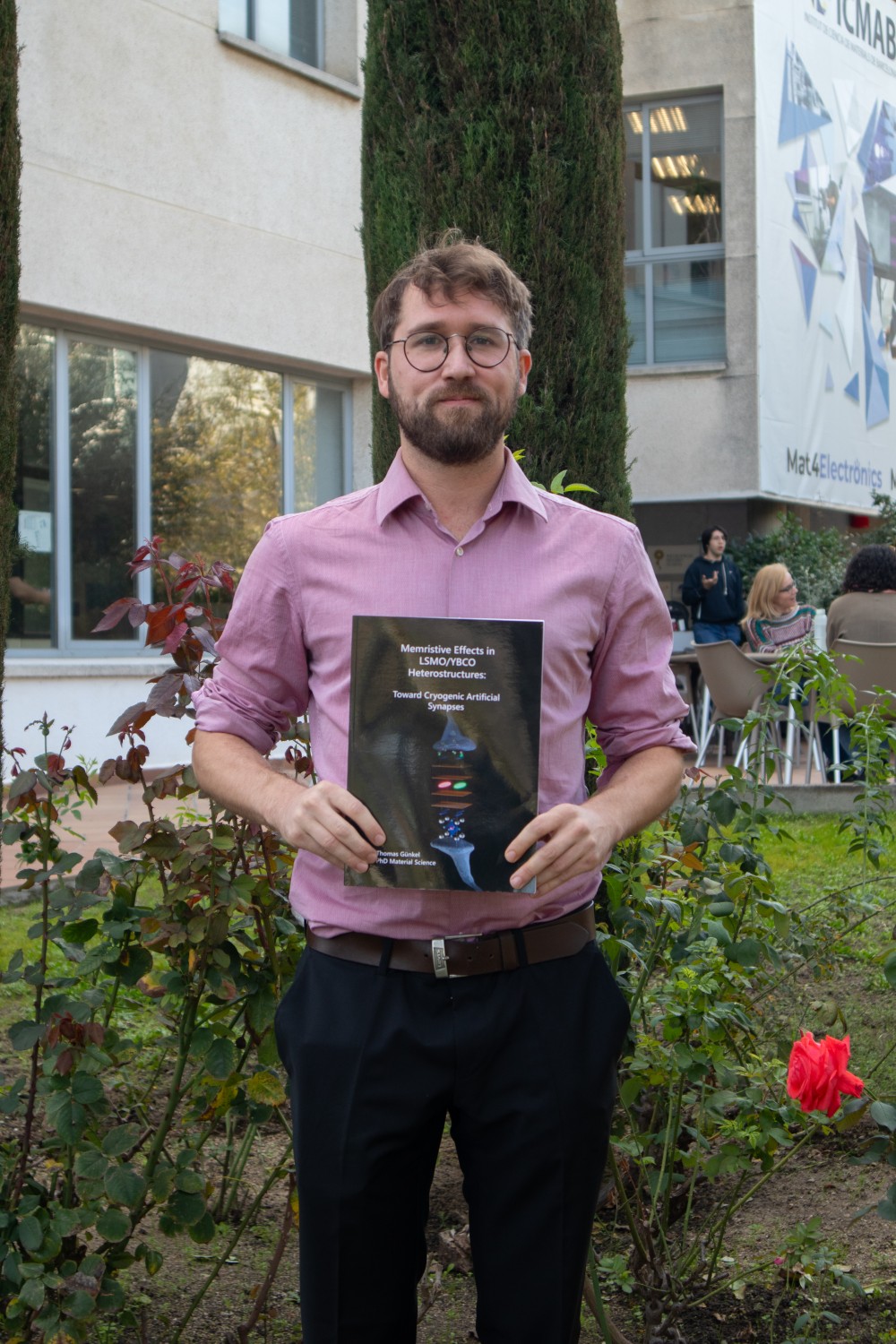 Thomas Günkel at the ICMAB garden on the day of his thesis | ICMAB-CSIC
Abstract
This thesis investigates memristive effects in heterostructures of the high-temperature superconductor YBa₂Cu₃O₇–δ and ferromagnetic La₀.₇Sr₀.₃MnO₃. It presents the phenomenological observation of memristive behavior in this material system and investigates the underlying conduction mechanism, with space-charge-limited conduction identified as the dominant transport mechanism. Building on these results, a compact circuit model compatible with LTspice is developed to reproduce the experimentally observed memristive behavior. The demonstrated synaptic-like functionality at cryogenic temperatures highlights the potential of cuprate-based memristive devices as circuit elements for future cryogenic neuromorphic hardware.
Supervisors
- Anna Palau, ICMAB-CSIC
- Jordi Suñé, UAB
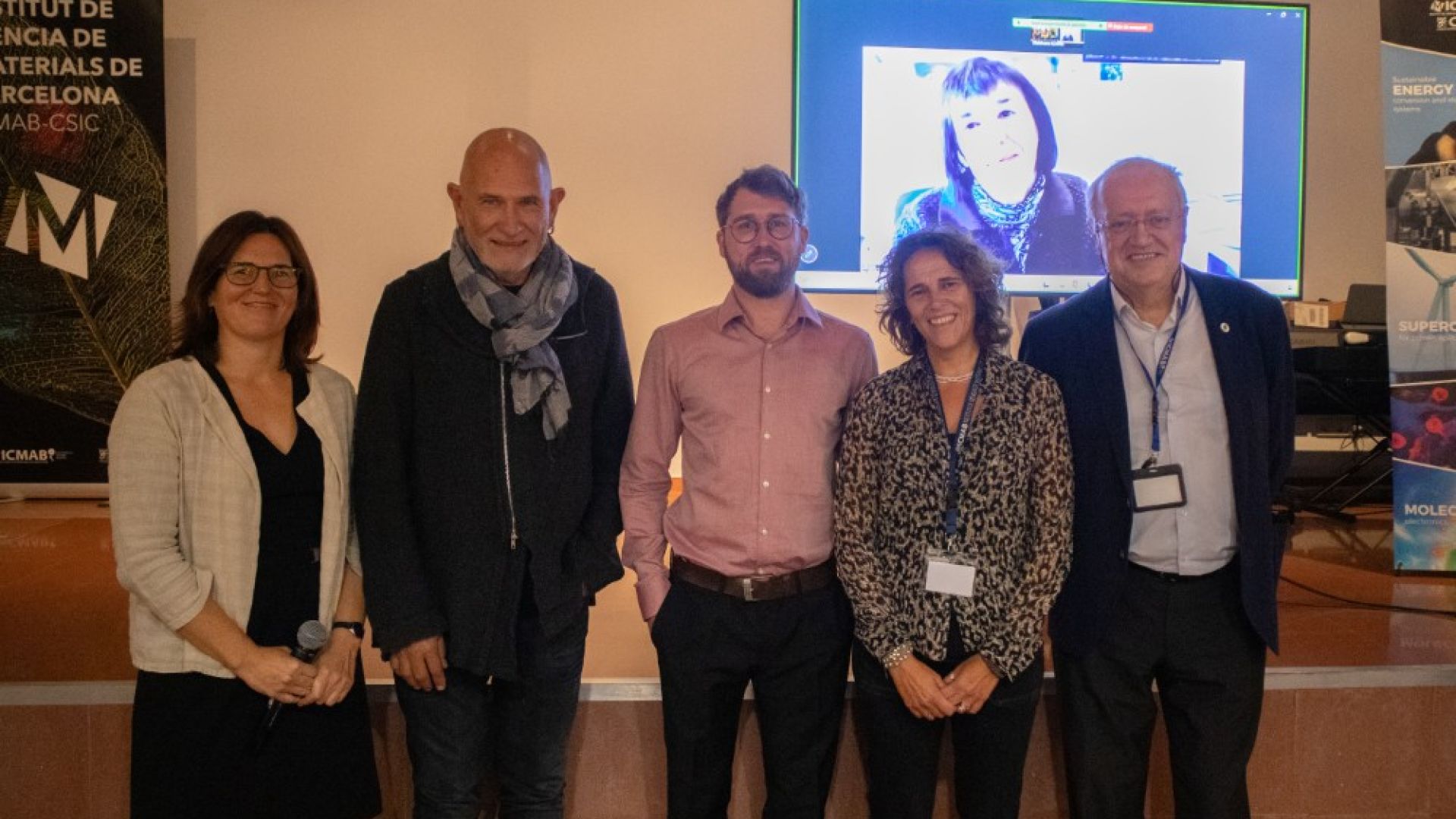
PhD committee
- President: Mónica Burriel, INMA, Spain
- Secretary: Xavier Obradors, ICMAB, Spain
- Vocal: María Helena Castán, Universidad de Valladolid, Spain
Read more
ICMAB - Thomas Günkel will defend his PhD thesis on 23 October 2026