

What was the focus of your PhD research? Can you explain it to a non-scientific audience?
Every photo, message and file we save is stored as billions of tiny “0” and “1” states in memory chips. Ferroelectric materials are very attractive for this: they contain tiny electric dipoles that can be flipped up or down with a small voltage, and they keep their state even when the power is off. Hafnium oxide (HfO2) is especially interesting, because it is already used in today’s silicon chips, so it could be integrated into real devices quite easily. The problem is that the ferroelectric form of HfO2 is not its natural, most stable structure, so it is not easy to obtain and control. In my PhD, I grew extremely thin crystalline films of hafnium–zirconium oxide, only a few nanometers thick (thousands of times thinner than a human hair), layer by layer using pulsed laser deposition. Then I studied which growth conditions make the ferroelectric response appear and become stronger, and how to be sure that what we measure is really ferroelectricity and not something that only looks like it.
Can you briefly summarize the main findings or contributions of your research? You can give us some examples.
My thesis has three main contributions. First, I showed that in epitaxial Hf0.5Zr0.5O2 (HZO) films, the ferroelectric phase is essentially decided during high-temperature growth. Once it is formed, it is very stable, and cooling the film in oxidizing or reducing atmospheres does not change it. This is quite different from polycrystalline films, where post-annealing plays a critical role. Second, I studied how substrate orientation, growth atmosphere and film thickness work together. Films grown on SrTiO3(110) substrates show higher polarization than those on SrTiO3(001), and growing them under slightly reducing conditions (O2/Ar mixture) enhances it further, reaching values above 30 μC/cm², close to the theoretical limit. The ferroelectric phase is favoured below about 10 nm thickness. Interestingly, I found no direct correlation between strain and polarization, which suggests that interface symmetry and oxygen chemistry play the key role, rather than strain. Third, I looked at the full Hf1-xZrxO2 series, from pure HfO2 to pure ZrO2. Some Zr-rich and ZrO2 films showed “giant” polarization values, up to around 50 μC/cm², far above what is physically expected. By combining different electrical techniques (DLCC and PUND), resistive switching measurements and piezo response force microscopy, I showed that these values come from extrinsic effects, mainly ionic movement and resistive switching, and not from intrinsic ferroelectricity.
Why do you think your research is important, and how could it impact your field or society?
Data storage and computing consume more energy, especially with the rapid growth of artificial intelligence. HfO2-based ferroelectrics are one of the most promising candidates for low-power, non-volatile memories, because they are compatible with the existing silicon technology and still work at the nanometer scale. My work helps to understand which parameters really control the ferroelectric properties of these films, which gives practical guidelines for engineering better materials and devices. I also think the last part of my thesis is important for the whole community: it shows that a large hysteresis loop does not automatically mean ferroelectricity, and it proposes a multi-technique way to distinguish real ferroelectric switching from artifacts. This can help avoid misinterpretations and make results in the field more reliable.
What was one of the most challenging aspects of your PhD journey, and how did you overcome it?
One of the most challenging parts was that many factors are coupled in these ultrathin films: thickness, substrate orientation, oxygen content, defects and interfaces all change at the same time, so it was difficult to separate their individual effects. To deal with this, we designed sample series where films were grown in parallel and only one parameter changed at a time, which made the comparison much more reliable. Another challenge was the unexpectedly huge polarization in the Zr-rich films. At the beginning it looked very exciting, but the values were simply too high to be true. Instead of taking the result at face value, I cross-checked it with several independent measurements until the physical picture was clear. This taught me a lot of patience, and to always stay critical of my own data.
Why did you end up at ICMAB? And what do you think you will miss the most from this institute?
I came to ICMAB because the FOXEM research group is one of the leading groups in the growth of high-quality epitaxial ferroelectric HfO2 films, with strong expertise in pulsed laser deposition and in the electrical characterization of ferroelectrics. It was the ideal place to work on the fundamental questions I was interested in.
What’s next for you after completing your PhD? Do you have any upcoming projects or goals?
After my PhD, I will continue my research career as a postdoctoral researcher in an institution of China. I am currently applying for postdoctoral positions in the field of ferroelectric materials and memory devices. My long-term goal is to keep working on functional oxide thin films and help bring new materials closer to real low-power electronic devices.
How has completing this PhD changed you, either professionally or personally?
Professionally, the PhD taught me how to plan experiments carefully, how to question my own results, and how to connect structure, growth conditions and device properties into a complete scientific story. I also learned to write papers, present my work at conferences and collaborate with people from different backgrounds. Personally, I have become more patient, independent and resilient. Research rarely goes as planned, and living and working abroad for several years has made me more open-minded and confident in facing new challenges.
What advice would you give to someone just starting their PhD journey?
Be curious, but also be critical, especially with results that look too good. Cross-check them with different techniques before getting excited. Don’t be afraid to ask questions and talk to people: your supervisors, colleagues and technicians know a lot, and many problems are solved much faster through discussion. Keep good records of your samples and measurements from day one, your future self-writing the thesis will thank you. And finally, remember that a PhD is a marathon, not a sprint: take care of your health and enjoy the moments outside the lab too.
Why did you become a scientist? Which have been your role models that inspired you to pursue a PhD?
I have always been curious about how things work, and during my studies I became fascinated by materials science, because it connects basic physics with real technologies that we use every day.
Who or what helped you the most during your PhD journey, and is there anyone you'd like to thank?
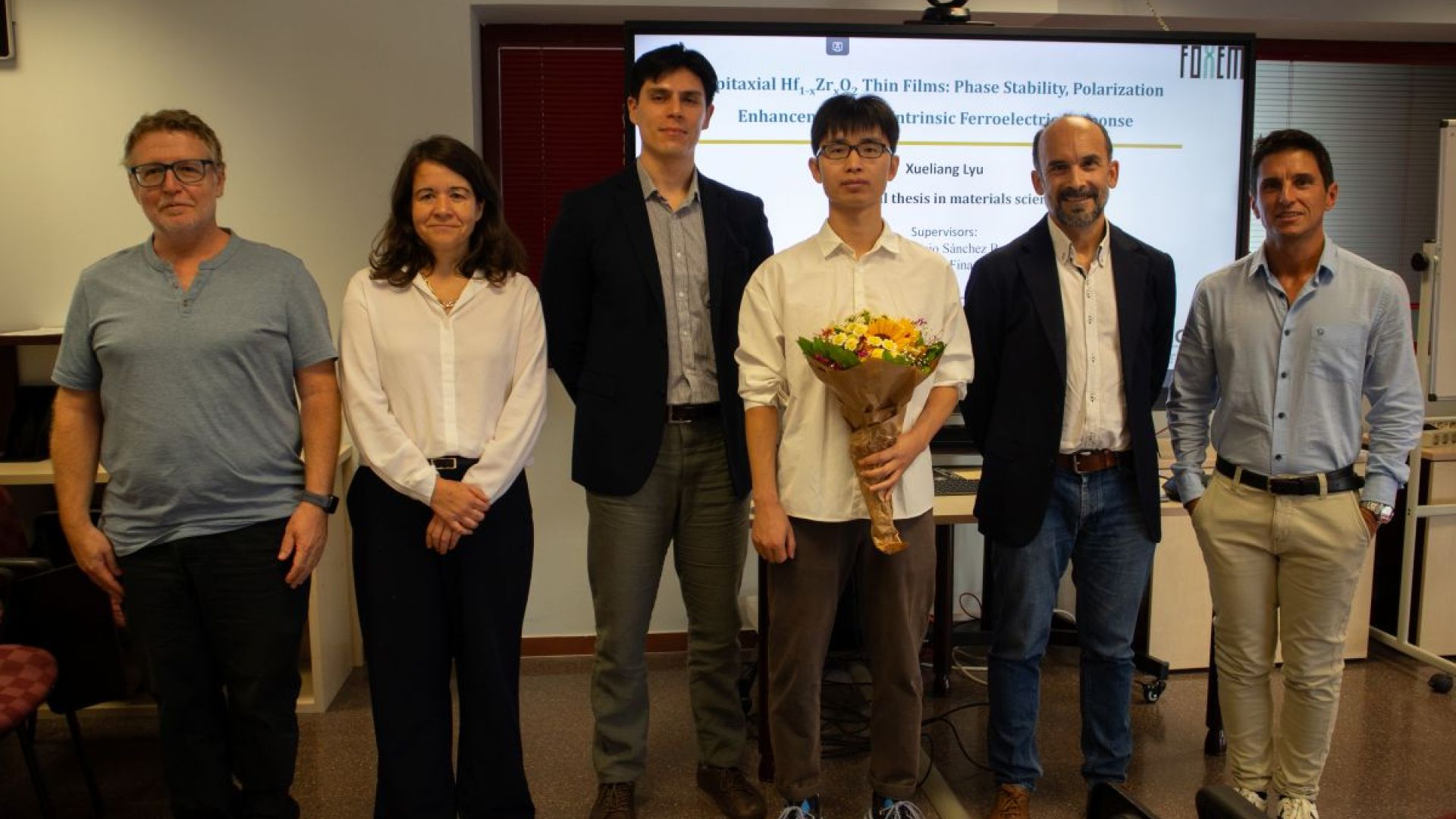
First, I would like to thank my supervisors, prof. Florencio Sánchez and Dr. Ignasi Fina, for giving me the opportunity to join their group, and for their guidance, patience and support throughout these years. I am also very grateful to all members of the FOXEM group, to the ICMAB scientific services for their help with XRD and PFM measurements. Finally, my deepest thanks go to my family and friends, for their unconditional support, encouragement and understanding during this journey.
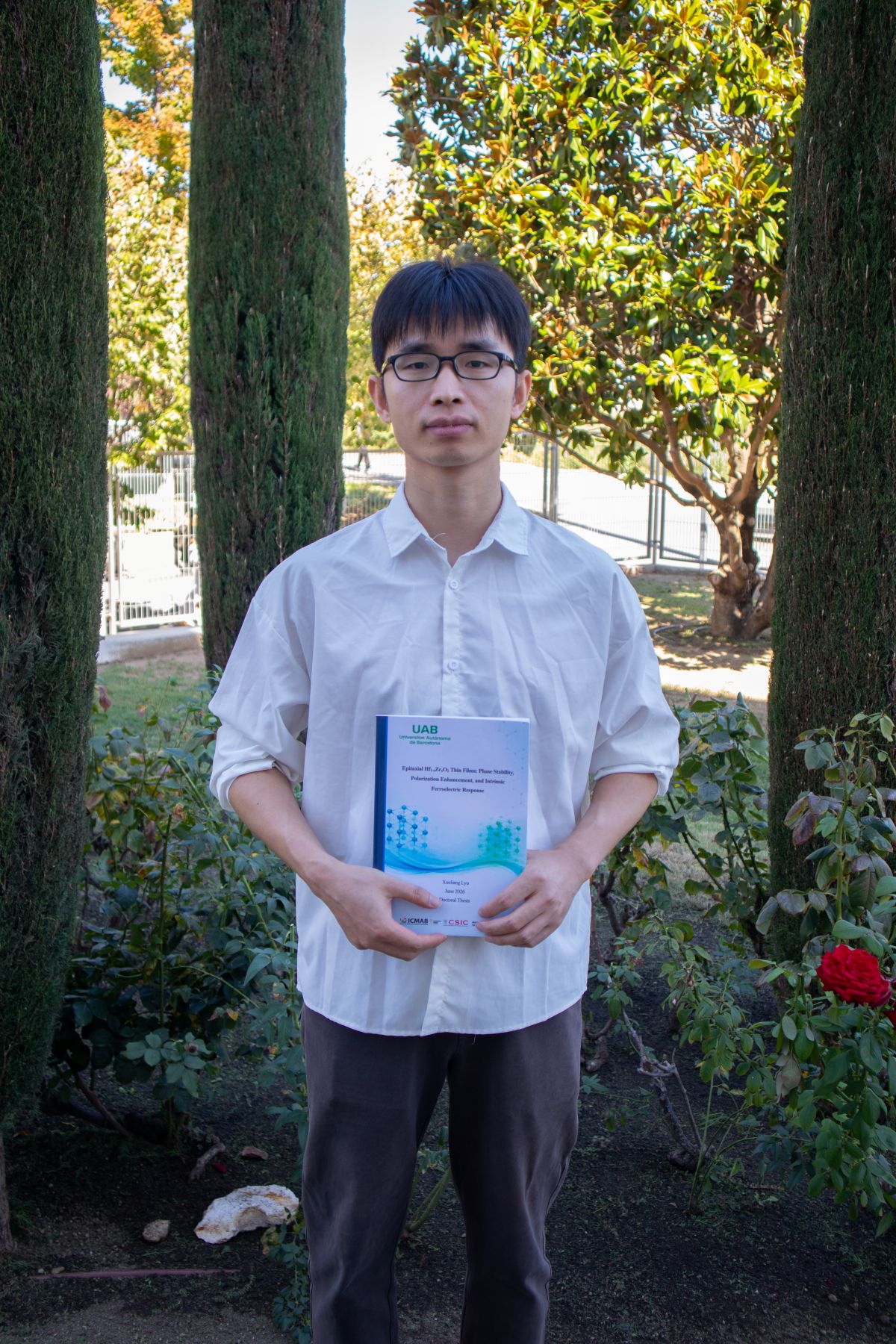
Xueliang Lyu at ICMAB garden on the day of his thesis | ICMAB-CSIC
Abstract
Ferroelectric HfO₂ is a leading candidate for CMOS-compatible non-volatile memory, yet the mechanisms governing its phase stability, polarization enhancement, and the distinction between intrinsic and extrinsic contributions remain unresolved. This thesis addresses these questions using high-quality epitaxial Hf₁₋ₓZrₓO₂ thin films grown by pulsed laser deposition on SrTiO₃ substrates with La₀.₆₇Sr₀.₃₃MnO₃ electrodes. First, the orthorhombic ferroelectric phase, once formed during growth, is shown to be structurally robust and largely insensitive to post-growth cooling atmosphere, unlike in polycrystalline films. Second, systematic control of substrate orientation, redox conditions, and thickness reveals that interface symmetry and reduced oxidation—rather than strain—govern polarization, which peaks at 6–10 nm and exceeds 30 μC/cm². Third, across the full Hf₁₋ₓZrₓO₂ composition range, anomalously high polarization in Zr-rich and ZrO₂ films is identified, through combined electrical and piezoresponse measurements, as an extrinsic resistive-switching artifact rather than genuine ferroelectricity, establishing criteria for its reliable evaluation.
Supervisors
- Florencio Sánchez, ICMAB-CSIC, Spain
- Ignasi Fina, ICMAB-CSIC, Spain
PhD Committee
- President: César Magén, INMA, Spain
- Secretary: Mireia Bargallo, IMB-CNM, Spain
- Vocal: Rubén Alcalá, NaMLab gGmbH, Germany
Read more
ICMAB - Xueliang Lyu will defend his PhD thesis on 23 September 2026

Oriol
25 September 2026