

What was the focus of your PhD research? Can you explain it to a non-scientific audience?
My PhD research focused on finding better ways to produce green hydrogen: a clean fuel made using renewable energy instead of fossil fuels. The main challenge with hydrogen production is that it usually requires a lot of electricity. So, I worked on designing new, more efficient materials called electrocatalysts that can make this process faster and require less energy.
Can you briefly summarize the main findings or contributions of your research? You can give us some examples.
In my PhD research, I developed three different electrocatalysts to improve the key reactions in green hydrogen production: hydrogen evolution, oxygen evolution, and alcohol oxidation. These catalysts helped make the water-splitting process more efficient and required less energy. One example is using alcohol oxidation to assist hydrogen generation, which further reduced the overall energy consumption.
Why do you think your research is important, and how could it impact your field or society?
My research is important because it helps make green hydrogen production more energy-efficient. By lowering the energy input required, we can use less electricity to produce more hydrogen, which serves as a clean and reliable form of energy storage. This is crucial for the future energy system — hydrogen can store excess renewable energy and provide backup power during sudden electricity failures or supply interruptions. In this way, the research contributes to building a more sustainable and resilient energy infrastructure.
What was one of the most challenging aspects of your PhD journey, and how did you overcome it?
One of the most challenging parts of my PhD journey was clearly defining the research objective. In the beginning, I spent a lot of time trying to understand what I truly wanted to achieve and how to approach it effectively. To overcome this, I read a large number of research papers and discussed ideas with my supervisor and colleagues. Through this process, I gradually clarified the goal of my work. Once I had a clear direction, everything became much smoother, and I could focus on achieving meaningful results.
Why did you end up at ICMAB? And what do you think you will miss the most from this institute?
Joining ICMAB was an important step in starting a new chapter after completing my PhD. I was attracted by its strong research environment and the opportunity to grow in an international and collaborative setting. What I will miss the most is the relaxed and supportive working atmosphere, as well as the wonderful relationships I’ve built with colleagues and friends here.
What’s next for you after completing your PhD? Do you have any upcoming projects or goals?
I haven’t made a final decision yet, and I see this as a good opportunity to take some time to reflect on my future direction. After such an intense PhD journey, I want to carefully consider the next step, whether it’s continuing in research, exploring industry opportunities, or developing new skills. It’s an exciting moment to see what comes next.
How has completing this PhD changed you, either professionally or personally?
The PhD journey is always challenging, but it’s through those challenges that we grow. Completing my PhD has taught me how to work more independently and think more critically. I’ve also learned to stay patient, organized, and professional that will benefit me in both my career and personal life.
What advice would you give to someone just starting their PhD journey?
Spend enough time at the beginning to clearly define your research objectives. Having a clear goal will make a huge difference, it can determine whether your PhD journey feels smooth or full of unnecessary struggles later on.
Why did you become a scientist? Which have been your role models that inspired you to pursue a PhD?
It has always been my dream to become a scientist — someone who can explore the unknown and contribute to society through research. I’ve been deeply inspired by many great scientists such as Chen Ning Yang, Tu Youyou, Albert Einstein, and others who dedicated their lives to discovery and innovation. Their achievements motivate me to keep learning and to pursue my own path in science.
Who or what helped you the most during your PhD journey, and is there anyone you'd like to thank?
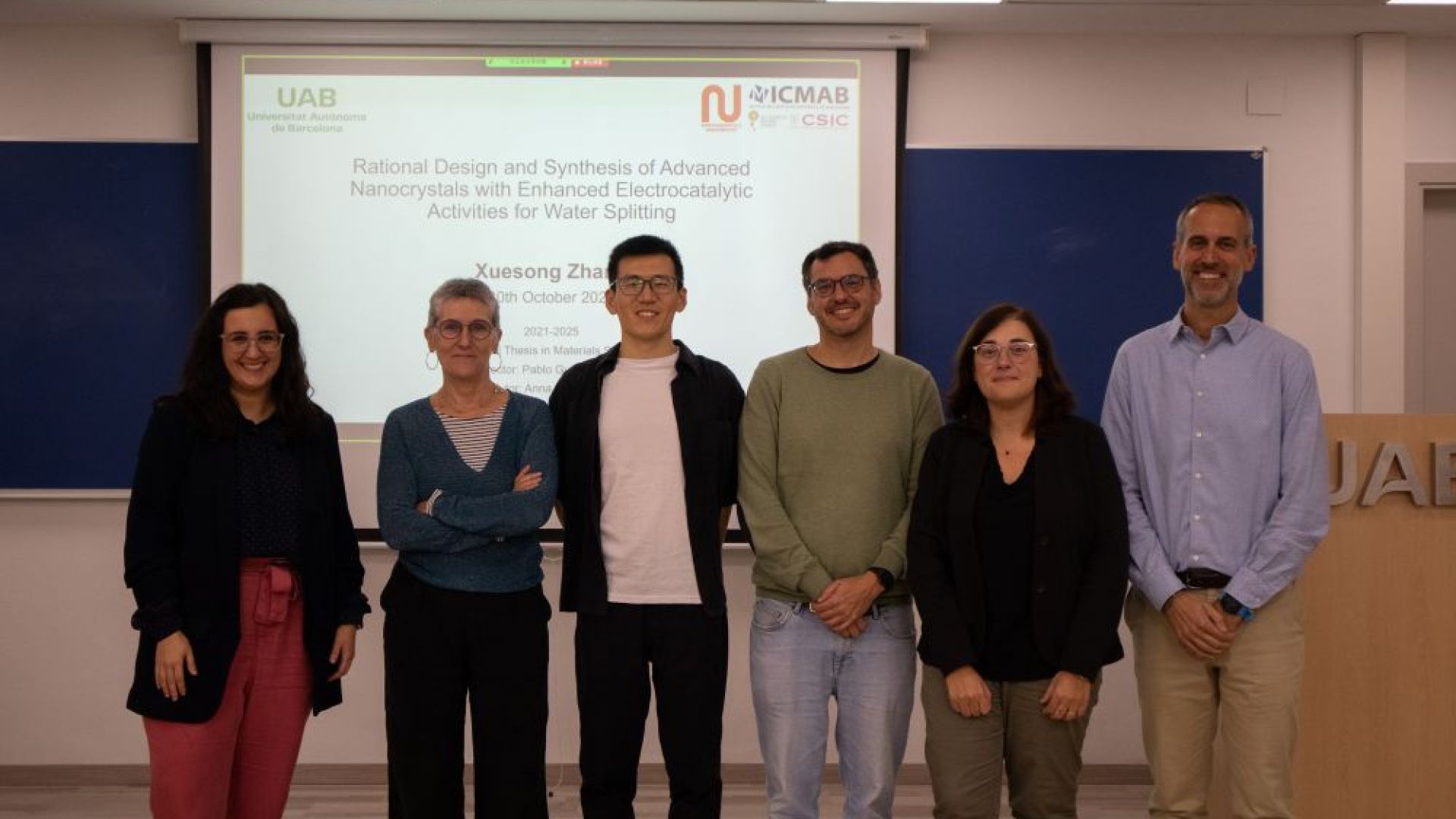
I would like to express my sincere thanks to my supervisor, Pablo Guardia, and my tutor, Anna Roig, for their continuous guidance and support throughout my PhD journey. I’m also very grateful to all my group members and friends for their help, encouragement, and the enjoyable moments we shared together.
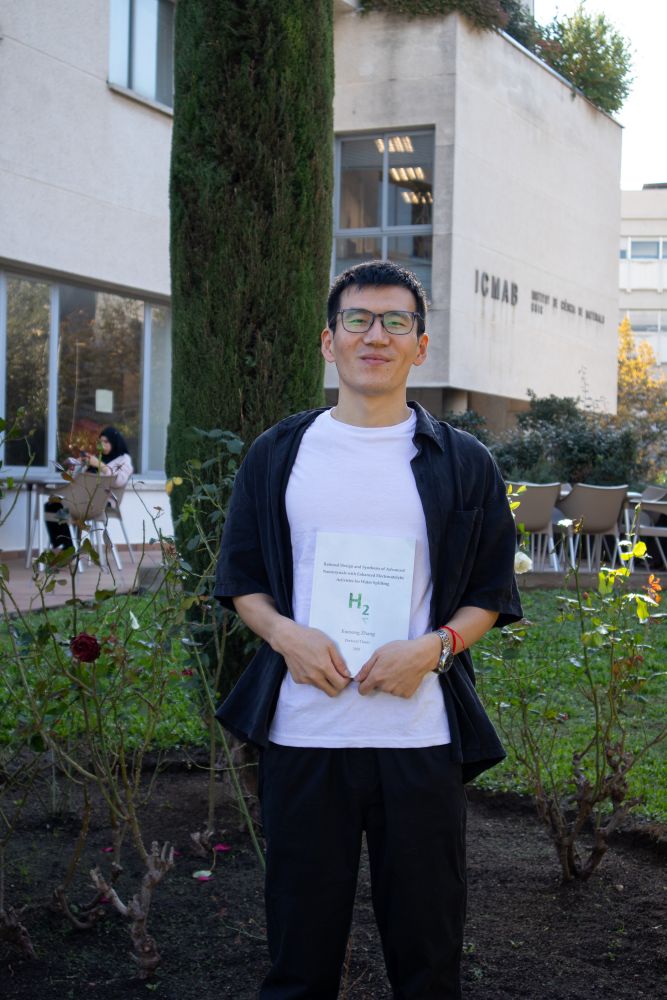
Xuesong Zhang at ICMAB garden on the day of his thesis | ICMAB-CSIC
Abstract
The global transition toward sustainable energy underscores hydrogen's potential as a carbon-neutral energy carrier. This thesis explores the development of cost-effective nanostructured electrocatalysts for water electrolysis, aiming to reduce reliance on noble metals. Au@Pt core-shell nanocrystals were produced by a microwave-assisted synthesis which achieved enhanced hydrogen evolution reaction (HER) activity with significantly reduced platinum loading. For the oxygen evolution reaction, co-doping of NiFe layered double hydroxides with boron and aluminum demonstrated improved activity and stability, even in seawater electrolysis.
Finally, the synthesis of Cu@CoO nanoheterostructures enabled efficient methanol and ethanol oxidation, offering alternative anodic reactions that add value to hydrogen production. Collectively, this work advances both the fundamental understanding and practical design of high-performance catalysts for sustainable hydrogen energy.
Supervisors
- Pablo Guardia, ICMAB-CSIC, Spain
- Anna Roig, ICMAB-CSIC, Spain
PhD Committee
- President: Teresa Andreu Arbella, UB, Spain
- Secretary: Lluís Soler Turu, UPC, Spain
- Vocal: María Escudero Escribano, UAB, Spain
Read more
ICMAB - Xuesong Zhang will defend his PhD thesis on 30 October 2025
