

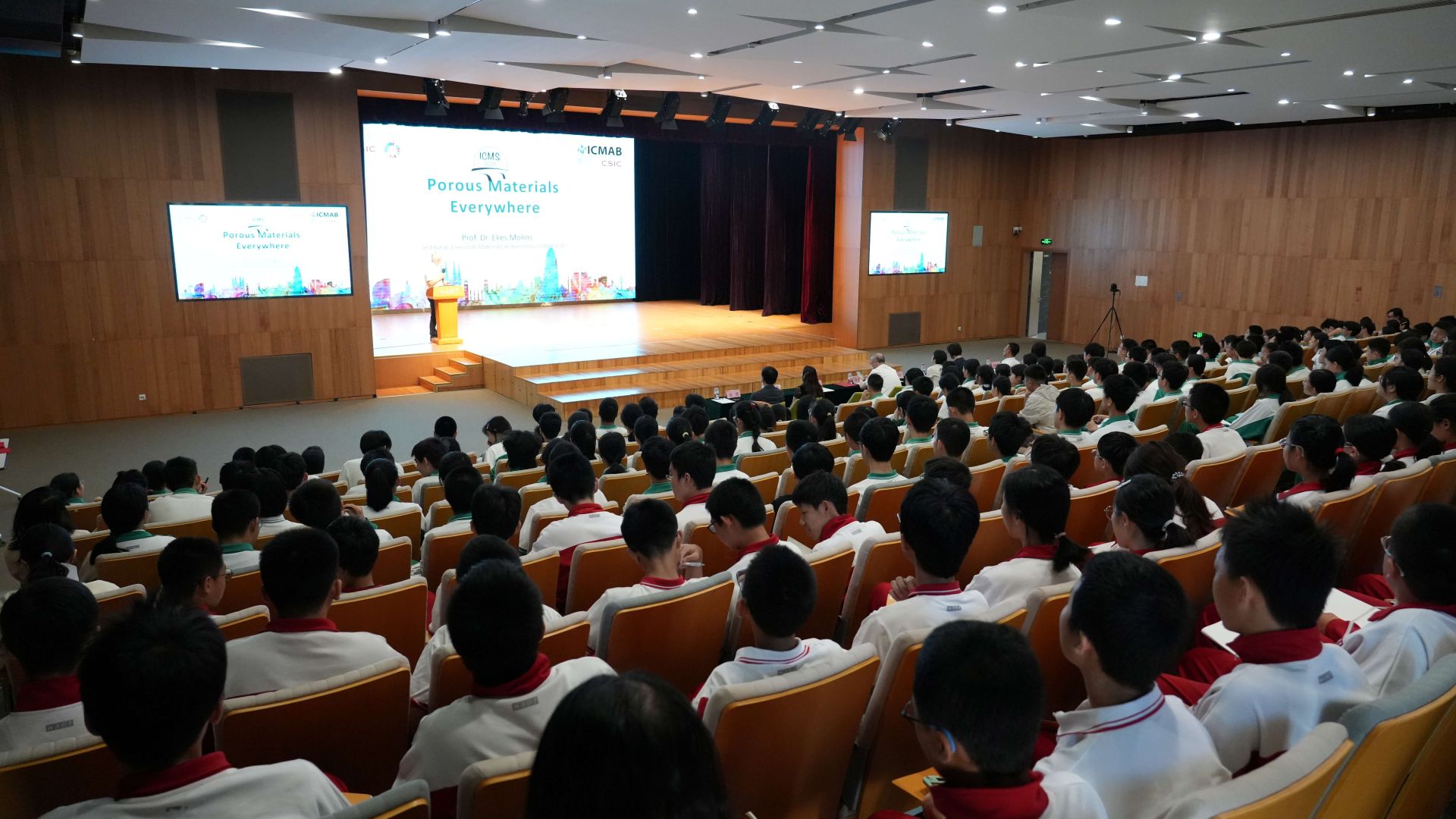
Last September, the World Organization of Science Literacy (WOSL) was launched in China, with 32 founding members from Asia, Europe, South America, Africa and Oceania. Established in June with the support of the China Association for Science and Technology (CAST), the organisation aims to promote scientific literacy internationally. Elies Molins, researcher at ICMAB and co-president of the World Federation of Scientific Workers (WFSW-FMTS), opened the conference with a plenary talk. We spoke with him about the urgency of scientific literacy, China's role in science and science communication, and the importance of international scientific organisations.
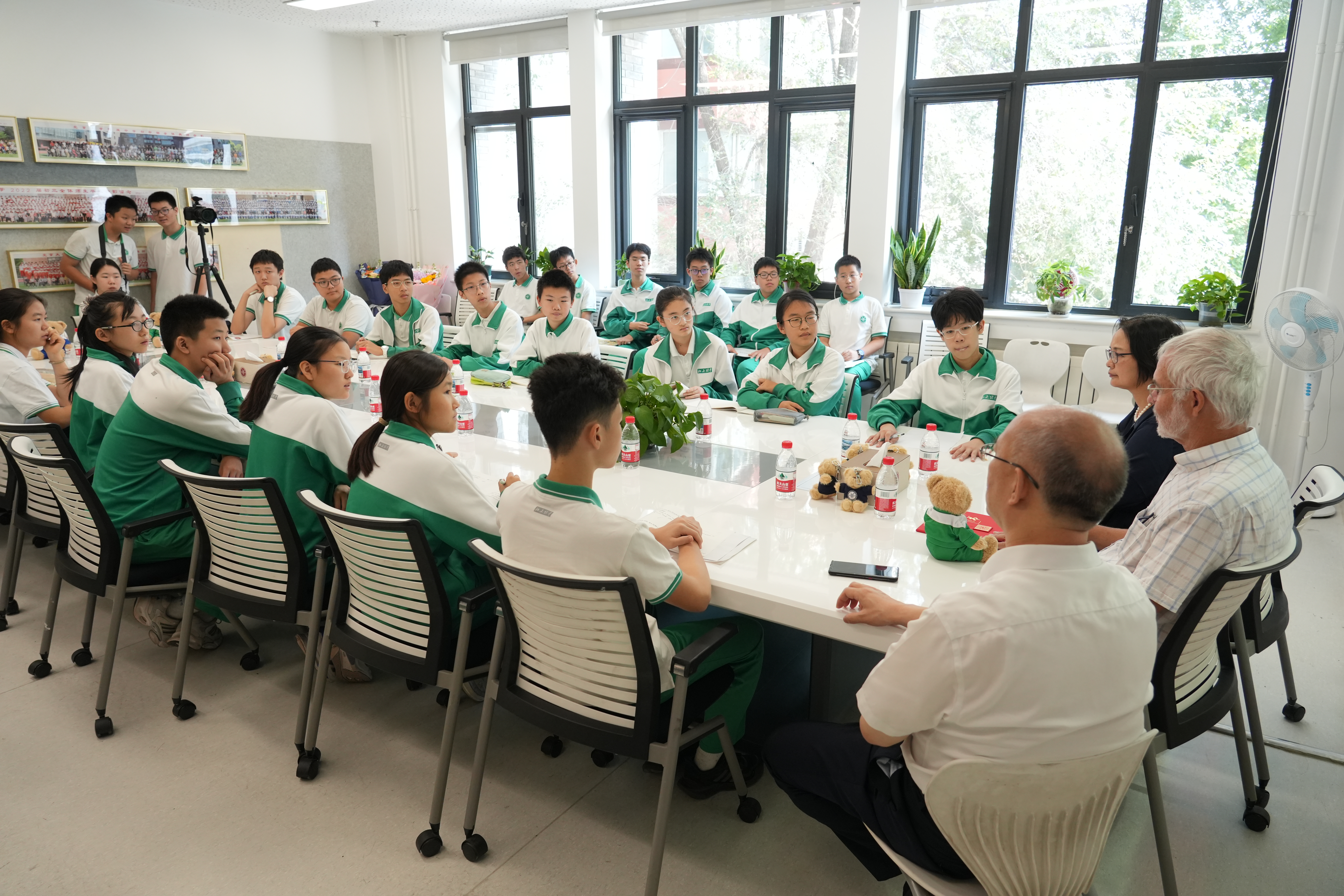
Elies Molins doing an outreach activity during his last visit in China
Could you explain the context in which the World Organization of Science Literacy emerged?
There is a fundamental idea that we need to bear in mind, especially at the present moment: humanity's enormous progress has been closely linked to advances in science and technology. Today, as this progress accelerates at an unprecedented rate, it is essential for a democratic system to function properly that people understand science. The quality of democracy is closely linked to the quality of information available and people's access to it. This is the underlying idea behind the World Conference on Science Literacy, which led to the launch of the World Organization of Science Literacy this year.
What kinds of organisations are involved in the WOSL?
The organisation brings together national academies of sciences, scientific associations, science museums, science communication companies and other organisations. There are 32 founding members, two-thirds of whom come from 19 countries across Asia, Europe, South America, Africa and Oceania. Most conference participants are science communicators working in museums, companies, public institutions and other organisations.
Ultimately, however, the target audience is anyone interested in improving scientific literacy, a concern shared by many countries. In China, for example, the proportion of the population with scientific literacy has risen by more than ten percentage points in less than fifteen years, reaching 16.74% in 2025.
China, and the China Association for Science and Technology in particular, plays a prominent role in this organisation. Could you tell us more about China's interest in scientific literacy?
Chinese society is strongly focused on technological progress and, for more than a decade, the government has considered scientific literacy essential. There is even a national law to promote it.
According to China Daily, the country has more than 1,900 science museums. There is also a strong movement to standardise the experiments and knowledge taught in these institutions and to promote a quality-assurance system for science education. From my experience, the topics covered are very much future-oriented, with practical applications that help people understand the implications of scientific and technological progress.
You are co-president of the WFSW-FMTS, a non-governmental organization of scientists that collaborates with UNESCO and was founded in 1946. Its main mission is to prevent the proliferation of nuclear bombs and promote the use of science to improve humanity's well-being. Frédéric Joliot-Curie was among its founders. What are the WFSW's objectives today, and how does it operate?
The WFSW's objective remains the same as when it was founded: to ensure that science and technology are used for the common good. We are a worldwide federation with members in 21 countries, including associations, trade unions and individual members.
We organise our work through working groups. The Peace and Disarmament group was very active during the Cold War and in campaigns against the proliferation of nuclear weapons. Another major group focuses on climate, water and energy and the Sustainable Development Goals (SDGs). A third concentrates on Africa, particularly through courses and projects that support scientific and technological development. We also have a group dedicated to women in science, which was very active for many years, although we are currently short of people to carry on the work.
In addition, there is a working group on research conditions. This group contributed to the first UNESCO recommendations on the status of scientific researchers, adopted in 1974 and revised in 2007.
We have also contributed to several UNESCO recommendations, including those on open science and the ethics of artificial intelligence. We also helped promote the first treaty establishing regulations for international waters.
We currently have another working group focusing on the federation's strategic plan and one on youth and research. Finally, we are preparing to establish a group to advocate internationally for public services in response to the growing trend towards privatization.
Being part of an international organization such as the WFSW is an enriching experience because it helps you understand the living conditions in your own country within a global context. For example, here we talk about improvements to public healthcare, while in other countries people are still fighting to obtain it. This is one of the federation's great strengths: we have learned to communicate to one another despite coming from very different backgrounds. You also come to see the extent to which the political conditions in each country shape science.
A classic question that remains unresolved: do you believe that scientific activity can be neutral, separate from the ways in which its results are used?
At the WFSW, we are strong advocates of fundamental science and the advancement of knowledge independently of its applications. Science is about discovering the world as it is. Morality comes into play when that knowledge is applied, through the intentions behind its use. A knife can be used to cut bread or to kill. This is where we appeal to scientists' sense of responsibility. We believe scientists should be involved in decisions about how science is used, because we are the people best placed to understand the harmful uses to which it can be put.
Finally, last Thursday you gave the Science for Peace seminar at ICMAB. What did you hope to convey to those who attended?
I wanted to convey a sense of concern, but also a sense of motivation. We are already concerned, and that concern has helped us raise public awareness of issues such as climate change.
We are living through an alarming period marked by AI, unchecked militarization, the climate crisis, pressure from the far right and social manipulation. And we know only a small part of the dangers that may lie ahead. But we cannot afford to stop informing ourselves. We must try to turn the paralysis caused by fear into enthusiasm for making the world a better place.
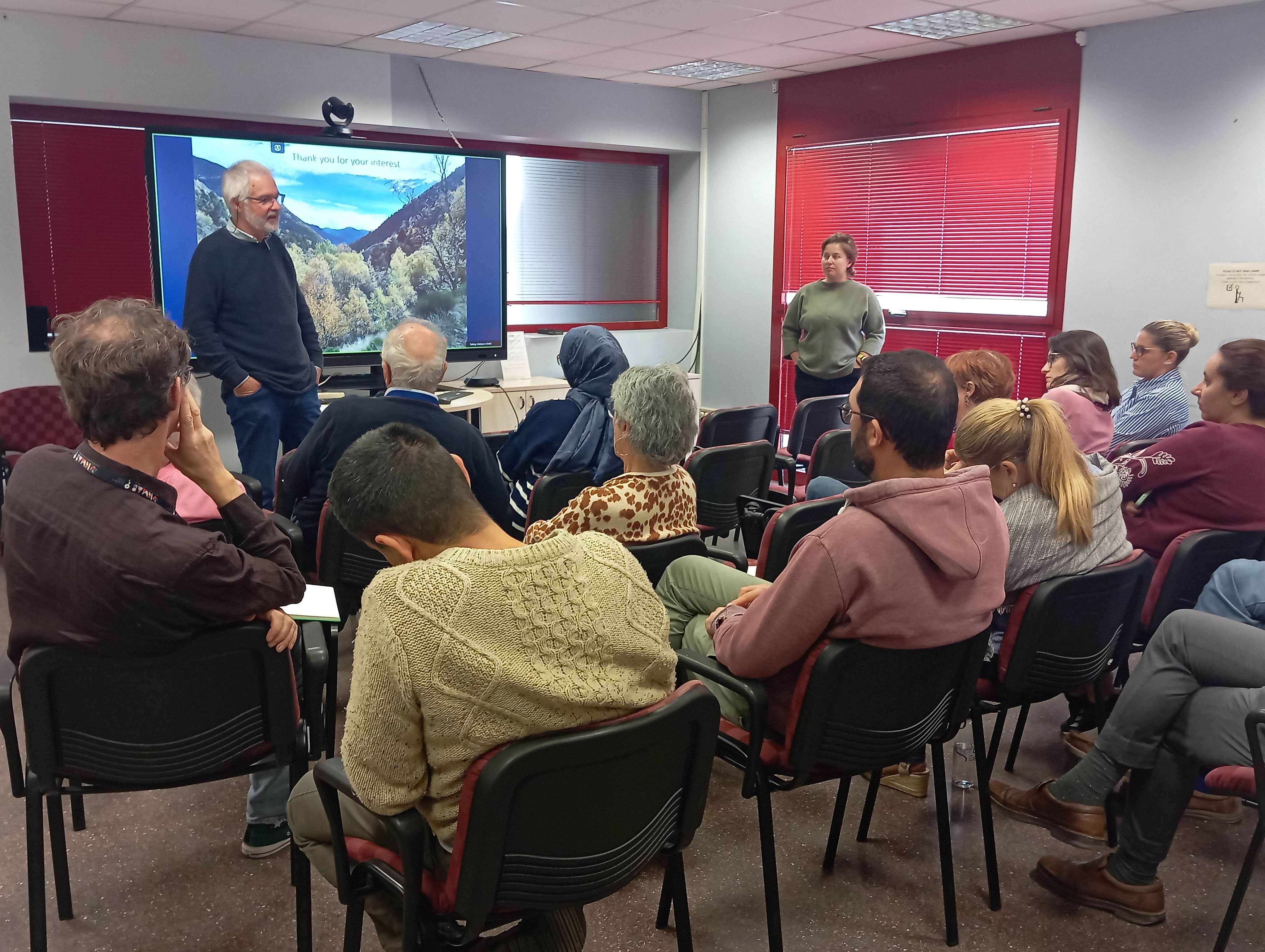
Elies Molins during the talk hosted by Ekaterina Khestanova
The video of the talk will soon be available online.
