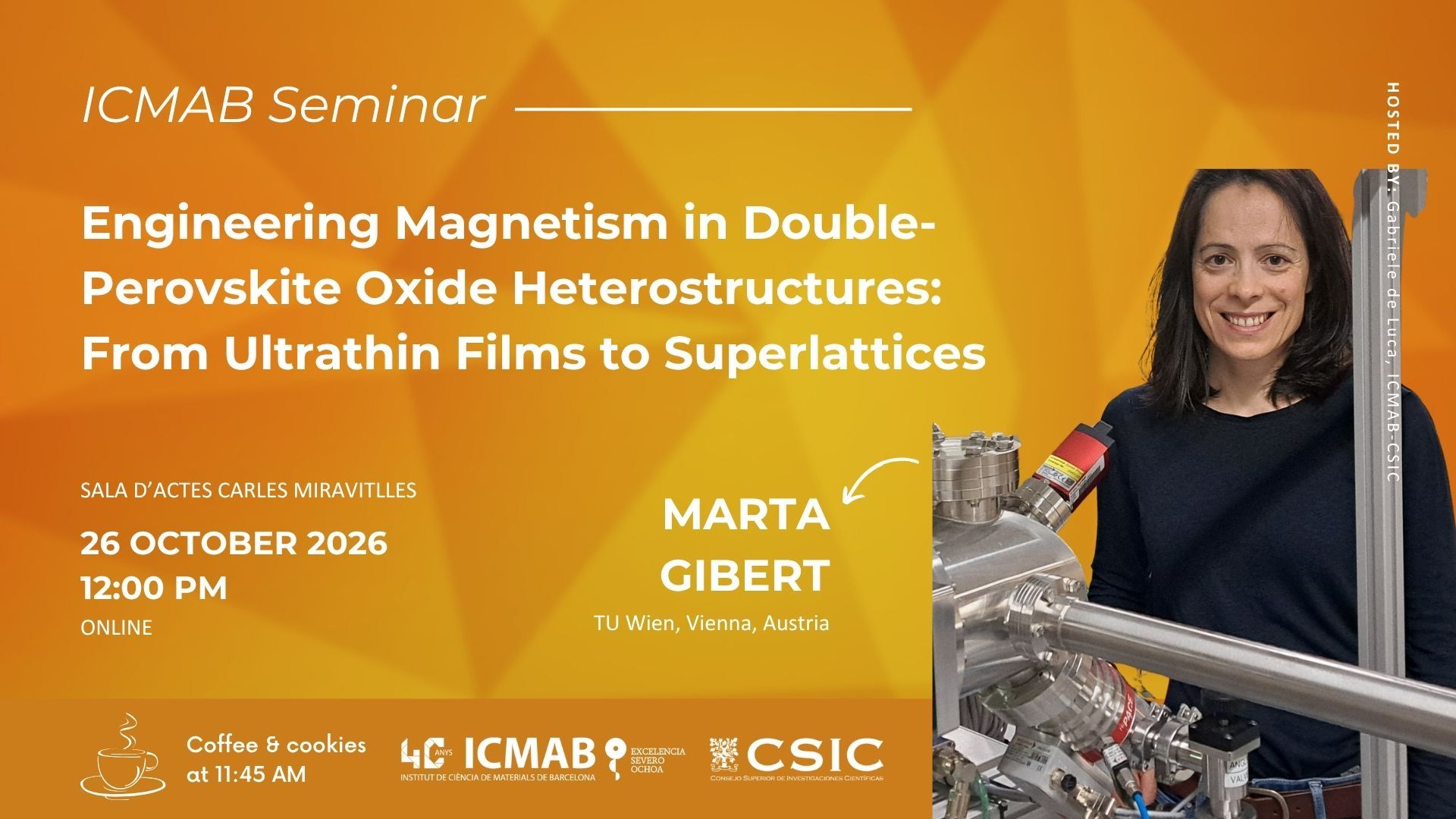
Engineering Magnetism in Double-Perovskite Oxide Heterostructures: From Ultrathin Films to Superlattices
Marta Gibert, TU Wien, Austria
Monday, 26 October 2026, 12.00 PM
ICMAB - Sala d'Actes MATGAS and online (Register here)
Abstract
Atomically engineered transition-metal-oxide heterostructures provide a versatile platform for probing and tailoring magnetic properties at the ultrathin limit and across interfaces. Materials that are both ferromagnetic and insulating are rare, yet they are key to spin-based and multifunctional devices. We focus on the double-perovskite family RE₂NiMnO₆ (RE = rare earth), one of the few families combining these two properties. La₂NiMnO₆ exhibits a Curie temperature (Tc) of 280 K, while Tc decreases linearly across the series with decreasing RE-radius.
In epitaxial RE₂NiMnO₆ thin films, ferromagnetism survives down to a few atomic layers, and we show that ferromagnetism is also retained in free-standing membranes.
To engineer the magnetic phase diagram and probe interfacial coupling, we fabricated atomically controlled superlattices (artificial stacks of alternating layers) of La₂NiMnO₆ and RE₂NiMnO₆ (RE = Nd, Sm), compounds with distinct Curie temperatures. Large-period superlattices display two separate magnetic transitions characteristic of the parent compounds. By contrast, reducing the layer thickness yields a single transition, indicating that short-period heterostructures behave as a single material. Interfaces also modify the magnetic exchange between neighboring layers.
Electron microscopy and first-principles calculations further reveal unequal antipolar cation displacements in these superlattices, consistent with a net electric polarization and suggesting hybrid improper ferroelectricity. Combined with robust ferromagnetism, these results highlight double-perovskite heterostructures as a promising platform for multiferroic devices,
Short bio
Marta Gibert studied Physics at the Autonomous University of Barcelona. She obtained her PhD in 2009 at the Institute of Materials Science of Barcelona (ICMAB-CSIC). During her PhD, she also did research internships at IFW Dresden (Germany), the University of Cambridge (UK) and Los Alamos National Laboratory (USA). She received the Physics Extraordinary PhD Award from the Autonomous University of Barcelona for her research on chemically grown self-assembled oxide nanostructures. In 2010, she joined the group of Prof. Triscone at the University of Geneva (Switzerland), first as a postdoctoral fellow and, from 2013, as maître assistant. In February 2018, she became a Swiss National Science Foundation (SNSF) Professor at the Physics Institute of the University of Zurich (Switzerland). Since September 2021, she has been full professor at the Institute of Solid State Physics at TU Wien (Vienna, Austria).
In 2016, Gibert was awarded the IBM Prize in Condensed Matter Physics of the Swiss Physical Society for “the study of unique magnetic coupling at oxide interfaces”. In 2020, she received the International Workshop on Oxide Electronics (iWOE) prize for excellence in oxides research.
Gibert’s research is motivated by the fascinating physical properties of complex oxides, including magnetism, metal-insulator transitions and superconductivity. By growing atomically controlled thin films and artificially layered structures, she focuses mainly on the electronic and magnetic properties that arise from reduced dimensionality and from reconstructions at oxide interfaces. Understanding the subtle atomic-scale structural and electronic mechanisms that control interface physics in complex oxides is key to designing materials with tailored properties.
Hosted by Gabriele de Luca, from the MULFOX research group (Materials for Electronics Research Line)
>>If you want to meet the speaker, please contact the host at This email address is being protected from spambots. You need JavaScript enabled to view it.