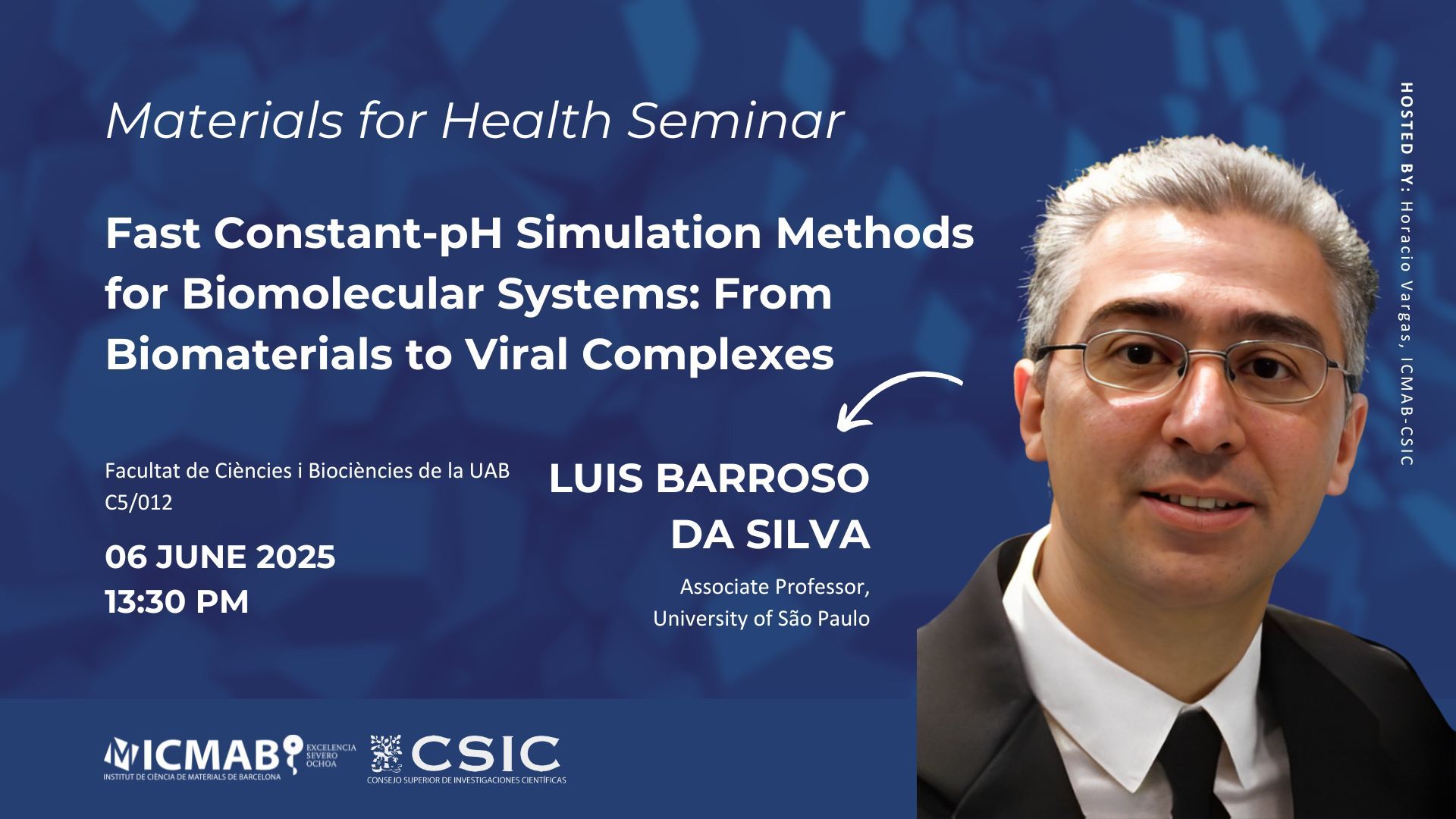
Fast Constant-pH Simulation Methods for Biomolecular Systems: From Biomaterials to Viral Complexes
Luis Barroso da Silva, University of São Paulo, Brasil
Friday 6 June 2025, 13.30 PM
Aula C5/012, Facultat de Ciències i Biociències de la UAB
Abstract
A wide range of challenges in biomolecular engineering (spanning disease understanding, diagnostics, therapeutics, pharmaceutical and food industry innovations, the design of (bio)functionalized materials, and bioseparation processes) depends on a detailed understanding of the fundamental physical forces governing molecular association and complex stability. Among these, pH stands out as a crucial physicochemical variable, especially due to its direct influence on macromolecular complexation, including the intriguing phenomenon of attraction between like-charged species, even at pH values far from their isoelectric point (pI).
In our team, we have focused on developing coarse-grained models that offer an efficient balance between capturing the essential constant-pH physics and enabling rapid simulations. In this talk, I will highlight key conceptual and computational advances that allow us to explore pH-dependent interactions at reduced cost, while preserving physical accuracy. I will review our constant-pH modeling approaches across different systems and illustrate how these tools, in synergy with structural bioinformatics and other simulation methods, have contributed to our understanding of spidroins, viral proteins (from flaviviruses and coronaviruses), and the rational design of antibodies.
Short bio
Associate Professor Fernando Barroso completed his Ph.D. in Theoretical Chemistry at the University of Lund, Sweden, under Bo Jönsson's supervision, studying statistical mechanics of biomolecular systems. After working as a Research Assistant in the Department of Physics at the State University of São Paulo, Brazil, he joined the Department of Physics and Chemistry at the University of São Paulo's (USP) School of Pharmaceutical Sciences in Ribeirão Preto as an Assistant Professor in 2001. He later advanced to Associate Professor in Molecular Biophysics at the Department of Biomolecular Sciences, where he specializes in protein electrostatics, Structural Bioinformatics, and Biophysical and Computational Virology. Since 2013, he has also served as a Visiting Scholar at North Carolina State University, USA.
His research centers on biomolecular interactions and data-driven science, with a current focus on developing computational tools for biomolecular systems. These tools are applied to study viral and food proteins, antibody engineering, and protein-RNA interactions. As Head of the Laboratory of Computational Biophysical Chemistry, he uses innovative technology to investigate molecular aspects of infectious diseases and to discover therapeutic agents, biomarkers, and methods for their controlled release. He maintains active scientific partnerships through regular visits to universities in Sweden, the USA, France, and Ireland.
This seminar is part of the Seminar Series on Biophysics: Multiscale Modeling, Experiments, and Machine Learning.
For more information, you can visit: https://sites.google.com/view/guzmanresearch/news?authuser=0
Hosted by Horacio Vargas Guzmán, from the MST group (Materials for Health Research Line)
>> If you want to meet the speaker, please contact the host, Horacio Vargas Guzmán, at This email address is being protected from spambots. You need JavaScript enabled to view it..