



Multi-modal and multi-scale experiments at the CLAESS and MISTRAL beamlines as well as at the METCAM electron microscope, all these instruments located at ALBA, have enabled to visualize the MnO2–cathode structural characteristics responsible for the limiting performances, where the accumulation of corner-sharing protonated octahedra have been found to block electron and ionic exchange before MnO2 complete dissolution.
As the world transitions towards cleaner energy, developing safer, more efficient, and sustainable batteries has become essential to power everything from portable electronics to electric vehicles and renewable energy storage systems.
Rechargeable aqueous zinc manganese dioxide (Zn–MnO2) chemistry batteries have gained great interest among the scientific community for storage purposes as they are a safer and cheaper alternative to lithium-ion batteries, particularly for large-scale storage. In addition to the intrinsic advantages coming from high zinc abundance and the non-flammable nature of the electrolyte, such batteries provide quick response and high theoretical specific capacity. Up to now, the observed first-discharge capacity of such batteries was limited to approximately 300 mAh g-1MnO2, around the half of what theoretically expected.
The study, recently published in Energy & Environmental Science, explains the electrochemical and structural mechanisms that limit the performance of MnO₂ cathodes.
The work, led by Dino Tonti (ICMAB-CSIC) and Laura Simonelli (ALBA Synchrotron), used advanced operando multi-modal and multi-scale characterization techniques to observe how manganese dioxide (MnO₂) transforms during discharge in a mildly acidic electrolyte. Using high-resolution synchrotron techniques, the authors directly visualized how MnO₂ dissolves and transforms under operating conditions — revealing hidden failure modes previously masked in standard tests.
This process is described as a reversible dissolution of MnO₂ into soluble manganese cations (Mn2+), which ideally involves reduction of the manganese oxidation state from IV to II via fast disproportion of intermediate Mn(III). Researchers found that part of the manganese in the III oxidation state becomes trapped within a disordered surface phase, particularly in corner-sharing octahedral structures. This trapped Mn(III) blocks the process, leading to an irreversible capacity loss.
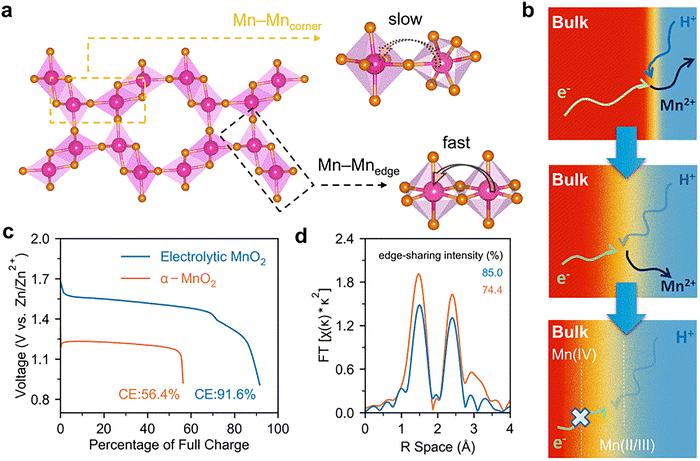
Proposed mechanism for the evolution of the α-MnO2 surface during discharge (a), scheme for the charge transfer required in the second step of MnO2 dissolution (b),
and comparison of discharges for obtained by two different MnO2 phases with respect to the theoretical capacity. (c) and the respective FTs-EXAFS (d). [From the artilce in EES]
When one view isn’t enough: the power of multimodal research
Thanks to the high-resolution techniques at the ALBA Synchrotron, the team was able to visualize these subtle structural changes from the macro to the nanoscale while the battery was working. In particular, at the CLAESS beamline researchers performed bulk sensitive operando X-ray spectroscopy analysis at both the Mn and Zn K-edge following at the same time the cathode and the electrolyte to track the reactions and the structural changes occurring during the first discharge.
Moreover, researchers used the MISTRAL beamline to visualize where on the electrode material the changes were happening and to detect minority phases that bulk techniques might miss.
Finally, by means of the METCAM electron microscope, part of JEMCA, the authors reached the nanoscale, visualizing the nanowire cathode surfaces responsible for the blocking mechanism.
By combining data from multiple complementary techniques, the study exemplifies the power of multimodal experiments, which provide a comprehensive, multiscale understanding of complex materials that no single method alone could achieve.
Advancing to safe, sustainable and low-cost batteries
These findings shed light on long-standing questions in Zn–MnO₂ battery research and point to strategies for overcoming these intrinsic limitations — for instance, by engineering the crystal phase, conductivity and morphology of the electrode active material to prevent irreversible Mn(III) accumulation.
“This new understanding will be essential to advance safe, low-cost, and sustainable aqueous zinc batteries. Knowing why the capacity is capped helps guide the design of next-generation materials and improve stability, energy output, and cost efficiency”, says Dino Tonti, one of the main authors of the study.
Reference article
Unveiling Capacity Limitations of MnO2 in Rechargeable Zn Chemistry Check for updates
Cheng Liu, Vlad Martin-Diaconescu, Ashley Phillip Black-Serra, Siavash Khabazian, Bernat Mundet, Krzysztof Matlak, Lorenzo Stievano, Andrea Sorrentino, Laura Simonelli and Dino Tonti
Energy Environ. Sci., 2025, 18, 9611-9622
https://doi.org/10.1039/D5EE03588K
This research is featured in the Radio Cugat Mèdia with Dino Tonti and Laura Simonelli
Listen to the radio program "Faves Comptades" here (in Catalan/Spanish).

Les bateries de zinc i manganès, una alternativa a les de liti?
Moltes de les bateries que usem en el nostre dia a dia són de liti, com les dels telèfons mòbils, però s’estan fent estudis sobre un altre tipus de bateria més barata i segura: les bateries de zinc i diòxid de manganès. Un equip de recerca de l’Institut de Ciència de Materials de Barcelona, en col·laboració amb el Sincrotró ALBA han descobert que aquestes bateries no arriben a donar tota la capacitat que en realitat podrien oferir. Dino Tonti, investigador a l’Institut de Ciència de Materials, l’ICMAB i Laura Simonelli, científica del Sincrotró ALBA i responsable de la línia de llum CLAESS han explicat els resultats de l’estudi al magazín ‘Faves comptades’.