Institutions
One institution collaborated with ICMAB researchers in 37 projects: ICREA. ICREA works hand in hand with Catalan universities and research centres to integrate ICREA research professors in the Catalan research system. At ICMAB we have three ICREA research professors: Núria Aliaga-Alcalde, Alejandro Goñi and Massimiliano Stengel.
After ICREA, one institution collaborated with ICMAB in 27 projects: the Universitat Politècnica de Catalunya, UPC, Spain. One researcher has both affiliations, Kasper Moth-Poulsen.
Following that, there is the Universitat de Barcelona (UB, Spain), with 25 projects. The UB is a university known for its diverse scientific studies, and many ICMAB researchers collaborate with researchers from the Physics and Chemistry Faculty, among others.
There are three institution that have collaborated with ICMAB in 22 occasions: the Barcelona Institute of Science and Technology (BIST, Spain) (wich includes various research centers with whom we collaborate, including ICN2, ICFO, IBEC, etc), the Centre National de la Recherche Cientifique (CNRS, France) and the Chalmers University of Technology (CUT, Sweden).
Finally, the Institut Catala de Nanociència i Nanotecnologia (ICN2, Spain) has collaborated with ICMAB in 19 separate occasions. The ICN2 is located at the UAB Campus, just next to ICMAB, and many ICMAB researchers collaborate with their researchers.
Top countries
ICMAB researchers work together with many different scientists around the world. International research partnerships are a key factor to improve our collective knowledge. Not only does it allow everybody to share access to different scientific installations and techniques, it also gives research a more diverse viewpoint that ensures every possibility is considered.
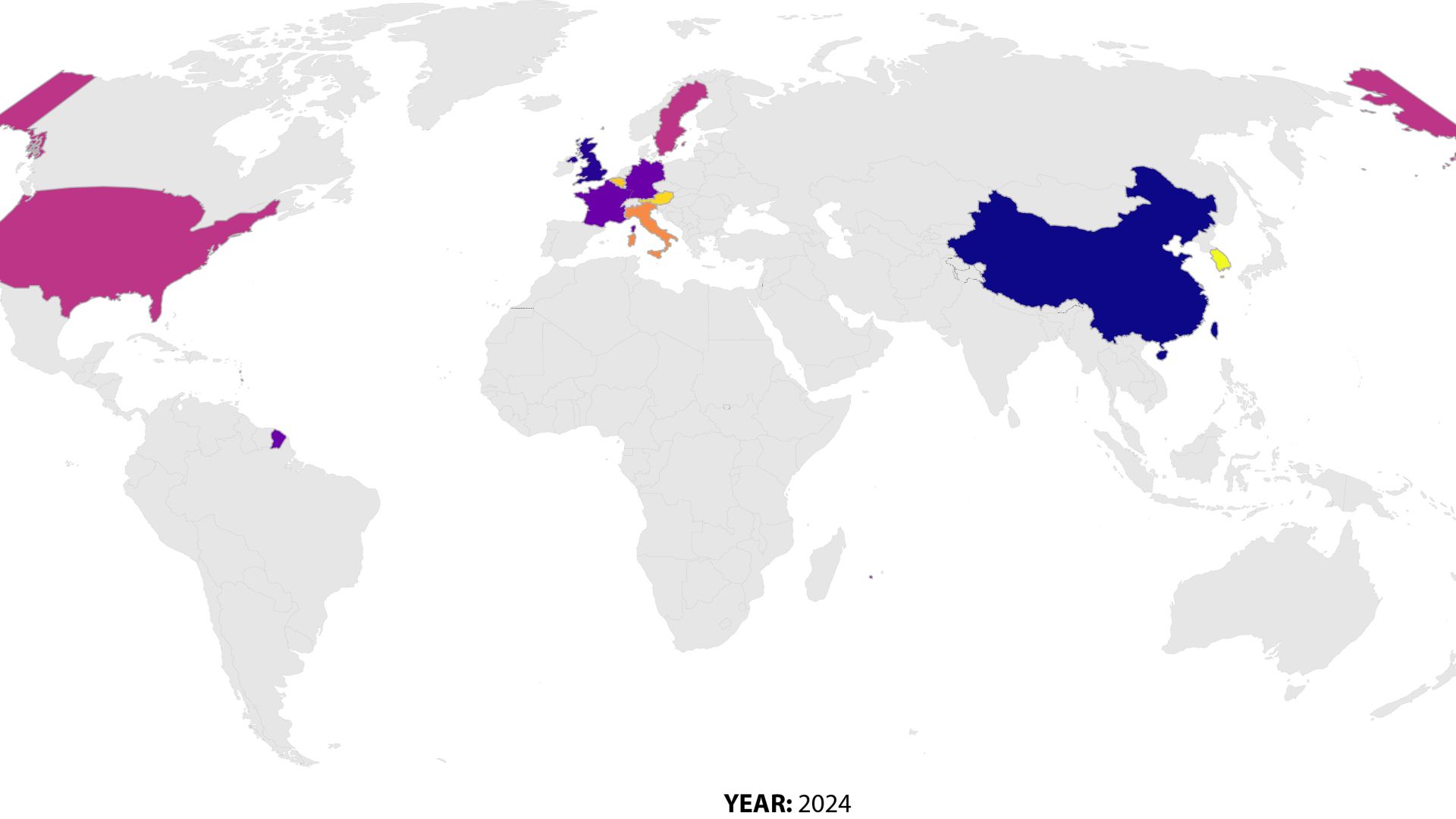
These are the top 10 countries that ICMAB has collaborated more with during 2024:
- People's Republic of China: 37
- United Kingdom: 36
- France: 32
- Germany: 32
- Sweden: 26
- USA: 26
- Italy: 19
- Belgium: 15
- Austria: 14
- South Korea: 12
More information
Note: The data has been gathered from the Web of Science-Core collection, as of 26/2/2025. Some 2024 articles may be not yet added to the Web of Science-Core collection. Thank you for your understanding.