


The CSIC and the Fundación General CSIC (FGCSIC) have announced the ex aequo winners of the first edition of the JAE Chairs pilot program. The selected initiatives are the DOMMINO project, focused on the design and optimization of molecular materials for innovative energy solutions, and the ALLCRYO project, aimed at cutting-edge techniques for the structural characterization of heterogeneous biological samples.
With an endowment of up to 600,000 euros, the grant involves the proposal and development of a research project that generates lasting impact on the Spanish public system of science, technology and innovation, acting as a catalyst for emerging and disruptive science. The objective of JAE Chairs, the first initiative of scientific chairs at the CSIC, a body under the Ministry of Science, Innovation and Universities, is to attract world-class researchers to promote excellence and scientific-technical impact in the organization.
The project at ICMAB: DOMMINO
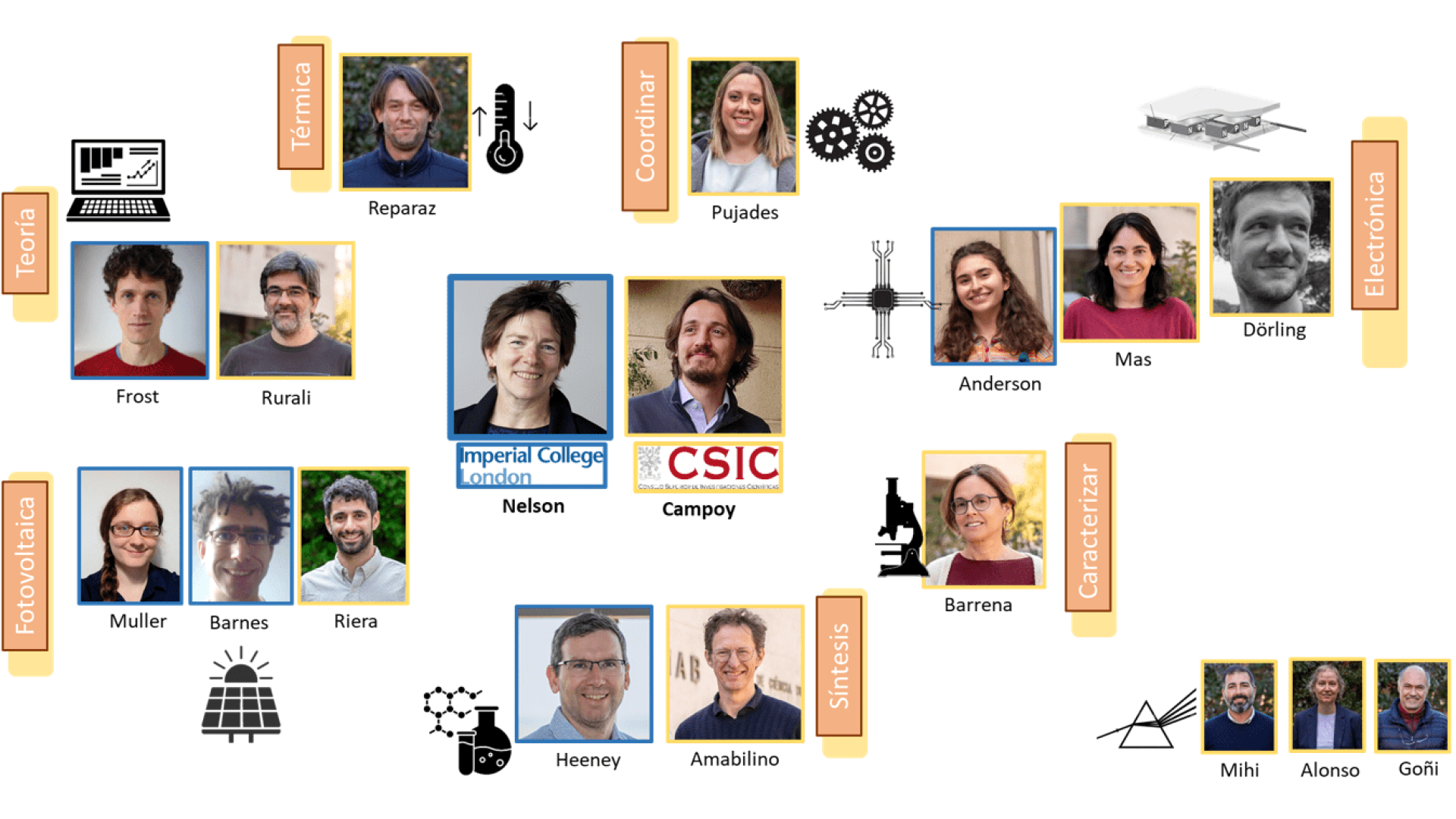
The chairholder of the DOMMINO project is researcher Jenny Nelson, from the Department of Physics at Imperial College London, UK. The project is coordinated by researcher Mariano Campoy Quiles, from the Institute of Materials Science of Barcelona (ICMAB-CSIC).
DOMMINO (Design and Optimisation of Molecular Materials for Innovative Energy Solutions) targets the basic science of electronic materials that can help accelerate the energy transition. Identifying molecular semiconductors as designer materials with rapid design and scale-up potential as well as tuneable properties, the project aims to discover the design rules that will improve device performance in three critical areas. These are, improved thermoelectric harvesting of waste heat, improved energy efficiency of low power electronic devices, and improved utilisation of solar radiation for photovoltaic conversion.
"Our approach is to combine the expertise of the CSIC PI in experimental and high-throughput exploration with the Chair’s in innovative materials modelling, to discover the relationships that control the electronic, thermal and doping behaviour of target materials and so to develop criteria for improved materials. The findings stand to benefit development of thermoelectric, photovoltaic and low-power electronics technology and attract industrial interest" says Campoy-Quiles.
Jenny Nelson will hold the JAE Chair position at ICMAB-CSIC. The project will be coordinated by Mariano Campoy and the team includes experts in device physics, synthesis, quantum calculations, solar cells, thermal transport, electronics, and advanced characterization.
Jenny Nelson (JN) has established a world-leading reputation in the fundamental physics, chemistry and materials science of novel electronic materials for application to solar energy conversion and related technology. Her expertise spans the physics of solar cells and other semiconductor devices; structure-property (optical, electrical, electrochemical and spin) relationships of molecular semiconductors; multiscale modelling of novel electronic materials; physics and chemistry of photocatalytic, photochemical and electrochemical energy conversion; and analysis of the mitigation potential of energy technologies.
She has published widely with a h-index of 120 and almost 60,000 citations, and written a widely known book on solar cell physics. She has been a Clarivate Highly Cited researcher since 2014, and was listed 32nd globally (and 1st in UK) on a Thomson ISI listing of materials science authors during 2001-2011. For her research she has received multiple awards, among them, the 2012 Royal Society Armourers and Brasiers Company Prize (premier award for materials science), the 2016 Institute of Physics Faraday Medal (gold medal for distinguished research in experimental physics) and the 2023 IEEE Photovoltaic Specialists’ Cherry Award (primary award for contributions to science or technology of photovoltaics). She has been elected as a Fellow of the Royal Society (2014), Fellow (2014) and Honorary Fellow (2021) of the Institute of Physics, Fellow of the Royal Society of Chemistry (2021) and was selected as an Inspirational Scientist and Engineer by the UK research councils (2014). She has been awarded competitive research awards that currently include a Royal Society Research and two ERC Advanced Grants.
The ALLCRYO project
The Chair of the ALLCRYO project is the researcher Eva Nogales de la Morena, from the University of California, Berkeley, USA. The project is coordinated by José María Valpuesta, researcher at the Centro Nacional de Biotecnología (CNB-CSIC). This project will focus on improving crucial aspects of electron cryomicroscopy, which has become a revolutionary and essential technique in structural biology, thanks to advances in sample preparation, data acquisition and processing that now routinely enable high-resolution structural description of many macromolecular complexes.
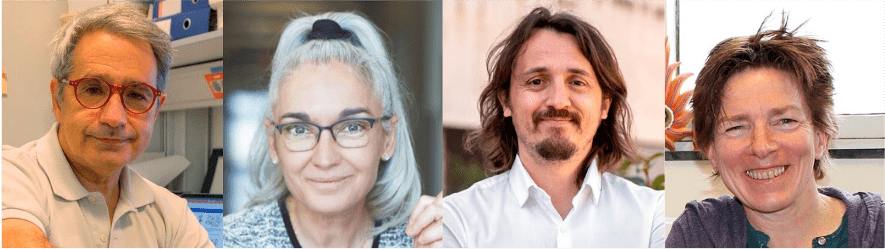
From left to right: José María Valpuesta, Eva Nogales, Mariano Campoy-Quiles and Jenny Nelson.
The grant
The holder of the Chair will spend at least two months per year at the receiving CSIC Institute and will lead, together with a CSIC researcher, the funded project that includes the co-direction of a doctoral thesis. To this end, they will have the collaboration of the CSIC research group and funds for the development of the research project, including the hiring of personnel.
The beneficiaries will receive funding for visits and stays, as well as for the organization of regular seminars, workshops and a congress at the end of the grant. Through these activities, the state of the art of the scientific discipline in which the chair holder develops his/her activity will be shown and the results obtained within the framework of the project will be disseminated. All this with the ultimate aim of opening up stable, long-term international collaboration frameworks and establishing new and disruptive lines of work at the CSIC.
Read more:
