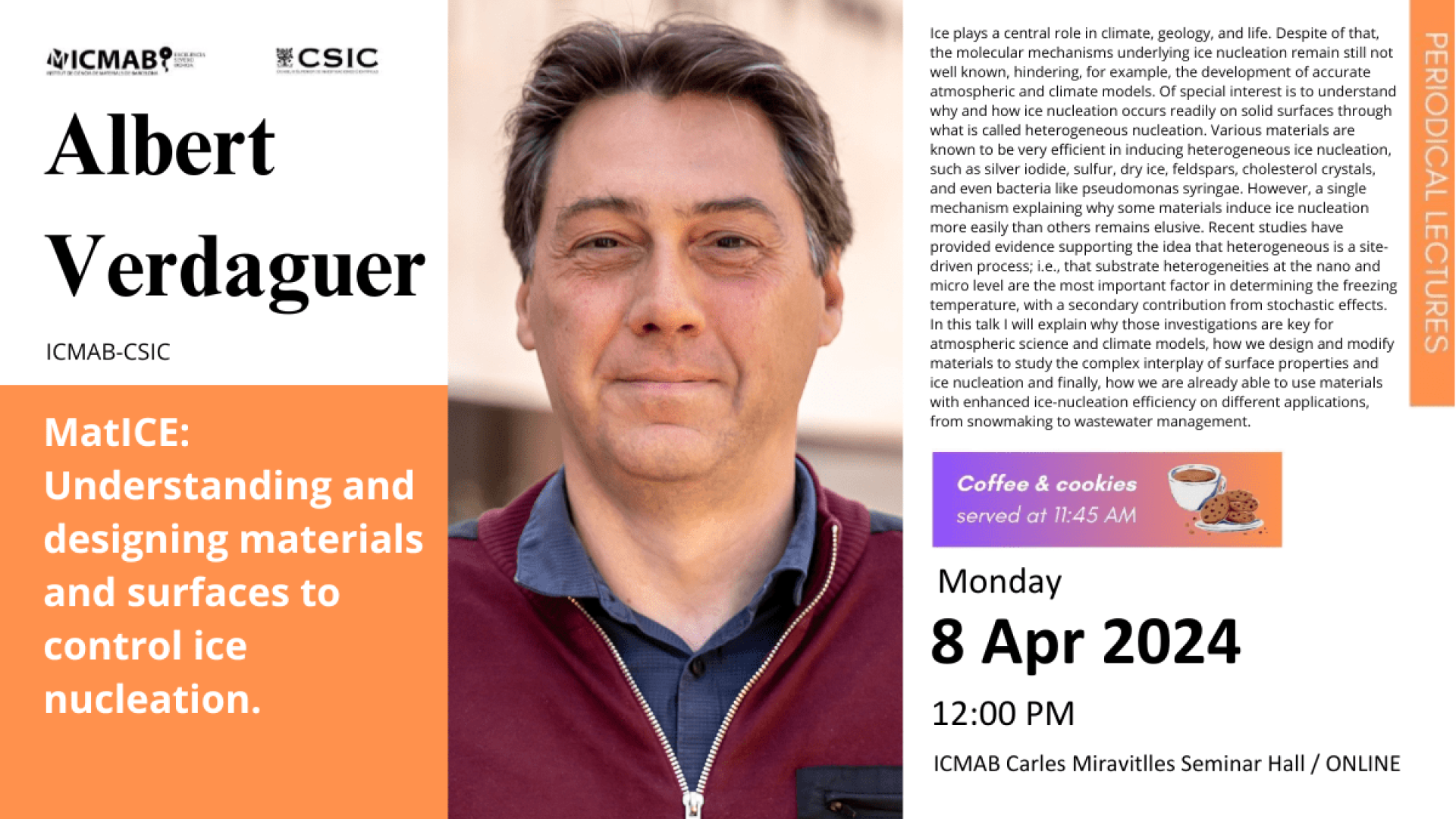
MatICE: Understanding and designing materials and surfaces to control ice nucleation
Albert Verdaguer, ICMAB-CSIC
Monday, 8 Apr 2024
12:00 PM
ICMAB - Sala d'Actes Carles Miravitlles
Abstract
Ice plays a central role in climate, geology, and life. Despite of that, the molecular mechanisms underlying ice nucleation remain still not well known, hindering, for example, the development of accurate atmospheric and climate models. Of special interest is to understand why and how ice nucleation occurs readily on solid surfaces through what is called heterogeneous nucleation. Various materials are known to be very efficient in inducing heterogeneous ice nucleation, such as silver iodide, sulfur, dry ice, feldspars, cholesterol crystals, and even bacteria like pseudomonas syringae. However, a single mechanism explaining why some materials induce ice nucleation more easily than others remains elusive. Recent studies have provided evidence supporting the idea that heterogeneous is a site-driven process; i.e., that substrate heterogeneities at the nano and micro level are the most important factor in determining the freezing temperature, with a secondary contribution from stochastic effects. In this talk I will explain why those investigations are key for atmospheric science and climate models, how we design and modify materials to study the complex interplay of surface properties and ice nucleation and finally, how we are already able to use materials with enhanced ice-nucleation efficiency on different applications, from snowmaking to wastewater management.
Short bio
Dr. Albert Verdaguer graduated in Physics at the University of Barcelona (UB) and obtained his PhD in Physics at the same university studying molecular collective motions in liquids using molecular dynamics simulations. Simultaneously he worked in the Nanometric Techniques Unit at the Scientific-Technical Services of the UB providing services in Scanning Probe Microscopies (SPM) to research groups. After his PhD he moved to the Lawrence Berkeley National Laboratory in California, USA, under the supervision of Prof. M. Salmerón. During this time he focused his research on the study of the liquid-solid interface at the nanoscale using SPM and Ambient-Pressure X-ray Photolectron Spectroscopy (AP-XPS). Those have been his main research tools until today. He returned to Spain at the Institut Català de Nanotecnologia (ICN, now ICN2) as a Tenured Scientist of CSIC. In 2016 he moved to the Institute of Materials Science of Barcelona (ICMAB-CSIC), joining the Group of Physical Chemistry of Surfaces and Interfaces. He is now centered on the study of the water/solid interfaces and the study of ice nucleation on surfaces.