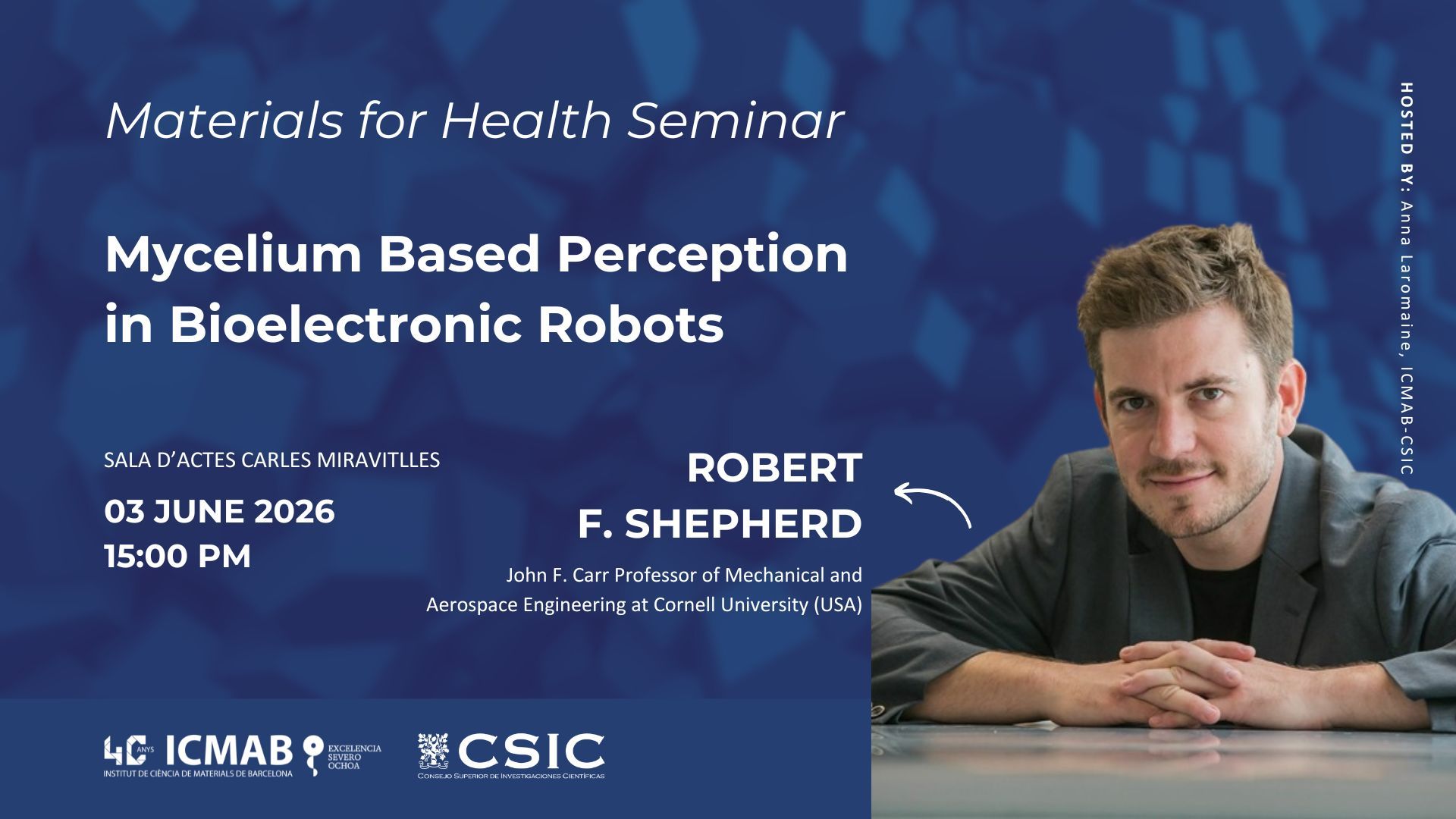
Mycelium Based Perception in Bioelectronic Robots
Robert F. Shepherd, John F. Carr Professor of Mechanical and Aerospace Engineering at Cornell University, USA
Wednesday 3 June 2026, 3.00 PM
ICMAB - Sala d'Actes Carles Miravitlles
ONLINE (Register here)
Abstract
Fungal mycelia offer a living, adaptive substrate for biohybrid robotic control because their action-potential-like electrophysiological signals respond to environmental stimuli and can be coupled directly to robot actuation. Mishra and Shepherd et al. demonstrated that fungal electrophysiology can mediate sensorimotor control in untethered robots, including spike-shape responses to ultraviolet stimulation and closed-loop motor control driven by mycelial signals. The work established a biohybrid platform in which living fungal tissue functions not only as a sensor, but as an embodied preprocessing layer that converts environmental input into actionable electrical dynamics. The system achieved robust UV-responsive signaling, including approximately 20 dB SNR, and remained functional after cross-country transport and public demonstration, highlighting the practical resilience of mycelial control systems. This study provides an important foundation for future deployable mycelial perception skins capable of multimodal environmental classification and autonomous robot response.
Short bio
Robert F. Shepherd is the John F. Carr Professor of Mechanical and Aerospace Engineering at Cornell University and a pioneer in soft robotics, biohybrid systems, and multifunctional materials. His research integrates materials science, additive manufacturing, electronics, and biological systems to create autonomous robotic platforms with embedded sensing, computation, and actuation. Shepherd’s group has developed foundational technologies in embodied energy systems, volumetric additive manufacturing, fiberoptic sensing, and fungal-mycelium-mediated robot control, including the first demonstrated untethered biohybrid robot driven by fungal electrophysiology. His work has been supported by DARPA, ONR, AFOSR, NSF, and ARPA-E, and has appeared in journals including Science Robotics, Nature, Science, and Advanced Materials. In addition to his academic research, he is co-founder of multiple technology companies focused on advanced manufacturing, wearable sensing, and autonomous material systems.
Hosted by Anna Laromaine, from the NN group (Materials for Health Research Line)
>>If you want to meet the speaker, please contact the host at This email address is being protected from spambots. You need JavaScript enabled to view it..