


New back-cover on the journal Small on trityl-based nanoparticles as tailored dual emitters of circularly polarized luminescence
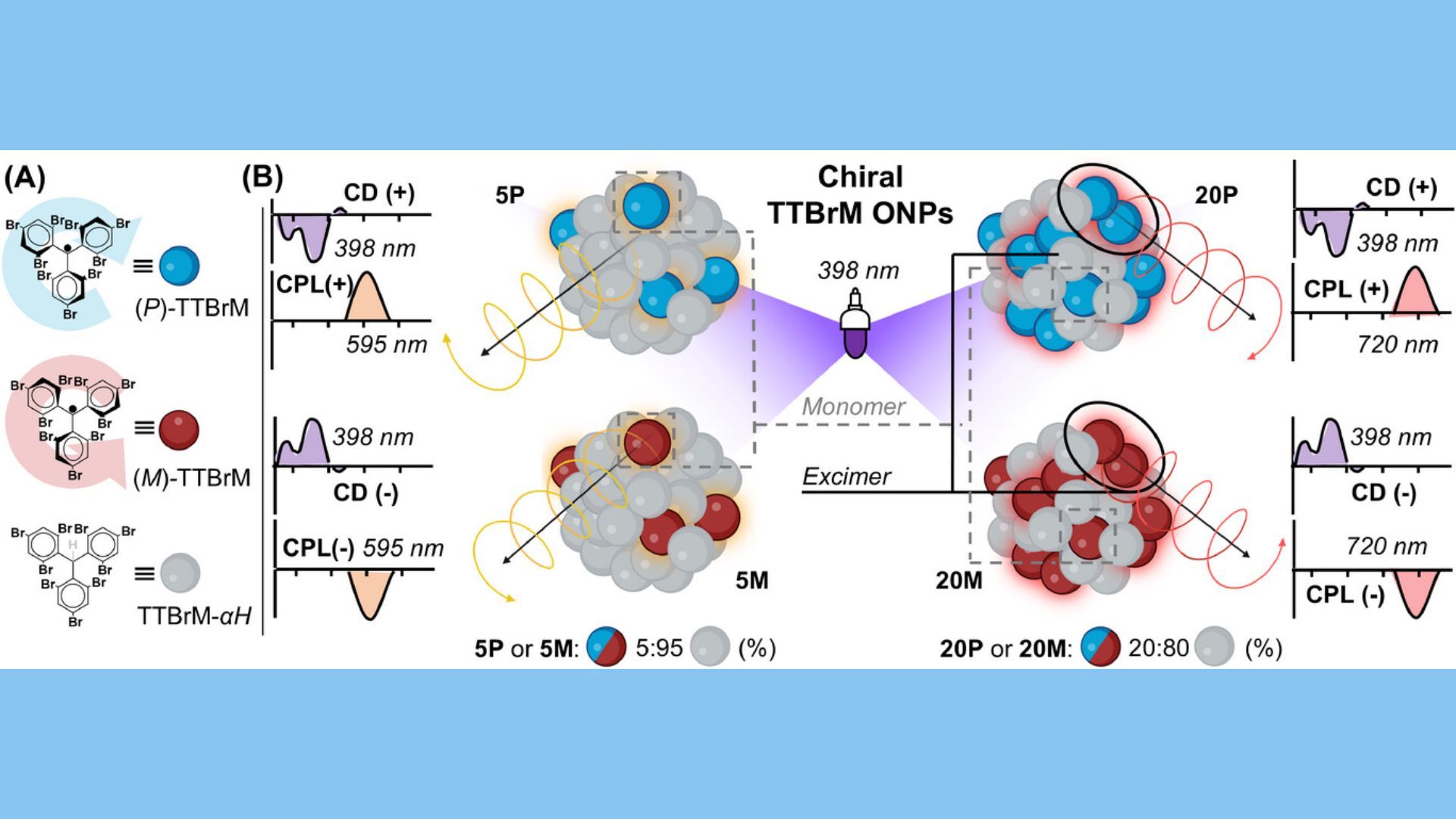
A team of researchers at ICMAB of the Nanomol-BIo group, led by Imma Ratera and Paula Mayorga, present water-compatible chiral organic nanoparticles based on a brominated trityl radical that convert unpolarized light into circularly polarized emission without energy-wasting filters. The luminescence is tunable via radical concentration, yielding chiral emission from monomeric species in the visible region and from intrinsically chiral excimers that extend into the near-infrared, enabling optical and biomedical applications.
Circularly polarized light (CPL) has the property of rotating the electric field vector in a clockwise or counterclockwise direction as it advances. This interesting property can be used as channels for information transmission, effectively doubling the transmission capacity compared to unpolarized light. In consequence, CPL is now thoroughly investigated in the photonic technologies for quantum communication, sensing, bioimaging or biomedical diagnosis
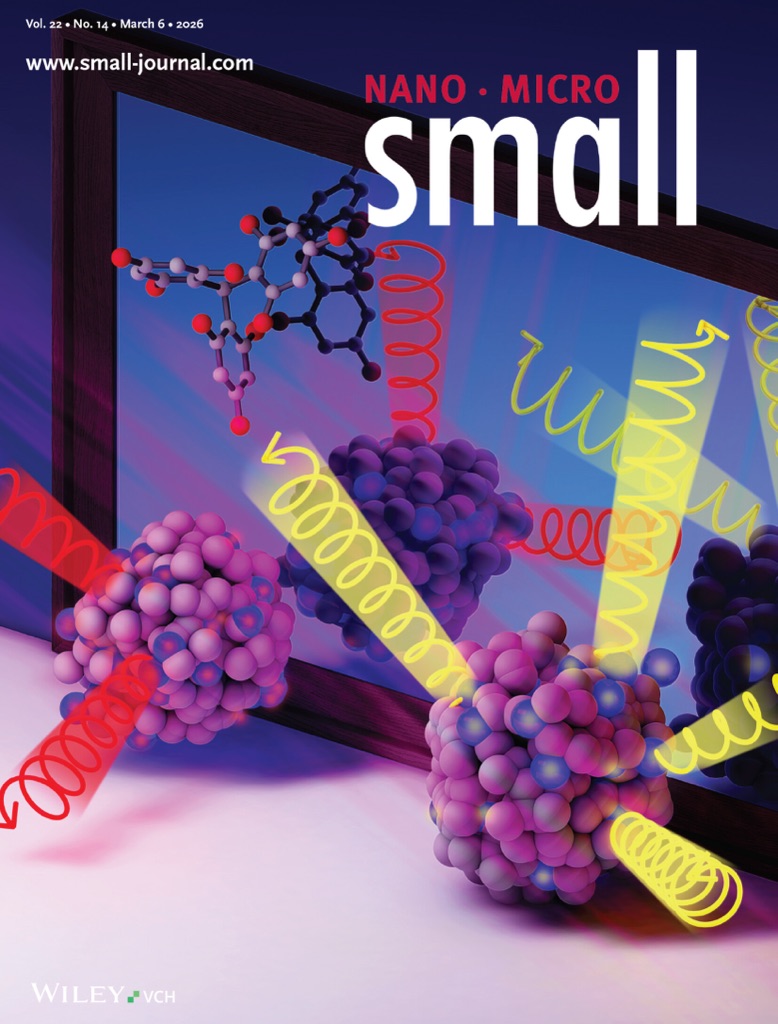
Back-cover featuring the article by ICMAB researchers on the journal Small
In this research, chiral brominated trityl radicals (TTBrM) were nanofabricated within nets of optically inactive non-radical TTBrM precursor (TTBrM-αH) in order to obtain water-compatible enantioenriched organic nanoparticles (TTBrM-ONPs). Those structures showed very interesting and important properties: lumiscence and circularly polarised excimer emission. Those properties were studied as a function of two radical doping ratios.
This research positions chiral trityl-based ONPs as efficient and biocompatible CPL emitters with strong potential for future applications in optical and biomedical technologies.
"Thrilled to share our latest breakthrough: chiral organic nanoparticles based on trityl radicals, as single platforms with tunable circularly polarized luminescence (CPL). By simply adjusting the ratio of radical enantiomers in the nanoparticles, the emission switches from visible to NIR—and remarkably, it all occurs in water! A game-changing advance for biocompatible photonic and biomedical technologies, reinforcing our leadership in harnessing the optoelectronic potential of trityl radicals.", said the researchers.
Reference Article
Intrinsically Chiral Excimers: Water-Compatible Trityl-Based Nanoparticles as Tailored Dual Emitters of Circularly Polarized Luminescence in the Vis or NIR Regions
Giovanni Schievano, Nerea Gonzalez-Pato, Sandra Míguez-Lago, Pau Armada, Jesús Cerdá, Juan Aragó, Jaume Veciana, Araceli G. Campaña, Imma Ratera, Paula Mayorga-Burrezo
Small, 2026
DOI: 10.1002/smll.202512627
- Hits: 248