


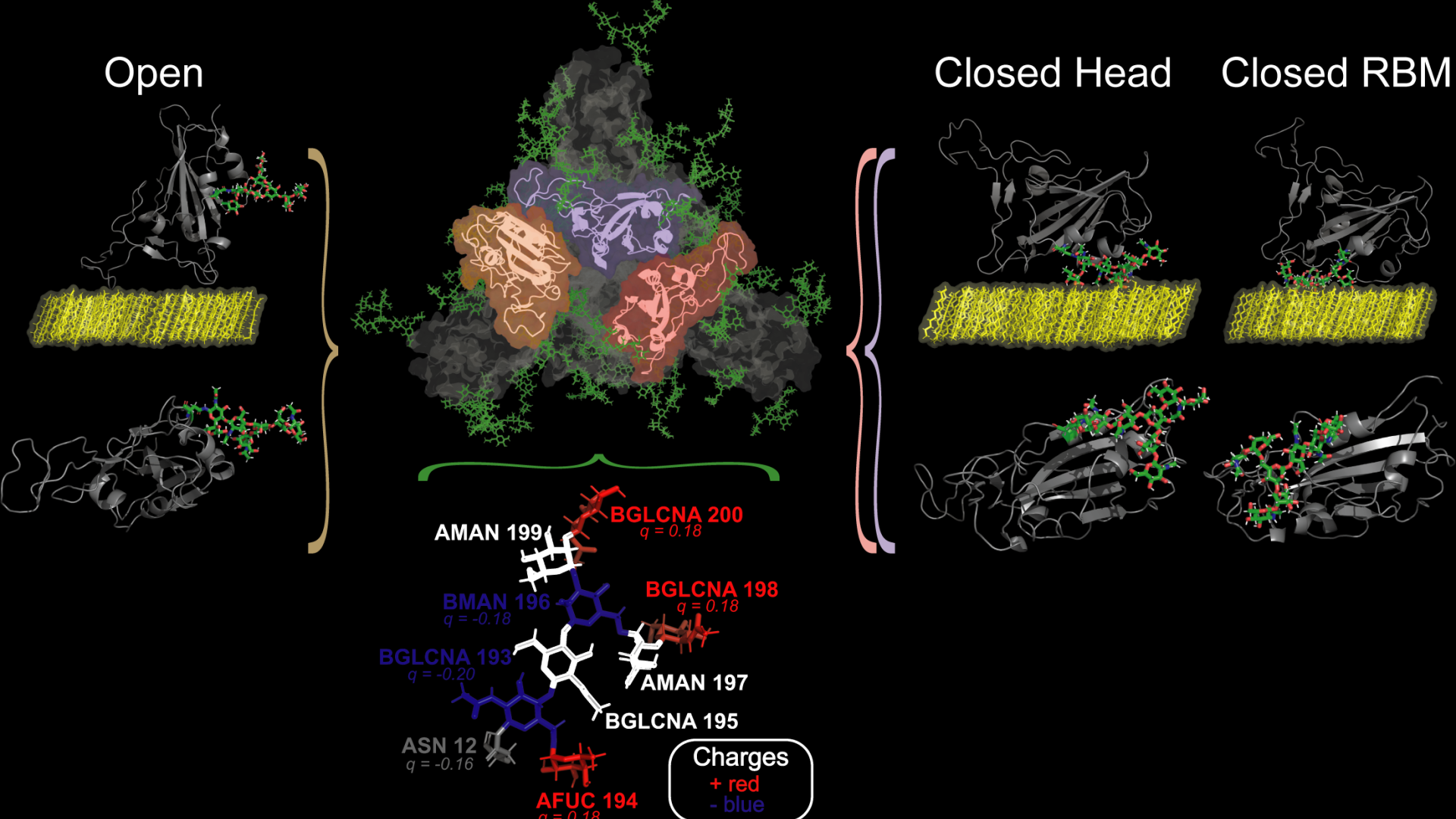
Proteins are the functional engines of the cell, requiring a deep understanding of their structure and dynamics to decode their mechanisms. Central to this complexity is glycosylation, a ubiquitous post-translational modification that coats protein surfaces with glycans/sugar chains, acting as a critical regulator of protein folding, stability, and cellular signaling.
The nature of glycan-surface interactions remains poorly understood. One open question is how these highly flexible molecules interact with semi-flexible ones (proteins) to modulate their adsorption on different surfaces according to their hydrophobicity. In the recent article published in Journal of Chemical Information and Modeling (JCIM) by Bosch, Menacho, Pérez, and Guzman they tackle this question to explore how these "sugar coatings" (glycans) of the SARS-CoV-2 Spike protein dictate how the virus sticks to polarizable surfaces (e.g. fomites).
The current issue of the Journal highlights the work of ICMAB researchers: Dr. Horacio V. Guzman and M.Sc. Willy Menacho with the main cover image. This research was a close collaboration between ICMAB and researchers at the Universidad Autónoma de Madrid (UAM), Antonio Bosch F. and Rubén Peréz.
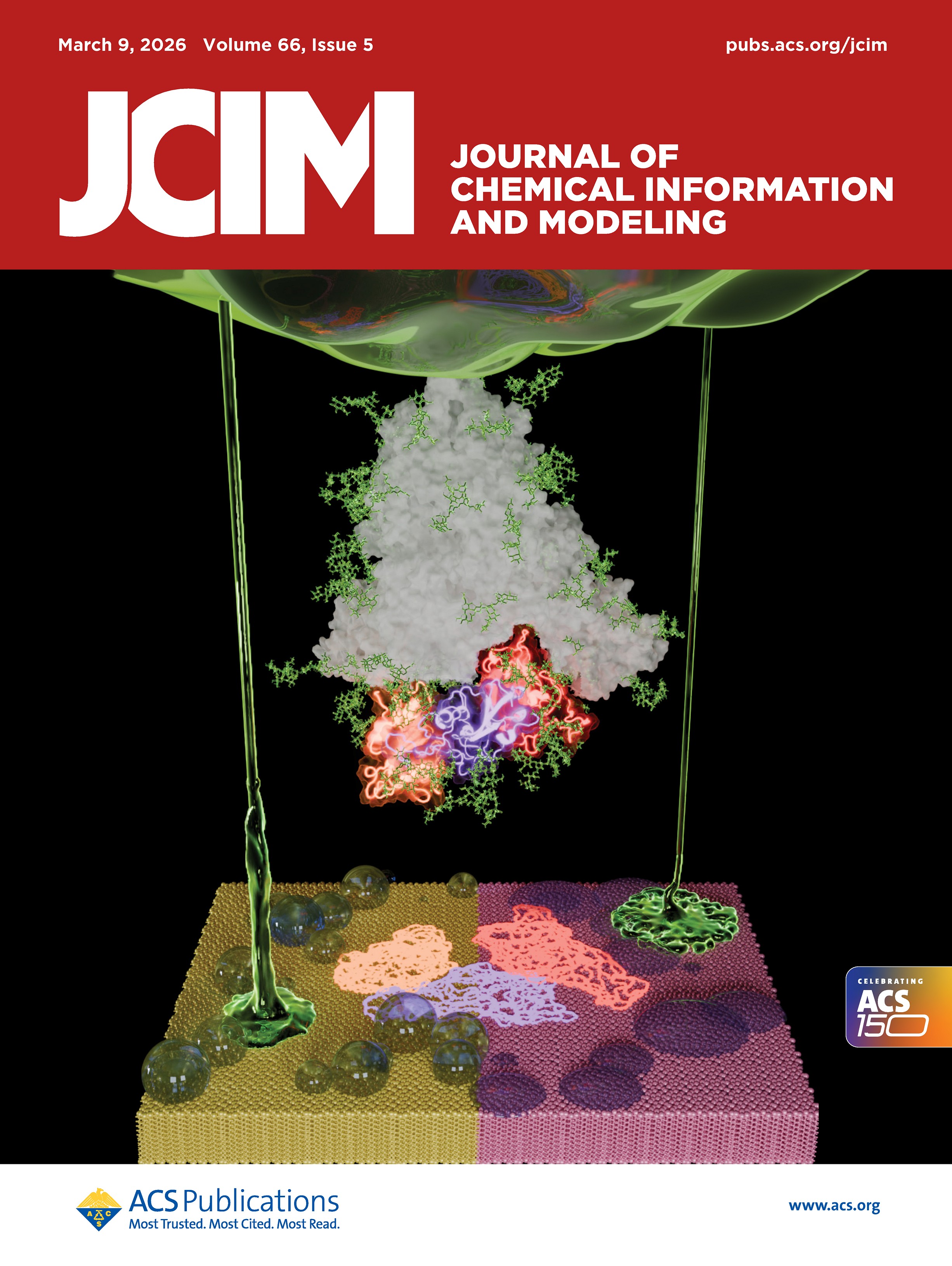
Cover of the Journal of Chemical Information and Modelling | The authors
The Core Discovery
Using advanced molecular dynamics simulations, the research team demonstrated that glycans act as molecular modulators that can either facilitate or block the adsorption of the virus onto surfaces depending on the material's hydrophobicity and the protein's conformation.
Key Findings
- Surface Type Matters: Hydrophobic surfaces facilitate stable and strong adsorption for both "open" and "closed" states of the Receptor Binding Domain (RBD). In contrast, hydrophilic surfaces show significantly reduced adsorption, particularly for the closed conformation.
- The Dual Role of Glycans: Glycans don't just sit there; they are active participants. In the closed-RBD state, they can enhance adsorption by acting as a "permanent tether" to the surface or, conversely, impede it by forming a protective shield, depending on the specific mutations (especially noted in the Omicron variant).
- Conformational Sensitivity: The study reveals that the "closed" conformation of the RBD is much more sensitive to glycan modulation than the "open" state. Glycans on hydrophilic surfaces tend to form hydrogen bonds with the surface, which can physically "trap" the protein or prevent it from making closer contact.
Reference article
Glycans Modulate the Adsorption of RBD Glycoproteins on Polarizable Surfaces
Antonio M. Bosch-Fernández, Willy Menacho, Rubén Pérez and Horacio V. Guzman
J. Chem. Inf. Model. 2026, 66, 5, 2719–2734
DOI: 10.1021/acs.jcim.5c02363
