


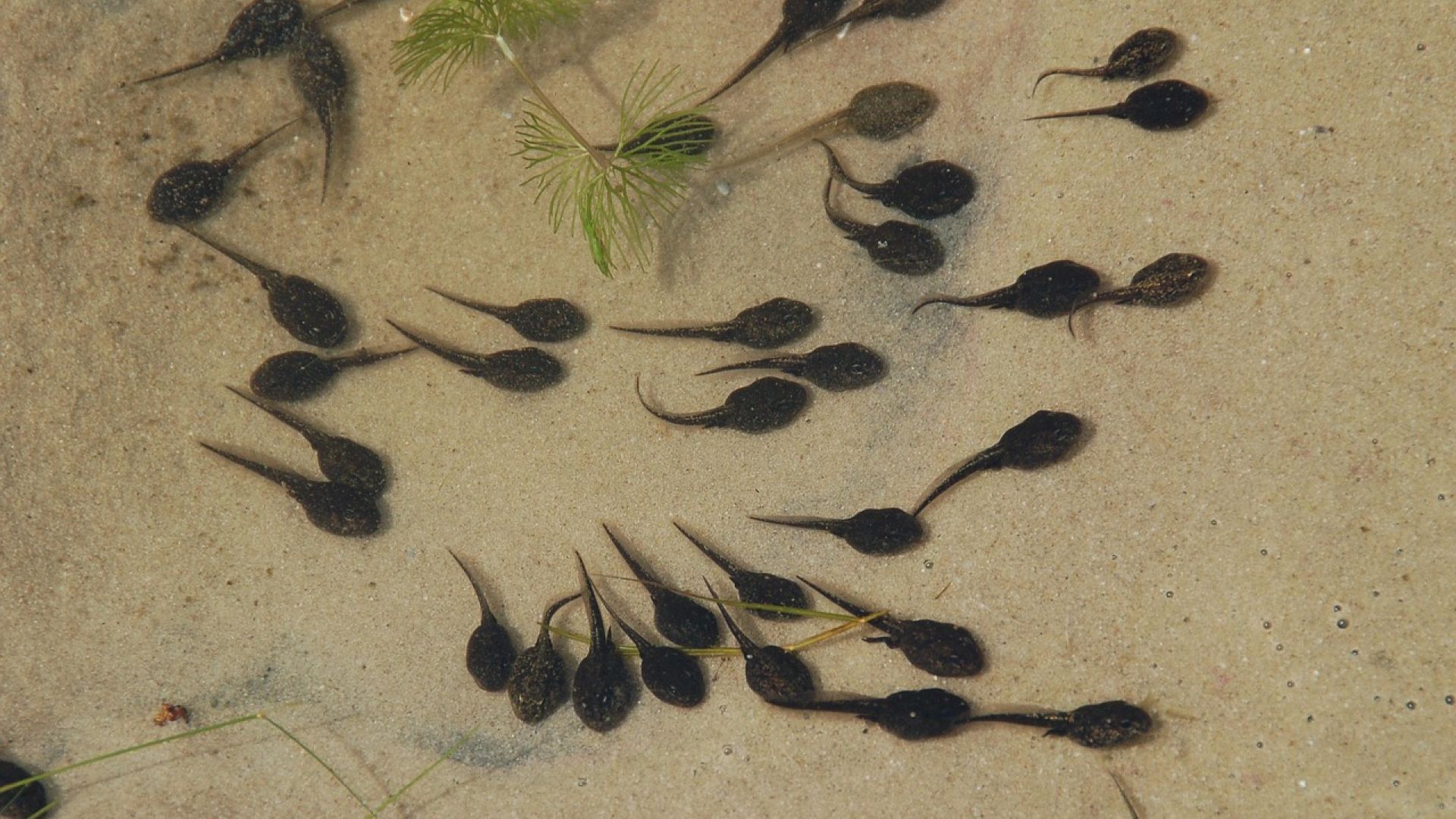
A research team co-led by Institute of Materials Science of Barcelona (ICMAB-CSIC) and the Institute for Bioengineering of Catalonia (IBEC) researchers has published a paper in Nature Communications about triplet sensitized cis-to-trans photoisomeration of azobenzene labelled drug, applied to control the heart rate of a frog tadpole.
Red, far red, or near-infrared photoswitchable drugs offer immense photo-pharmacological advantages due to the higher light penetration through the skin. Such photoactivation is achieved using processes such as two- and three-photon absorption, excited-state absorption, and triplet-triplet annihilation upconversion, which require higher photon fluences (W to kW cm−2) than the resilience constraints of skin (200 mW cm−2).
In this paper a generalized approach of cis-to-trans photoisomerization of azobenzenes is demonstrated via triplet sensitization with NIR-I illumination (850 nm) of a new Zn-octa-substituted phthalocyanine photosensitizer, in aqueous medium at 2.62 mW cm−2.
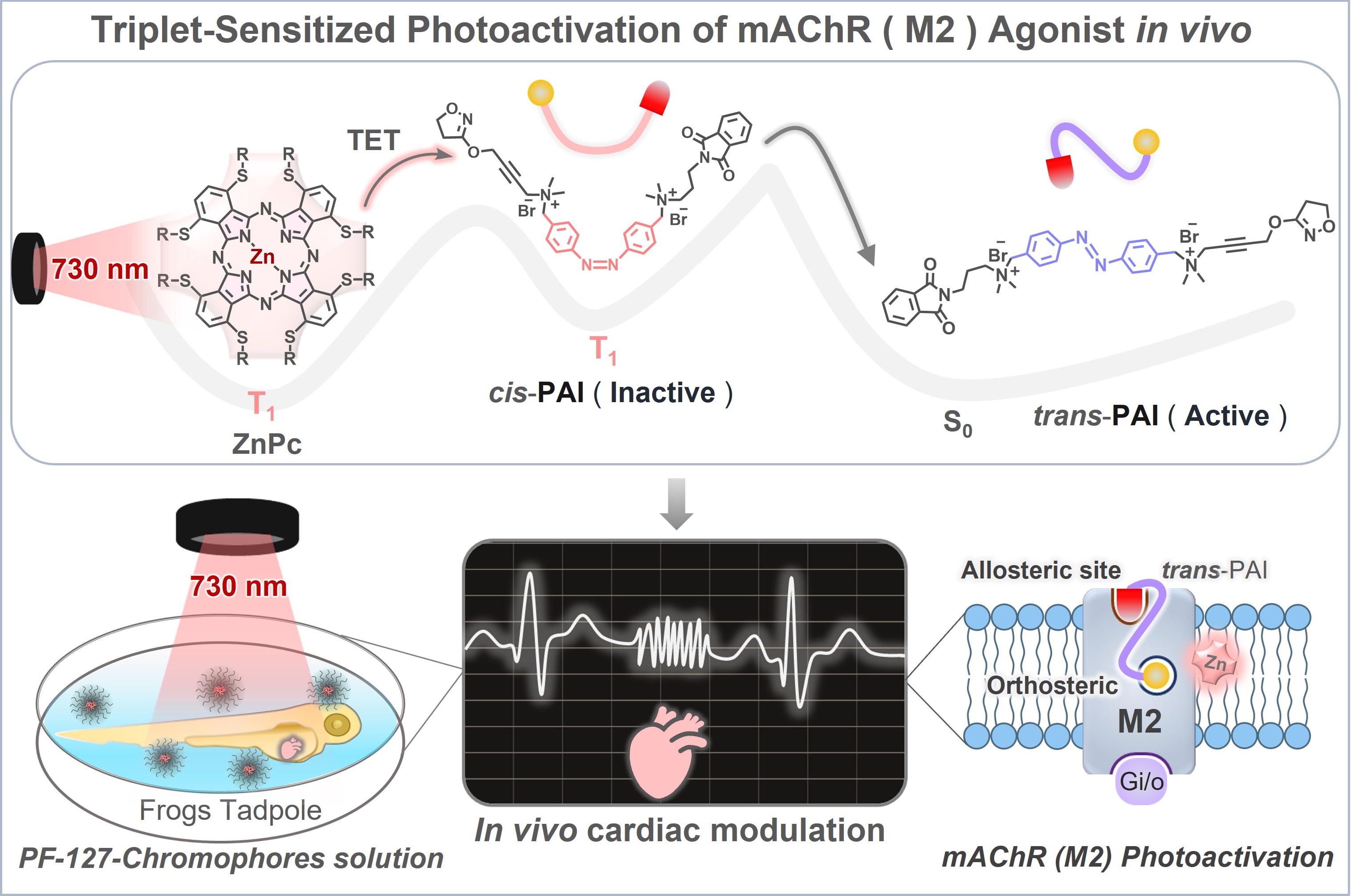
This approach is then applied to control the heart rate of a frog tadpole via cis-to-trans photoisomerization of an azobenzene-functionalized muscarinic acetylcholine receptor M2 agonist in the phototherapeutic window (730 nm excitation: 42 mW cm−2). This advance highlights a powerful photo-pharmacological strategy for modulation of in vivo activity at 2-4 orders of magnitude lower photon fluences of NIR light compared to established methods.
"The idea that the action spectrum of photoswitches can be red-shifted into the phototherapeutic window through triplet sensitization paves the way for the utilization of such systems in photopharmacology, particularly at low excitation power densities of red and near-infrared light," states Pankaj Bharmoria." It could potentially evolve into a significant photo-pharmacological tool for the regulation of drug functions in vivo through non-invasive photo control using NIR light. And in the future, it may even contribute towards the development of more sophisticated phototherapies with a minimum energy cost.”
A collaborative research
The story of this research revolves around the power of effective teamwork and research collaboration. In 2022, researchers Pankaj Bharmoria, Kasper Moth-Pulsen (now at UPC) and colleagues unexpectedly discovered that the action spectrum of cis-to-trans photoisomerization of azobenzene can be red-shifted through triplet-sensitization. Shortly after, their research group relocated to a new home at ICMAB in Barcelona. They wanted to make a strong start in a new environment and translate our triplet-sensitized isomerization into the field of photopharmacology.
The goals were clear: they wanted to develop a technology for photopharmacology that could lead to deep NIR light penetration into skin with low excitation fluences. They started the project by successfully shifting the action spectrum of azobenzenes towards the NIR-I region. Initial progress was promising, but to achieve full potential, we turned to our collaborators for more advanced sensitizers and photoswitches.
They then reached out to Prof. Dumoulin (AMAAU, Türkiye) for expertise in biocompatible photosensitizers. Prof. Dumoulin provided them with a novel biocompatible Zn-phthalocyanine sensitizer absorbing in the NIR-I region. Through Prof. Dumoulin, they were also introduced to Prof. Lindsey (NCSU), who supplied them with another biocompatible photosensitizer, nature-inspired bacteriochlorophyll. Around the same time, Naimovičius, an Erasmus+ M.S. student from Prof. Karolis's group (Vilnius University), joined the project. Together with Miroshnichenko, a Ph.D. fellow in ICMAB's group, they began working on shifting the action spectrum of novel azobenzenes received from Prof. Kimizuka (Kyushu University) and synthesized by Hölzel from their group in the skin biomimetic film using various photosensitizers.
Once the action spectrum of cis-to-trans isomerization of azobenzenes was successfully shifted to the NIR-I region, they tested the approach in aqueous micellar solutions under ambient conditions. To implement our findings in real-world applications, they reached out to researcher Pau Gorostiza, a photopharmacologist at IBEC. Gorostiza provided the azobenzene-based drug (PAI) used to regulate the heart rate. They confirmed that photoisomerization of PAI occurs under low excitation fluences within the NIR-I range. Ekin, a Ph.D. fellow from Gorostiza's group, utilized the PAI-ZnPc micelle formulation to effectively control the heart rate of frog tadpoles upon excitation at 730 nm, marking the success of the project.
The collaborative effort achieved the first application of triplet-sensitized photoswitching in photopharmacology, highlighting that teamwork can translate fundamental research into real-world applications.
About ICMAB-CSIC
The Institute of Materials Science of Barcelona is a research center of the Spanish National Research Council (CSIC) dedicated to the study, design, and application of new functional materials. With a strong commitment to sustainability and technology transfer, ICMAB leads pioneering projects in fields such as energy, electronics, and biomedicine.
Reference Article
Noninvasive cardiac modulation via triplet-sensitized photoswitching in the phototherapeutic window
Lukas Naimovičius, Mila Miroshnichenko, Ekin Opar, Helen Hölzel, Masa-aki Morikawa, Nobuo Kimizuka, Manvydas Dapkevičius, Justas Lekavičius, Edvinas Radiunas, Karolis Kazlauskas, Víctor Cilleros-Mañé, Fabio Riefolo, Carlo Matera, Kevser Harmandar, Masahiko Taniguchi, Fabienne Dumoulin, Jonathan S. Lindsey, Pankaj Bharmoria, Pau Gorostiza & Kasper Moth-Poulsen
Nature Communications volume 16, Article number: 6377 (2025)
DOI: 10.1038/s41467-025-61301-3
>> Read the history of this research here.
