

The chirality amplification the Nobel Prize winners discovered is one possible explanation for the fact that living things have a predominance of one chirality of their molecular components, in our case sugars in our DNA and amino acids in our proteins. It is also important for society, because many medicines and insecticides, for example, are chiral. Producing them selectively is cheaper and more sustainable. Amplification increases efficiency of production.
Synthesis of chiral molecules
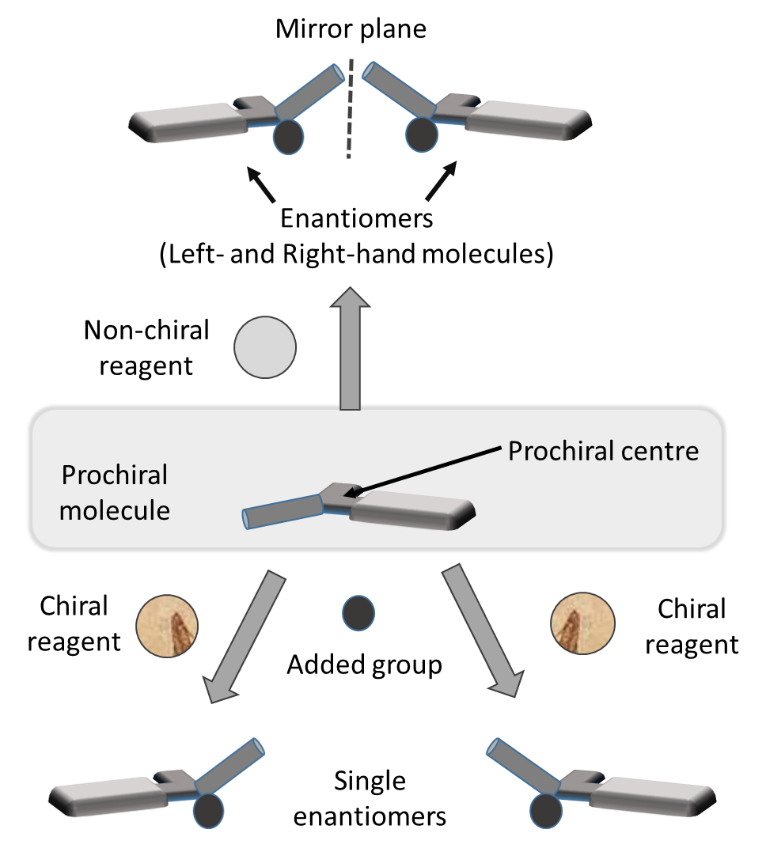
In general, using a chiral reagent or catalyst can lead to the formation of single enantiomers. The important discovery made by this year’s awardees is that when the chiral reagent exists as a mixture of enantiomers, the product of the reaction does not exist as the same proportion of enantiomers, but the product has an increased proportion of the majority enantiomer. Therefore, during the reaction, there was an amplification of the chiral content.
Professor Henri Kagan (Université Paris-Sud) and co-workers showed that the proportion of enantiomers in a chiral reagent made to carry out different kinds of reactions on prochiral molecules showed a non-proportional outcome in the enantiomers of the product, in other words there was an amplification of chirality. (C.Puchot, O. Samuel, E. Duñach, S. Zhao, C. Agami, B. Kagan, J. Am. Chem. Soc., 1986, 108, 2353) Professor Kensō Soai (Applied Chemistry Department of Tokyo University of Science) showed that a chiral molecule was able to amplify its own chirality, by acting as a catalyst, even when there was a very slight excess of one enantiomer in the starting mixture. (K. Soai, T. Shibata, H. Morioka, K. Choji, Nature 1995, 378, 767) He extended that observation to a host of situations where chirality is induced, including the use of circularly polarised light, (T. Kawasaki, M. Sato, S. Ishiguro, T. Saito, Y. Morishita, I. Sato, H. Nishino, Y. Inoue, K, Soai, J. Am. Chem. Soc., 2005, 127, 3274) a possible source of the biases in chirality in life on Earth.
As Professor Kagan himself said “Who would have thought before 1986 that an enantiomerically impure catalyst could give a product in an asymmetric synthesis with an enantiomeric excess higher than that of the catalyst?” (C. Girard, H.B. Kagan, Angew. Chem. Int. Ed., 1998, 37, 2922) The discoveries have not only revolutionised thought in approaches to producing single enantiomers, but also in the way that chiral materials are made, where amplification of chirality (non-linear induction effects) can be extremely effective in their preparation.
The ICMAB had the pleasure of hosting Professor Soai at the “Chirality at the Nanoscale meeting in Sitges in 2007, where he presented a lecture on his amazing work. His curiosity for the amplification of chirality was evident in that event, and he has continued to attend the conference that we started.
Text by David Amabilino, ICMAB-CSIC Director
