

Outreach News
Congratulations to all the new Ramón y Cajals researchers at ICMAB
The new Ramón y Cajals researchers are: Horacio Guzmán (from the 2022 call) and Paula Mayorga, Juan Pellico, Valeria Blanco and Pankaj Bharmoria (from the 2023 call).
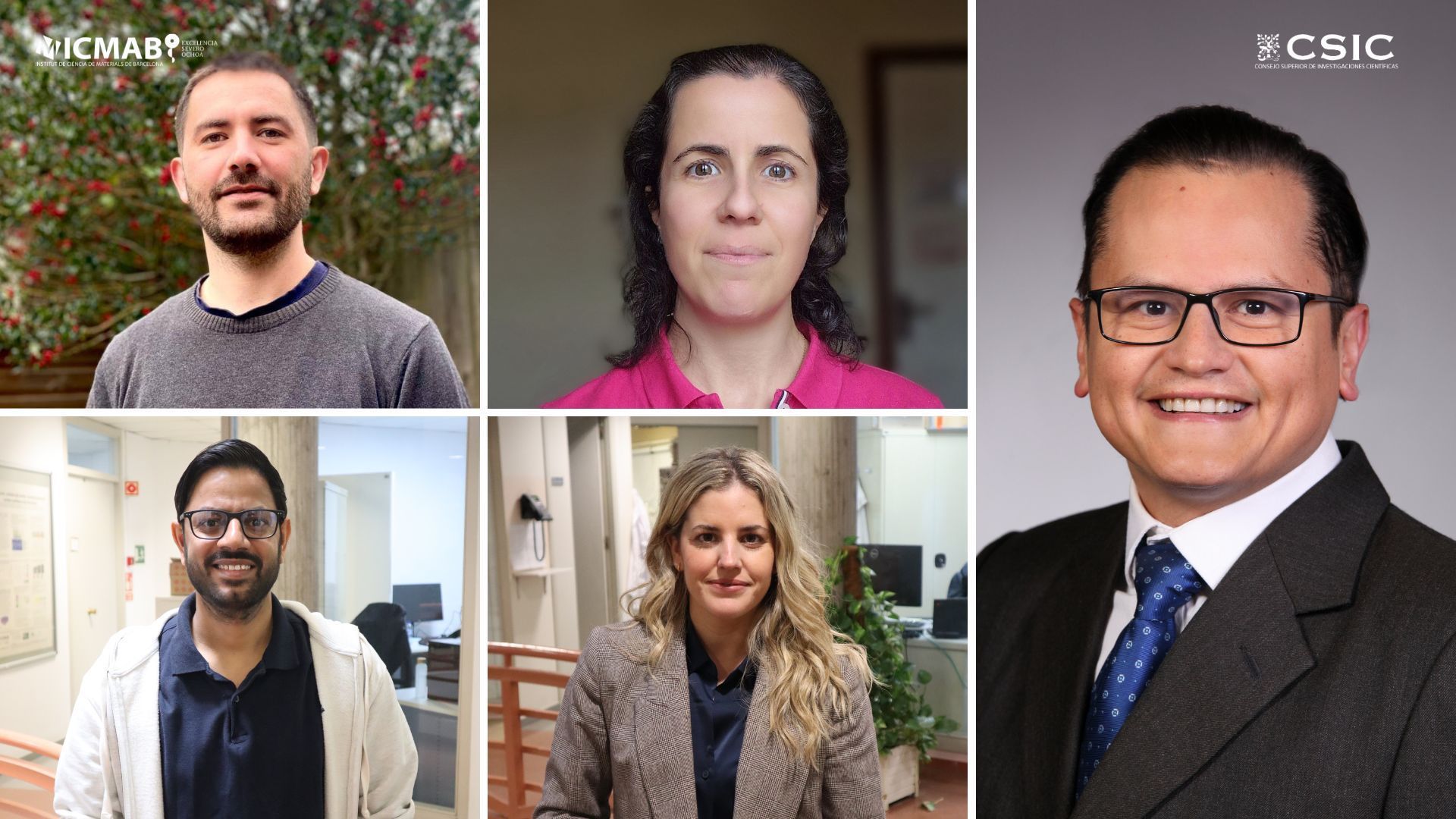
In the last Ramón y Cajal calls, four researchers have been granted a Ramón y Cajal and will be incorporated at ICMAB. One in 2022 (Horacio Guzmán), and three more in the 2023 call (Paula Mayorga, Juan Pellico, and Valeria Blanco). In addition, another reseracher working currently at ICMAB has been granted the Ramón y Cajal and will be incorporated at the UPC soon (Pankaj Bharmoria). Congratulations to all of them!
Here is a bit of info about each one:
Horacio Guzmán
Horacio Guzmán's research focuses on the molecular understanding of electrostatic and mechanical properties of biomacromolecules. He has led several projects within the last 5 years, with the aim of interconnecting the different modelling elements (RNA, protein capsids, solvent and membranes) required to simulate whole viruses and explore assembly/disassembly processes through the quantification of biophysical properties. Throughout his career, he has presented his work at over 50 international conferences, and 23 have been invited contributions.
His research at ICMAB will aim to establish a systematic connection of electrostatic and mechanical properties to the disassembly process for the release of nucleic acids inside cells and to engineer those material/viral properties as tuning knobs to exploit their enormous potential for improving nucleic acids nanodelivery. To this end, his team will develop radically novel approaches adding the perspectives of machine learning algorithms to multiscale computational models for quantitative and parsimonious predictions of nucleic acids delivery inside cells, closely related to the nanoparticle fabrication at ICMAB. Horacio Guzmán will create his own research group at ICMAB at the Materials Simulation and Theory Research Unit.
Paula Mayorga
Paula Mayorga-Burrezo graduated in Chemical Engineering (2011) from the University of Málaga, where she also got the PhD in Advanced Chemistry (2015) working on molecular electronics at the Physical Chemistry Department. Her PhD Thesis “Vinylene-Bridged Aromatic Oligomers: Molecular Spectroscopy in the Highest p-Electronic Correlation Limit” received the Special Doctorate award and was recognized by the General Foundation of the University of Málaga (FGUMA) at the X FGUMA Research Awards.
In 2017 she joined the NANOMOL group at ICMAB-CSIC as a Juan de la Cierva-Formación fellow, where she broadened her research horizons and started to work on the development of applied molecular materials for electronics and bioimaging. Under the guidance of Prof. Jaume Veciana, she deepened her expertise in organic–based multifunctional platforms involving chiral stable organic radicals for (spin)electronic applications. In 2019 she became co-principal investigator of her own research project thanks to a FUNMAT-FIP-2018 grant from the ICMAB Severo Ochoa programme.
In 2020 she moved to the Czech Republic, first to Brno (CEITEC-BUT) and then to Prague (UCT), where she gained new knowledge on inorganic applied materials for the design of advanced microrobots devoted to nanomedicine and water remediation. From 2023 she is a member of the Nanomol-Bio group at ICMAB, where she leads her own research line on the development of new materials for cancer therapies thanks to the Junior Leader fellowship from la Caixa Foundation. Her work in the field has been recently recognized by the "L'ORÉAL-UNESCO For Women in Science program in Spain.
Juan Pellico
Juan Pellico Sáez obtained his BSc in chemistry from the University of Salamanca in 2010. After 2 years working as Research Assistant at the department of organic chemistry of the same university, he joined the advanced imaging unit at the Centro Nacional de Investigaciones Cardiovasculares (CNIC) in Madrid in 2012. There, he carried out his thesis under the supervision of Prof. Jesús Ruiz-Cabello and Dr. Fernando Herranz on the synthesis and radiolabelling of iron oxide nanoparticles for MRI and PET. He got the PhD degree in Chemistry from the Complutense University of Madrid (UCM) in 2016 and continued his research at CNIC with a Spanish grant. In 2018, he moved to the University of Oxford as postdoctoral research associate to work on the development of bio-responsive mesoporous silica nanoparticles as contrast agents for MRI under the supervision of Prof. Jason J. Davis.
He joined the group of Dr. Rafael T.M de Rosales at King’s College London in 2019 as a senior researcher associate in radiochemistry and nanotechnology and very recently, joined the group of Nanoparticles & Nanocomposites at ICMAB as Ramón y Cajal fellow. During these years, Juan has published more than 40 works in peer-reviewed publications, 2 patents, supervised 2 PhD theses, 5 postgraduate and 5 undergraduate theses. Moreover, his achievements have been acknowledged with awards by prestigious societies such as the European Society of Molecular Imaging, the Royal Society of Chemistry, and the UK Preclinical Imaging community.
As a materials scientist, his research is focused on integrating novel nanomaterials with radionuclides to create advanced imaging agents for multimodal molecular imaging. His current research focuses are: 1) Investigate the mechanisms through which radionuclides are incorporated into nanomaterials, 2) Develop innovative imaging probes using single nanoparticle tracers, 3) Establish reliable methodologies for the quantification and isolation of individual nanoparticles and 4) Explore the dose-related effects of administering precise quantities of nanoparticles. Juan will join the Nanoparticles and Nanocomposites group.
Valeria Blanco
Valeria Blanco earned her PhD in Materials Sciences and Engineering from Balseiro Institute (Argentina), focusing on the development of hydrogen storage alloys for practical applications. In 2016, she joined the ID31 High Energy Diffraction beamline of the European Synchrotron Radiation Facility (ESRF, France) as a postdoctoral fellow, where she specialized in the in-situ characterization of energy storage devices using X-ray techniques. During her time at ESRF, she established new research initiatives on Li-ion batteries and CO2 solid sorbents. In 2018, Valeria joined the Norwegian University of Science and Technology (NTNU, Norway) as a postdoctoral fellow, advancing her work on high-capacity silica anodes for Lithium-ion batteries, employing both electrochemical techniques and advanced synchrotron X-ray characterization. By 2020, she became an Adjunct Associate Professor at NTNU and was awarded a “Research Project for Young Talents” to lead a small group for the study SiO2 anodes reaction mechanisms and for developing strategies for its effective implementation in electrochemical cells using state-of-the-art scattering techniques.
In 2021, she secured a European project as Principal Investigator, leading an international consortium of six academic and industrial partners to develop sustainable SiOx materials from the exoskeletons of diatom microalgae for high-energy density Lithium-ion batteries. In 2022, Valeria joined the Aragon Institute of Nanoscience and Materials (INMA, CSIC-University of Zaragoza) with a “Maria Zambrano Grant for the Attraction of International Talents” to further investigate the structure-performance interplay of sustainable anode materials for Lithium-ion batteries. Valeria has authored over 35 peer-reviewed publications and delivered numerous invited talks at international conferences. She has supervised six master’s theses and one PhD thesis, and has organized international workshops focused on advanced X-ray techniques for energy storage.
Valeria will be working on the in-situ/operando analysis of structure-performance interplay of advanced SiOx/graphite blended anodes derived from diatom microalgae for Li-ion batteries using synchrotron X-ray diffraction techniques. She plant to joint ICMAB in 2025 to continue her scientific carrer. She will join the Solid State Chemistry - Battery group, working with M. Rosa Palacín.
Pankaj Bharmoria
Pankaj Bharmoria s an experimental photo-physical chemist, working at the interface of photochemistry, surfactant science, and biology. He did my PhD in biophysical chemistry from AcSIR India, where he investigated structural and functional changes in globular proteins upon interaction with ionic liquid surfactants. During his postdoc, he explored new scientific avenues and starting working on photo-physical chemistry.
He did postdoc research in Japan, Portugal, Sweden, and since 2023 at ICMAB. He mainly works on the development of photon upconversion materials where he has has contributed towards the development of new methodology to develop efficiently aqueous stable and solid-state UC materials in the form of hydrogels and bioplastics. During this period, he also won prestigious international postdoc fellowships and grants like JSPS postdoc fellowship Japan (2016), Marie-Sklodwska Curie Actions postdoc fellowship European Commission (2019); PASIFIC-MSCA Cofund postdoc fellowship Poland (2022); La Caixa Foundation Postdoc fellowship in Spain (2022), and 2.4 million SEK of research funding from Swedish cancer society (2022) to fund my research.
His current research interests are focused on a fundamental understanding of triplet sensitized photon upconversion and photoswitching and ionic liquid-protein chemistry to develop materials for biotechnology and photo pharmacology applications. At ICMAB, he is engaged in the development of sustainable photonic materials that integrate recyclable biopolymers with the organic photon upconversion system. Now, with the Ramón y Cajal grant, he will join Kasper Moth-Pouslen group at Universitat Politècnica de Catalunya · Barcelona Tech - UPC.
Good luck in your scientific career!
