

What is spin-orbit coupling?
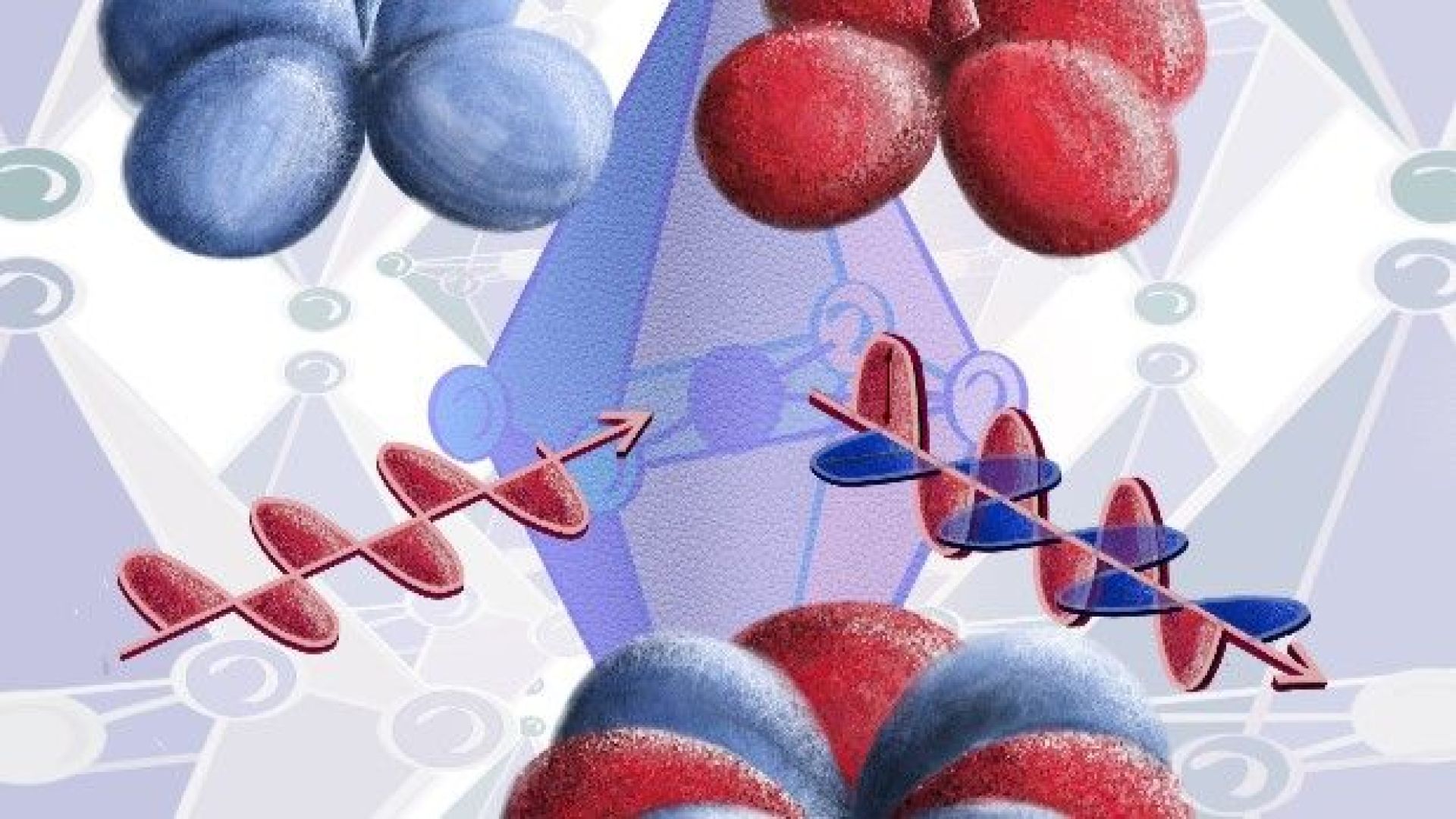
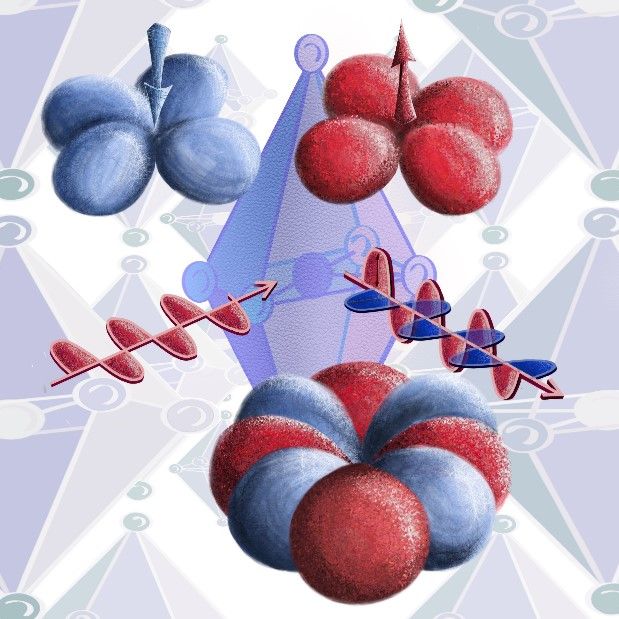
In a solid, electrons have several degrees of freedom. They occupy orbitals with different energies and spatial distributions, which determine how they move through the crystal. This motion affects their spin due to relativistic effects, where the electrons perceive an effective magnetic field in their rest frame. This interaction is known as spin-orbit coupling, where the electron’s orbital motion becomes intertwined with its spin state.
What is the Jahn-Teller effect?
Another key interaction comes from the lattice of ions in the crystal. Electrons interact with these ions and can locally distort the arrangement of surrounding nuclei. A specific form of this electron-lattice interaction is the Jahn-Teller effect, where the system lowers its energy by distorting the lattice and localizing the electrons. This leads to a coupling between the spin, orbital, and lattice degrees of freedom, resulting in entangled states.
How are they related and what is new in this study?
In this work, researchers demonstrate that electromagnetic waves can be used to detect these spin-orbit entangled states at specific resonance frequencies. This opens up a new way to study the dynamic coupling of these degrees of freedom in a broad range of strongly correlated materials. This approach provides insight into their rich phase diagrams, including charge and orbital order, complex magnetic phases, and metal-insulator transitions. It offers a path to explore the intricate interplay between spin, orbital, and lattice interactions, particularly in 3D correlated systems.
This is a study led by ICMAB researchers in collaboration with researchers from the Universitat de Barcelona (UB) and the Universitat Rovira i Virgili (URV). The study has been published in Nature Communications.
Reference Article
Spin-orbit entanglement driven by the Jahn-Teller effect
Alejandro S. Miñarro, Mario Villa, Blai Casals, Florencio Sánchez, Jaume Gázquez & Gervasi Herranz.
Nat Commun 15, 8694 (2024)
doi.org/10.1038/s41467-024-52848-8
Related Article
Jahn-Teller states mixed by spin-orbit coupling in an electromagnetic field
A. S. Miñarro and G. Herranz
Phys. Rev. B 106, 165108 (2022)
doi.org/10.1103/PhysRevB.106.165108
More information
Spin-orbit entanglement driven by the Jahn-Teller effect (Scientific Highlight at ICMAB website)
Jahn-Teller states mixed by spin-orbit coupling in an electromagnetic field (Scientific Highlight at ICMAB website)