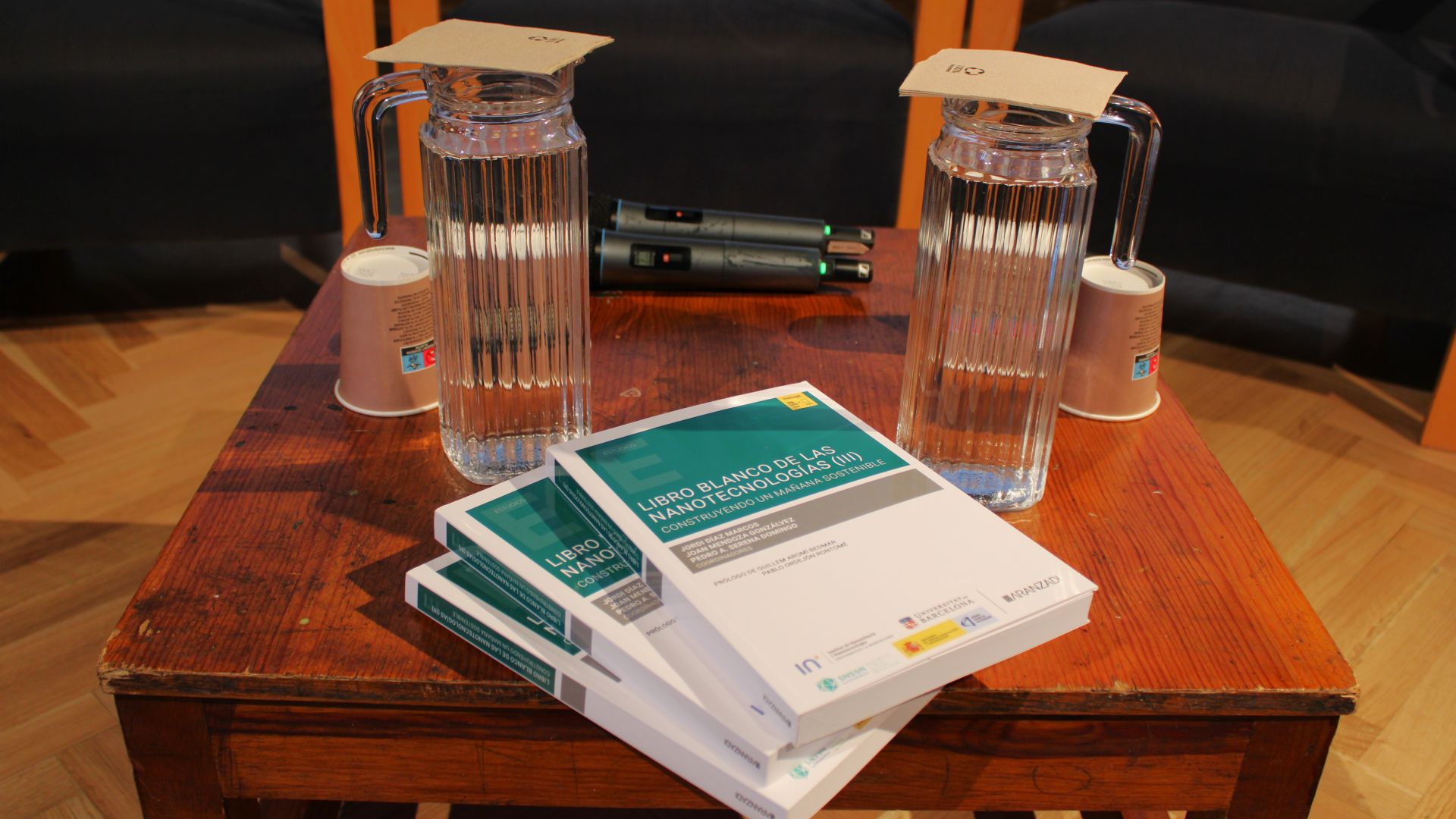
On April 9, the Centre Cultural Casa Elizalde in Barcelona hosted the presentation of the III Libro Blanco de las Nanotecnologías (Third White Book on Nanotechnologies), a collective work promoted by the Spanish Network for Safe and Sustainable Nanotechnologies (SNSSN), bringing together contributions from more than 80 experts from academia and the scientific community, representing the 13 centres that are part of the network.
The event featured a series of presentations on the network and the book’s contents, including opening talks by CSIC Prof. Pablo Ordejón and Guillem Aromí, directors of ICN2 and IN2UB, respectively, who are also authors of the book’s forewords. This was followed by two roundtable discussions:
- The first, titled “Advances in Nanotechnology and Sustainability”, brought together several researchers and contributing authors, including Gemma Rius (IMB-CNM, CSIC), Víctor Puntes (ICN2 / VHIR), Xavier Obradors (ICMAB, member of the SUMAN research group), and M. José Esplandiu (ICN2), to discuss the role of nanotechnology in the energy transition, as well as in health and environmental protection.
- The second roundtable, “Nanotechnology and Sustainability in Public Policy”, included participants from public institutions, featuring Núria Benítez (CERCA), Teresa Sanchis (Department of Research and Universities, Catalan Government), and Oriol Recasens (Barcelona City Council), focusing on how these technologies can be integrated into policymaking. The discussion also addressed strategies to bring science closer to society.
A roadmap towards a more sustainable future
Coordinated by Jordi Díaz Marcos, Joan Mendoza Gonzálvez (CCiTUB) and Pedro A. Serena Domingo (ICMM, CSIC), the book brings together contributions from a wide range of experts within the SustainableNano – SNSSN, which connects 13 research centers. It is structured into six chapters that explore key areas where nanotechnology plays a crucial role:
- The impact of nanotechnology on science, policy and society
- The potential of nanomaterials for innovation
- The link between energy and sustainability — from catalysts to smart buildings
- Achievements and challenges related to water, the environment and agri-food systems
- Nanomedicine, with a focus on early diagnosis, personalised medicine and tissue regeneration
- Information and communication technologies (ICT) and their role in sustainable development
- The impact of nanotechnology on science, policy, and society
Through its participation, ICMAB reaffirms its commitment to advancing safe, responsible nanotechnology aligned with global sustainability goals.
Read more
Libro Blanco de las Nanotecnologías (III): Presented in both Madrid and Barcelona – SNSSN – SustainableNano