The article is coauthored by R. Justin Grams, Webster L. Santos, Ion Romulus Scorei, Antonio Abad-García, Carol Ann Rosenblum, Andrei Bita, Hugo Cerecetto, Clara Viñas, Marvin A. Soriano-Ursúa.
The traditional reliance on organic chemistry as the foundation of modern biomedical chemistry has led to remarkable outcomes. Despite these achievements, experts in medicinal chemistry (a highly interdisciplinary science combining organic chemistry with other fields such as biochemistry, computational chemistry or pharmacology) continue to develop new drugs to improve clinical efficacy against persistent challenges. Over the last fifty years, boron has risen as a key element in medicinal chemistry, steadily gaining momentum and recognition as a vital tool for probing biological activity.
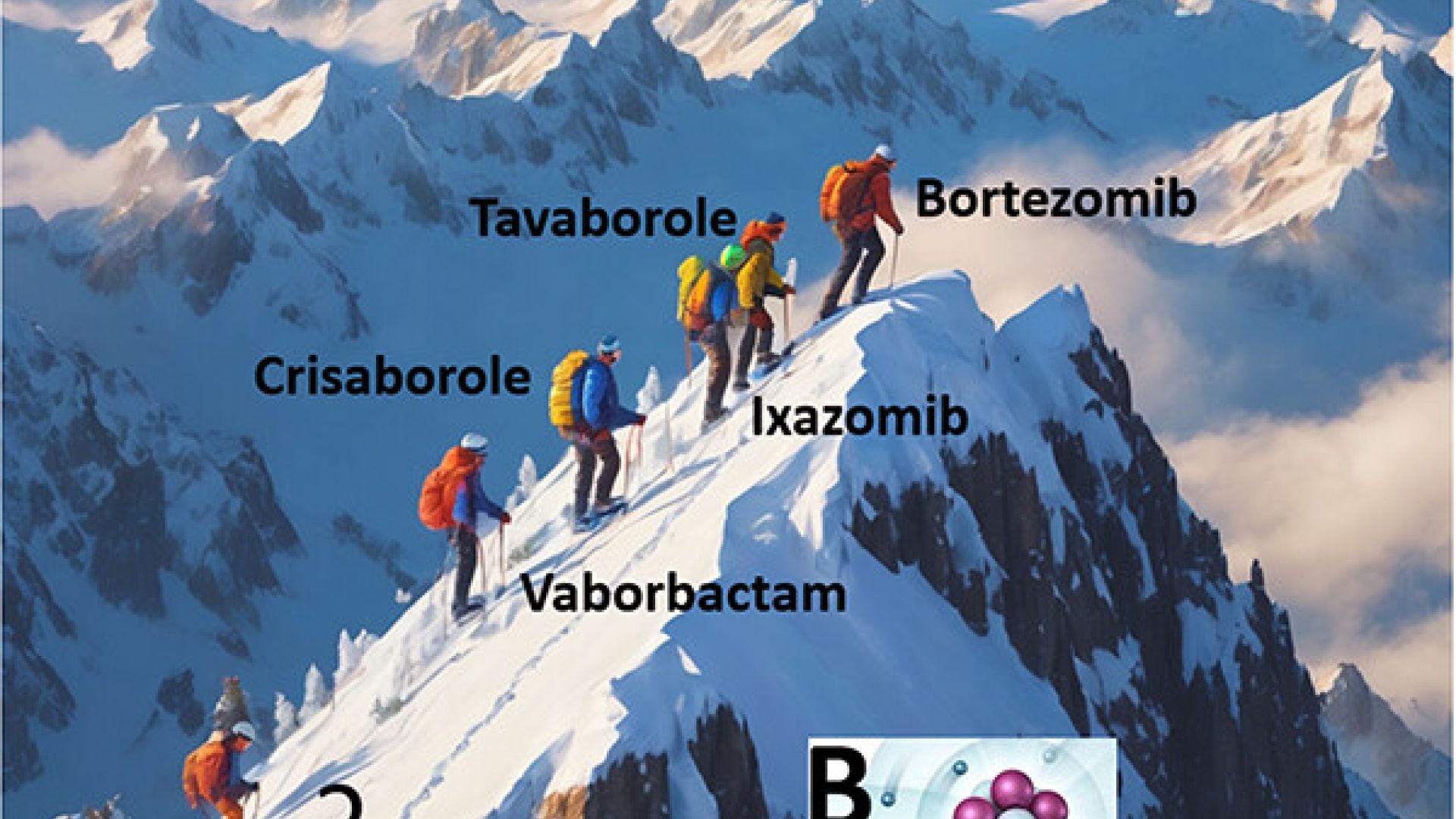
This comprehensive review explore into the emergence of boron-containing compounds providing a critical analysis of these compounds, their synthesis and their myriad applications and targets in medicinal chemistry as well as their promising future perspectives in this field.. Prof. Clara Viñas from ICMAB is co-author of the review together with by R. Justin Grams* and Webster L. Santos* (Virginia Tech Center for Drug Discovery), Ion Romulus Scorei (BioBoron Research Institute), Antonio Abad-García (Escuela Superior de Medicina del Instituto Politécnico Nacional de Mexico), Carol Ann Rosenblum (Virginia Tech Center for Drug Discovery), Andrei Bita (University of Medicine and Pharmacy of Craivoa), Hugo Cerecetto (Centro de Investigaciones Nucleares de Uruguay), and Marvin A. Soriano-Ursúa* (Escuela Superior de Medicina del Instituto Politécnico Nacional de Mexico). The article cover offers an artistic graphical overview of the accomplishments highlighted in the review.
About the review
Boron-containing compounds (BCC) have emerged as important pharmacophores. To date, five BCC drugs (including boronic acids and boroles) have been approved by the FDA for the treatment of cancer, infections, and atopic dermatitis, while some natural BCC are included in dietary supplements. Boron’s Lewis acidity facilitates a mechanism of action via formation of reversible covalent bonds within the active site of target proteins. Boron has also been employed in the development of fluorophores, such as BODIPY for imaging, and in carboranes that are potential neutron capture therapy agents as well as novel agents in diagnostics and therapy. The utility of natural and synthetic BCC has become multifaceted, and the breadth of their applications continues to expand. This review covers the many uses and targets of boron in medicinal chemistry.
Reference article
The Rise of Boron-Containing Compounds: Advancements in Synthesis, Medicinal Chemistry, and Emerging Pharmacology
R. Justin Grams*, Webster L. Santos*, Ion Romulus Scorei, Antonio Abad-García, Carol Ann Rosenblum, Andrei Bita, Hugo Cerecetto, Clara Viñas*, and Marvin A. Soriano-Ursúa*
Chemical Reviews 2024 124 (5), 2441-2511
DOI: 10.1021/acs.chemrev.3c00663