

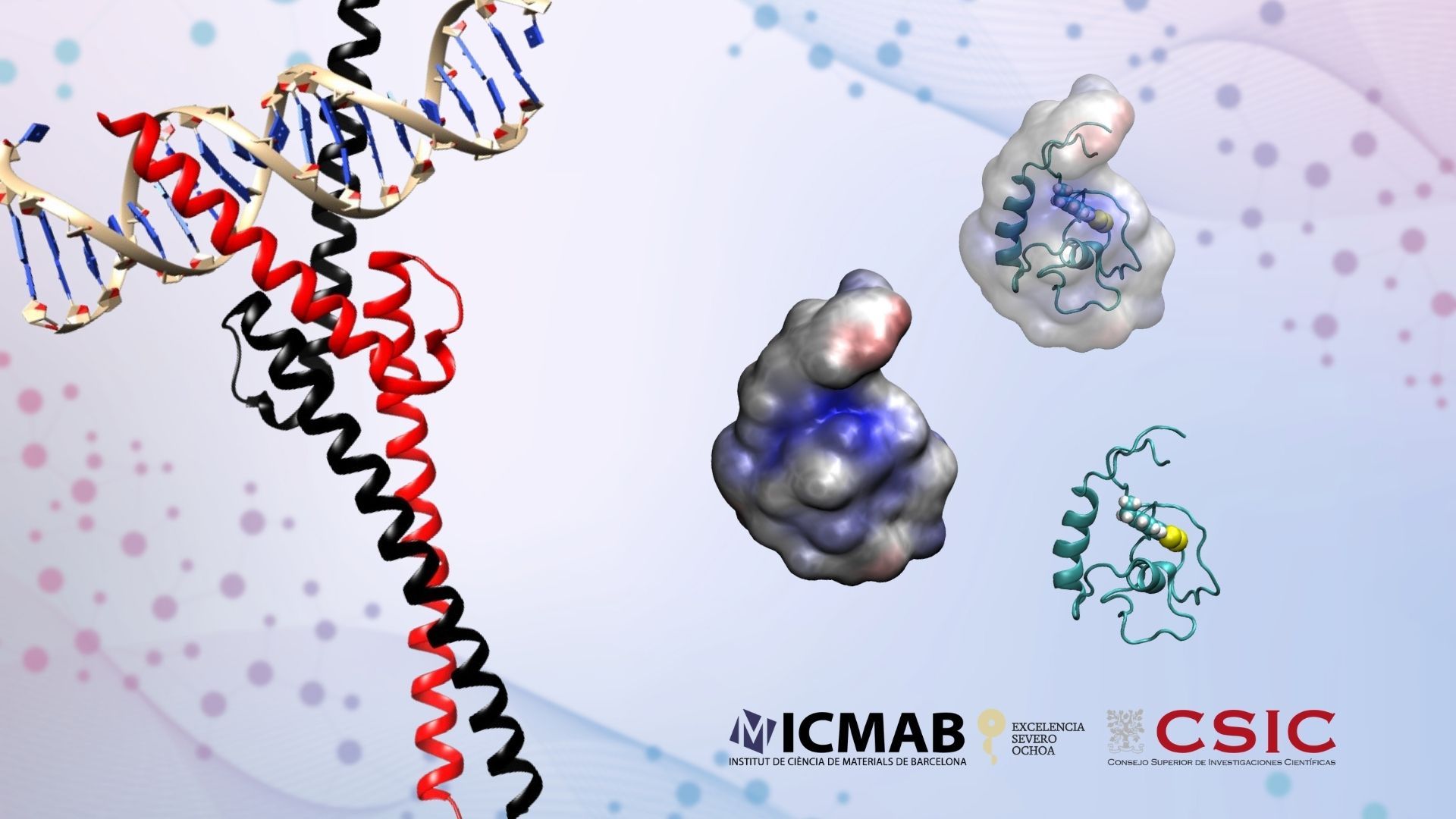
Researchers from the Institute of Materials Science of Barcelona (ICMAB-CSIC) Huixia Lu and Jordi Faraudo, together with Jordi Martí (UPC), have discovered that MAX, when studied on its own, adopts shapes very different from the rigid forms seen in crystallography. “For many years, we had thought the scissor shape of this couple we saw via X-ray was the shape in real-world conditions. Now we see it is not”, says the senior researcher Jordi Faraudo. The idea for drug researchers is to suppress either of the two molecules before they combine and become overexpressed, thereby reducing cancer growth. This study suggests that the shapes they were aiming for may not be accurate.
Until now, most studies relied on X-ray crystallography, which showed MYC and MAX in a rigid scissor-like shape. But proteins in living cells are not static. Using advanced molecular simulations, the team explored how MAX behaves in aqueous solution and found that it does not stick to its crystallised structure. Instead, it adopts several alternative shapes that require much less energy and are therefore much more likely to occur in real biological conditions.
This discovery changes the game, says Faraudo: “the most optimal way to combat its overexpression is another one that targets other shapes.” To which Huixia Lu adds: “This might help explain why MAX has remained difficult to target with drugs since its first structure was solved more than 30 years ago.”
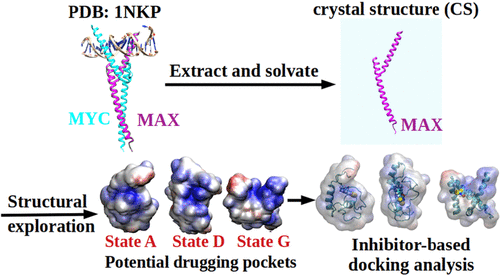 Graphical abstract of the investigation | Lu et al., available in ACS
A new hope for drug design
A question remains
Reference
Probing the Structural Dynamics of the Unbound MAX Protein: Insights from Well-Tempered Metadynamics
Lu, H., Marti, J., & Faraudo, J.
Journal Of Chemical Information And Modeling. 2025.
DOI: 10.1021/acs.jcim.5c02155
More news