

Both Anna Roig (NN research group) and Mariano Campoy (NANOPTO research group) groups at ICMAB-CSIC will participate as partners in different MSCA Doctoral Network initiatives. Specifically, Anna Roig takes part in the STEM-CORE project, while Mariano Campoy contributes to FADOS.
STEM-CORE: Stem Cell Therapy Development for Corneal Epithelium Regeneration
STEM-CORE addresses one of the leading causes of blindness worldwide: corneal disease, a condition that remains challenging to treat. This MSCA-funded Doctoral Network provides an international, intersectoral platform to train a new generation of researchers in developing more effective therapies for damaged corneas.
The Doctoral Network aims to develop a sustainable and affordable stem cell therapy to restore vision in patients with corneal blindness caused by stem cell deficiency. Led by Jo Huiqing Zhou from the Research Institute for Molecular Life Science (RIMLS) – Radboud University (The Netherlands), STEM-CORE brings together top scientists and supervisors from nine countries across Europe, representing both academic and non-academic sectors.
Through interdisciplinary and intersectoral research, STEM-CORE offers a comprehensive training program covering the full trajectory of stem cell therapy development. Doctoral candidates acquire advanced research skills alongside transferable competencies, preparing them to translate innovative eye therapies from the lab to the clinic and enhancing their career prospects in both academia and industry.
At ICMAB-CSIC, the Nanoparticles and Nanocomposites (NN) group, led by Anna Roig, has expertise on bioactive nanomaterials for nanomedicine applications, such as nanocellulose corneal patches that protect and accelerate regeneration, combining biocompatibility, flexibility, and cell-supportive properties, for example. In this project, the PhD fellow at ICMAB will develop bioactive biobased hydrogels for corneal (stem) cell culture as an animal-free cell scaffold and will profit from internships in other consortium labs.
Partners in this STEM-CORE project are:
- Stichting Radboud Universiteit, NL, coordinator
- Institut de Ciència de Materials de Barcelona (ICMAB-CSIC), ES
- Tampereen Korkeakoulusaatio, FI
- Fondazione Banca degli Occhi del Veneto Onlus, IT
- Izmir Biyotip ve Genom Merkezi, TR
- Klinikum der Universitaet zu Koeln, DE
- Linköpings Universitet, SE
- Institut National de la Santé et de la Recherche, FR
- Universität des Saarlandes, DE
- Biotalentum Tudasfejleszto Kft, HU
This project is due to start on 1 January 2026 and has been awarded a total of approximately 4.1 million euros in funding. Find more information on the project and recruitment process here.
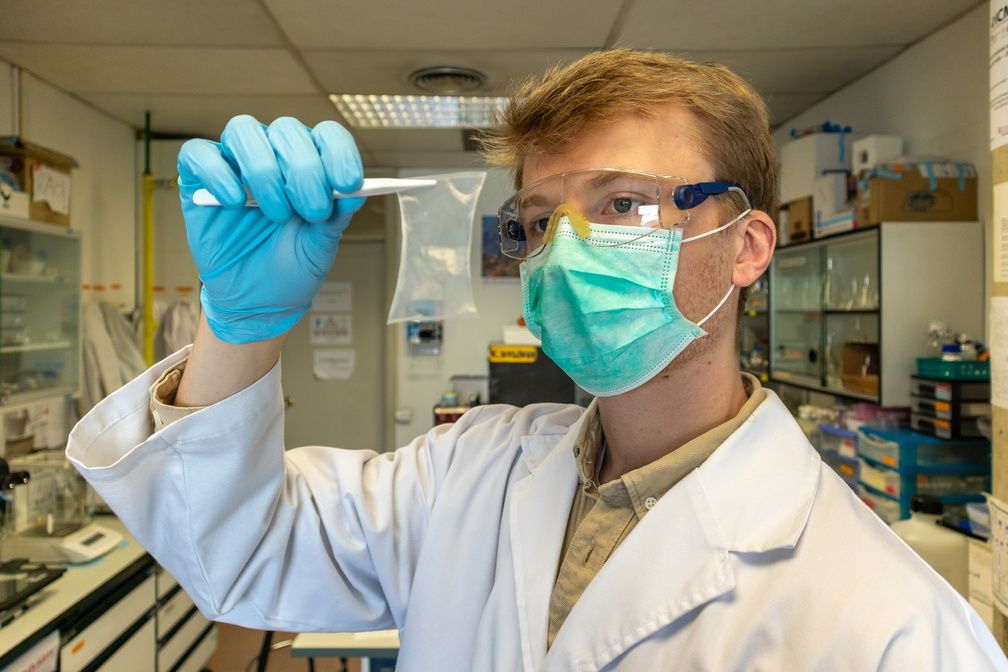
Thomas Meslier, researcher at the NN group holding a sample of bacterial nanocellulose in the NN lab | ICMAB-CSIC
FADOS: Fundamentals and Applications of Doped Organic Semiconductors
The FADOS project, funded under the Marie Skłodowska-Curie Actions, is an international doctoral network that aims to train the next generation of researchers in advanced organic semiconductors. FADOS focuses on spatio-temporal control of doping and its influence on all material properties—including electronic, thermal, mechanical, and biological aspects—enabling both solutions to urgent technological challenges and the creation of novel switchable and reconfigurable devices.
FADOS brings together a consortium of 8 universities, 4 research institutes, and 4 companies, covering major application areas in organic electronics such as light emission, photovoltaics, logic circuitry, and instrumentation. The network combines academic and commercial training, giving doctoral candidates exposure to both research and industry environments while developing scientific, entrepreneurial, and transferable skills. On the short to medium term, FADOS aims to strengthen European competitiveness in growing high-tech markets, while on the longer term it aspires to open new fields in sustainable and multifunctional soft semiconductors. The FADOS network is coordinated by Prof. Dr Martijn Kemerink, a researcher at the Institute for Molecular Systems Engineering and Advanced Materials at Heidelberg University.
The Nanostructured Materials for Optoelectronics and Energy Harvesting (NANOPTO) group at ICMAB, led by Mariano Campoy, contributes to FADOS with its expertise in synthesizing and characterizing advanced semiconductor nanostructures. The group focuses on understanding the relationship between material structure and performance, developing devices such as organic solar cells, photodetectors, and light-management systems. Through advanced spectroscopy, precise processing techniques, and combinatorial screening, NANOPTO supports both fundamental research and applied innovation, bridging the gap between scientific discovery and technological application.
Partners in the FADOS project, apart from ICMAB, are:
- Ruprecht-Karls-Universität Heidelberg, GE, coordinator
- Institut de Ciència de Materials de Barcelona (ICMAB-CSIC), ES
- Chalmers Tekniska Högskola AB, SE
- Linköpings Universitet, SE
- Fondazione Istituto Italiano di Tecnologia, IT
- Centre National de la Recherche Scientifique, FR
- University of Stuttgart, GE
- Imperial College of Science, Technology and Medicine, UK
- Universidade da Coruña, SP
- FlexEnable Technology Limited, UK
- Epishine AB, SE
- Lunalec AB, SE
- The University of Liverpool, UK
- Forschungszentrum Jülich GmbH, GE
This project is due to start on 1 September 2025 and has been awarded a total of approximately 4.7 million euros in funding.

Mariano Campoy, researcher and leader at the NANOPTO group with organic solar cell samples in the NANOPTO lab | ICMAB-CSIC
About MSCA Doctoral Networks
Doctoral Networks (DN) are funded under the Marie Skłodowska-Curie Actions (MSCA) programme (Horizon Europe) and aim to provide excellent training opportunities for doctoral candidates. These networks bring together universities, research centres, companies—including SMEs—and other organisations across Europe and beyond.
Through this collaborative framework, they not only address pressing research and innovation challenges but also expose early-stage researchers to both academic and non-academic environments. The ultimate goal is to foster scientific creativity, strengthen innovation capacity, and enhance long-term employability by combining advanced research training with transferable skills development.
Doctoral Networks can last up to four years (five for Joint Doctorates) and funding covers researchers’ salaries through a living allowance, a mobility allowance, and, where applicable, family or special needs allowances, as well as costs related to research, training, networking, and project management.
The current call is now open and will close on 25 November 2025.
Read more
