

A team of researchers at ICMAB, in collaboration with researchers from CINBIO (Centro de Investigación en Nanomateriais e Biomedicina, Universidade de Vigo), has made a significant breakthrough in understanding the temperature dependence of the energy gap in metal halide perovskite nanocrystals. Their study, recently published in The Journal of Physical Chemistry Letters and featured on the cover, sheds light on an unusual vibrational phenomenon that influences the electronic properties of these materials, with potential implications for optoelectronic applications such as solar cells and LEDs.
Unraveling the temperature dependence of the band gap
The band gap is one of the most fundamental properties of semiconductors, as it determines how they interact with light and how efficiently they can convert energy. In this study, the researchers focused on mixed-halide CsPb(Br,Cl)₃ nanocrystals, which exhibited an unexpected reversal in the temperature dependence of their band gap near ambient conditions. Specifically, below a chlorine concentration of approximately 40%, the gap increased with increasing temperature, while above this threshold, it decreased—an effect that had remained unexplained until now.
The team’s experiments revealed that this behavior is driven by rattler-like vibrational modes associated to oscillations of the Cs cations within the perovskite structure that significantly alter electron-phonon interactions. These Cs rattler modes, previously known in thermoelectric materials, had never before been linked to such a dramatic effect on the band gap in perovskites.
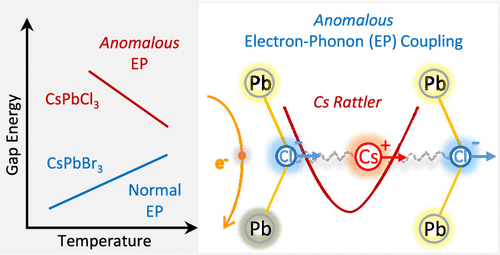 Graphical Abstract of the article published in The Journal of Physical Chemistry Letters by Goñi et al. Reprinted with permission from DOI: 10.1021/acs.jpclett.4c03491. Copyright 2025. American Chemical Society.DOI: 10.1021/acs.jpclett.4c03491
Impact on optoelectronic applications
Understanding how temperature affects the band gap in perovskite nanocrystals is crucial for improving their performance, for example, in light emitting devices (LEDs). The findings of this study could pave the way for designing materials with more stable and tunable electronic properties, enhancing their efficiency and reliability in real-world applications.
“Our work addresses a very fundamental aspect of the optoelectronic properties of metal halide perovskite nanocrystals, and we expect it to have significant technological impact,” ICREA researcher at ICMAB-CSIC, Alejandro Goñi, explained.
What’s next?
Following this discovery, the team is now exploring other perovskite systems where similar anomalous electron-phonon interactions might occur. One promising direction involves mixed-cation FAxMA₁₋ₓPbI₃ single crystals, where preliminary results suggest a comparable effect related to the dynamics of formamidinium (FA) cations.
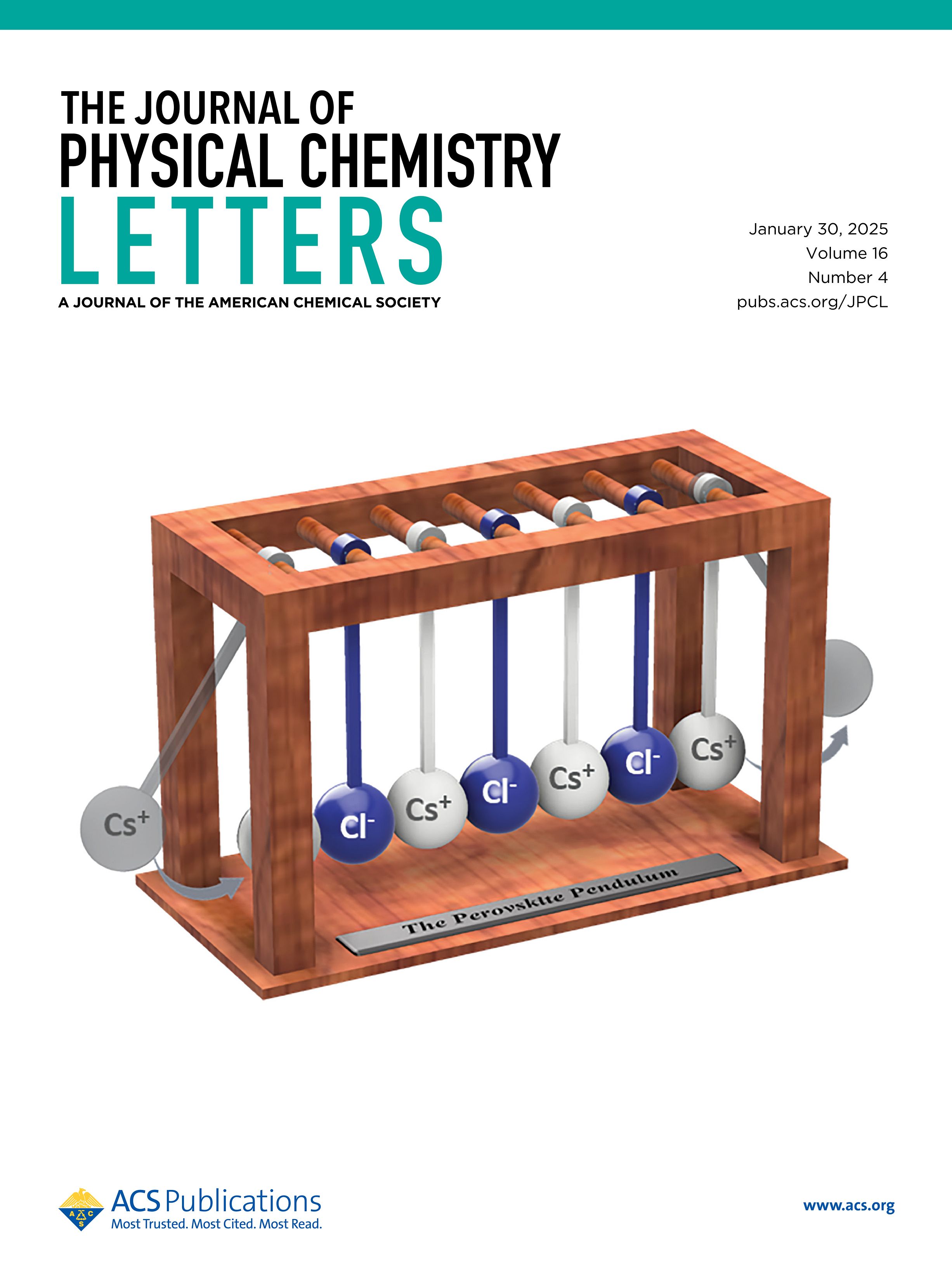
Cover featuring the article by Goñi et al. in The Journal of Physical Chemistry Letters. Reprinted with permission from DOI: 10.1021/acs.jpclett.4c03491. Copyright 2025. American Chemical Society.DOI: 10.1021/acs.jpclett.4c03491
Cover recognition
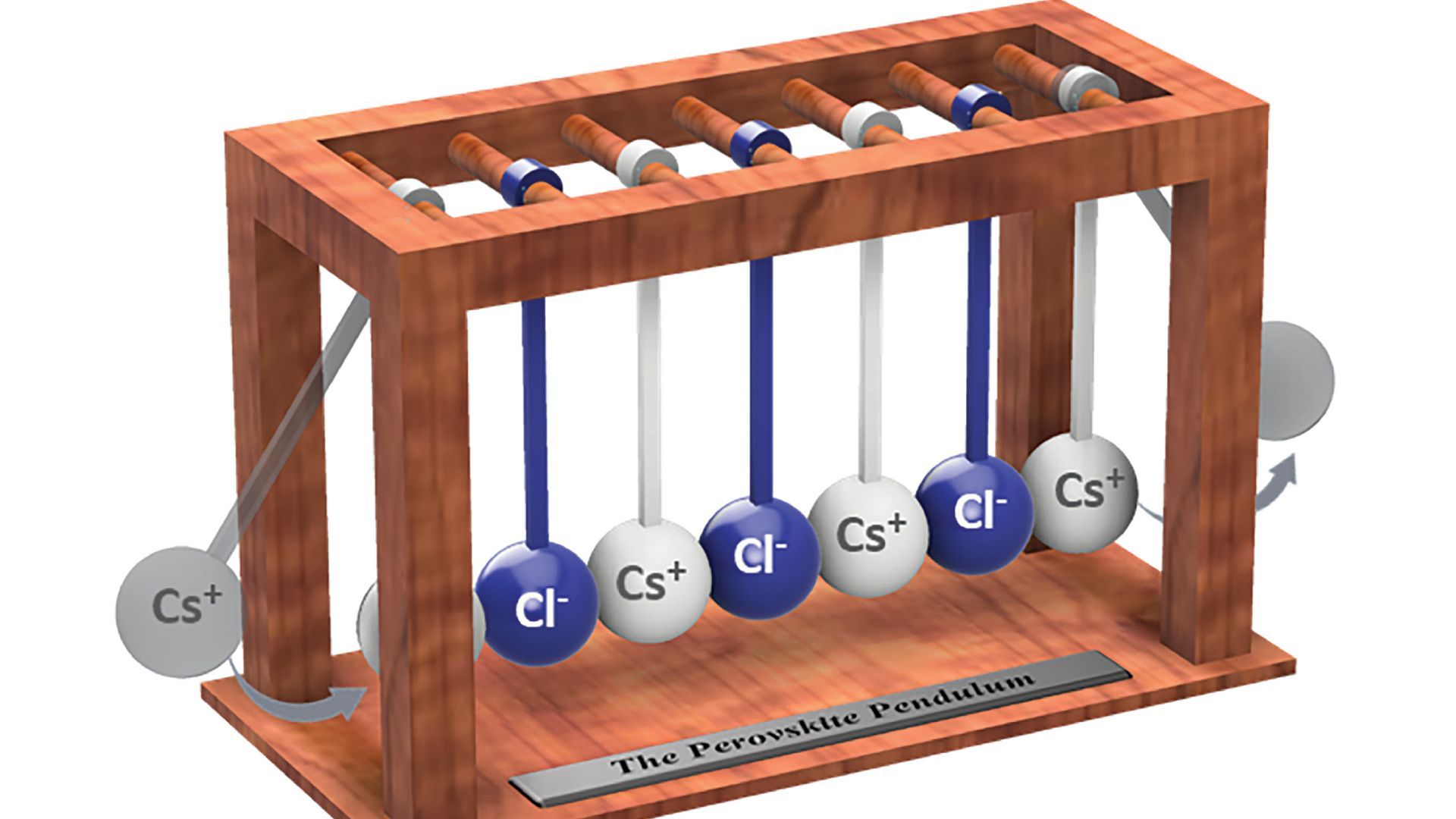
The significance of this research was highlighted with a The Journal of Physical Chemistry Letters cover feature. The cover illustration, inspired by Newton’s pendulum, visually represents the interplay between the inorganic perovskite cage and the loosely bound cesium (Cs) cations—an analogy to the rattler modes that govern the unusual temperature behavior of these materials.
This work represents a major step forward in the fundamental understanding of perovskite nanocrystals and their potential for next-generation optoelectronics.
Reference article
Sign of the Gap Temperature Dependence in CsPb(Br,Cl)3 Nanocrystals Determined by Cs-Rattler-Mediated Electron–Phonon Coupling
Shima Fasahat, Nadesh Fiuza-Maneiro, Benedikt Schäfer, Kai Xu, Sergio Gómez-Graña, M. Isabel Alonso, Lakshminarayana Polavarapu, and Alejandro R. Goñi
DOI: 10.1021/acs.jpclett.4c03491
The Journal of Physical Chemistry Letters 2025 16 (4), 1134-1141