

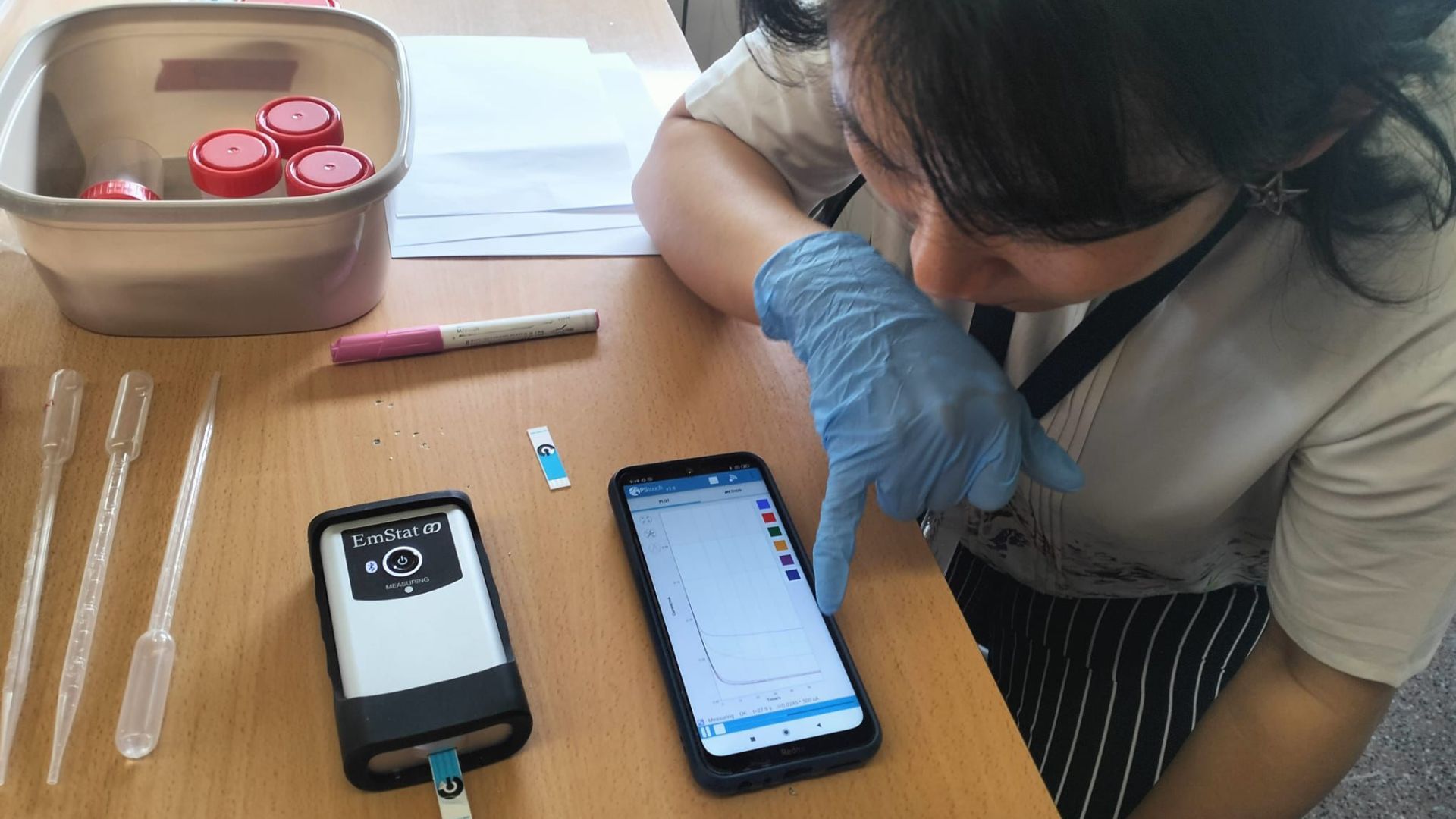
One of the project's central objectives is to engage in citizen science, introducing teenagers to the upcycling process while engaging with hand-on experiments. The three schools visited were INS Manolo Hugué in Caldes de Montbui; INS Castellar in Castellar del Vallès; and INS L'Estatut in Rubí.
“We visited three schools to show students how waste materials can be transformed into conductive inks for sensor design. The students learned the science behind the process, experimented with different water samples, and saw how water quality can be quickly assessed. Their response was very positive: they engaged actively, asked many questions, and showed genuine interest in both the results and the science behind them.” said Muling Zeng, postdoc at the Nanoparticles and Nanocomposites group and responsible of these activities.
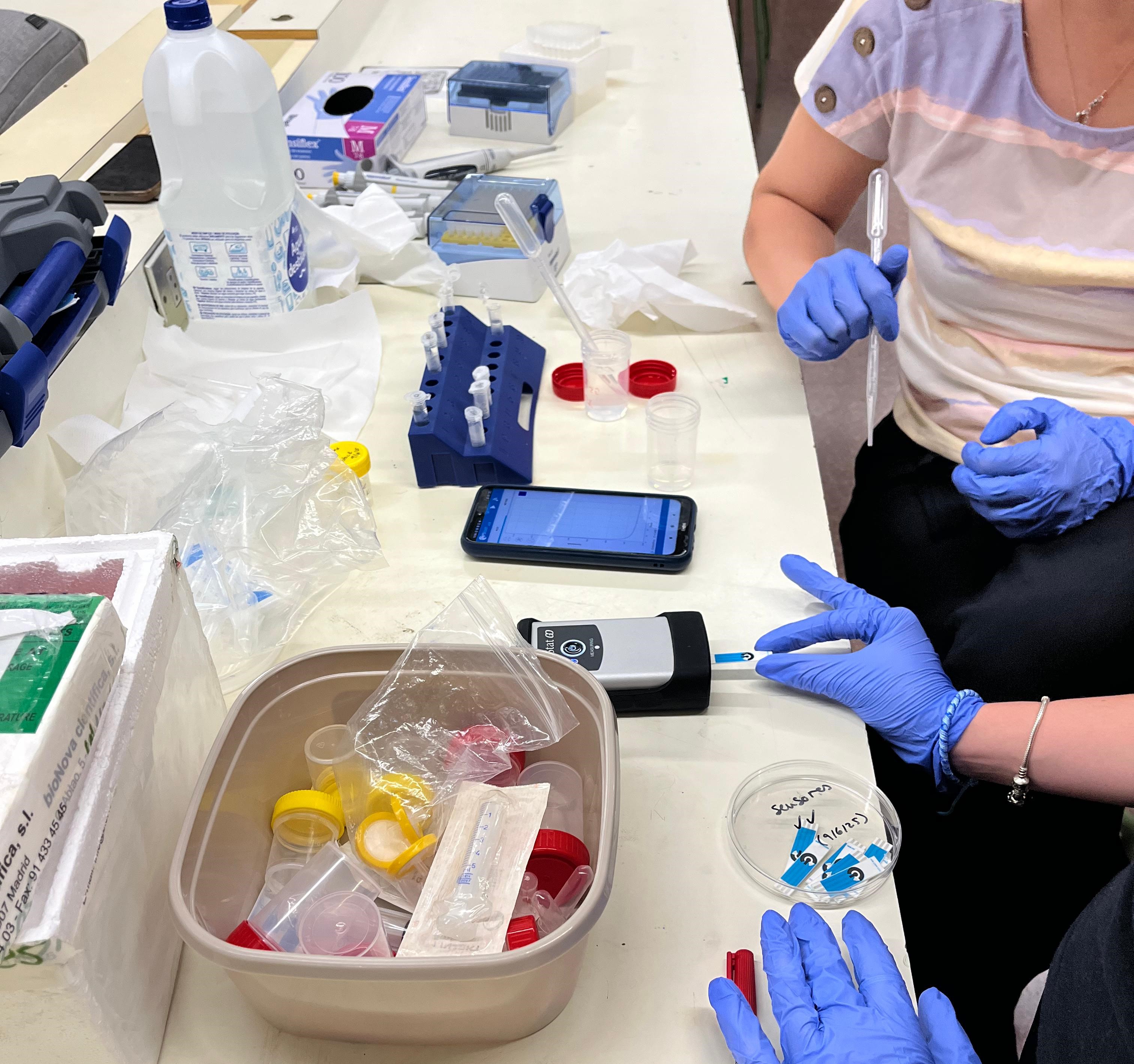 Student using the sensor at Castellar del Vallès highschool | ICMAB-CSIC
Turning waste into useful sensors
Wood and textiles are among the most common leftovers produced. According to the Waste Agency of Catalonia, around 12% of the municipal waste generated in Catalonia comes from these two kinds of residues. The UPCYCLING-NOW researchers cooked these materials at high temperature without oxygen, a process known as a pyrolysis, to obtain carbon powder. It was then transformed into low-cost, conductive inks that were used to fabricte biodegradable environmental sensors.
The sensors created to showcase in these schools were specifically engineered to measure the Chemical Oxygen Demand (COD) in water. COD is a factor of water pollution due to the excess of organic matter. The research team engaged with students to teach them about the chemical processes behind these sensors and accompanied them at field tests in nearby waters, which allowed comparing the different COD levels in different water sources, such as streams, stagnant waters, or supermarket water.
"Students were highly engaged, asked lots of insightful questions, and were genuinely interested in both the water test results and the science behind them"
In total, 41 teenagers participated in the project. "During each school visit, we introduced the scientific theory behind the process, explained the concept of upcycling, and guided the students through testing various water samples—collected from local rivers, fountains, or even dirty water from the schools themselves—to evaluate water quality in a quick way", says Muling Zeng, who adds that the visits went very well: "students were highly engaged, asked lots of insightful questions, and were genuinely interested in both the water test results and the science behind them. We truly enjoyed the experience."
About the project
UPCYCLING-NOW (Upcycling Organic Waste into Carbon-based Functional Inks for Environmental Sensing and Smart Textiles) project (TED2021-130819B-I00) is funded by the Spanish Ministerio de Ciencia e Innovación within the «Proyectos Estratégicos Orientados a la Transición Ecológica y a la Transición Digital» 2021 call.
The project ran from December 2022 to July 2025. Led by Martí Gich (ICMAB-CSIC) and César Fernández-Sánchez (IMB-CNM-CSIC), the project developed carbon-based inks from biopolymer waste for smart textiles and biodegradable water sensors through energy-efficient processes.
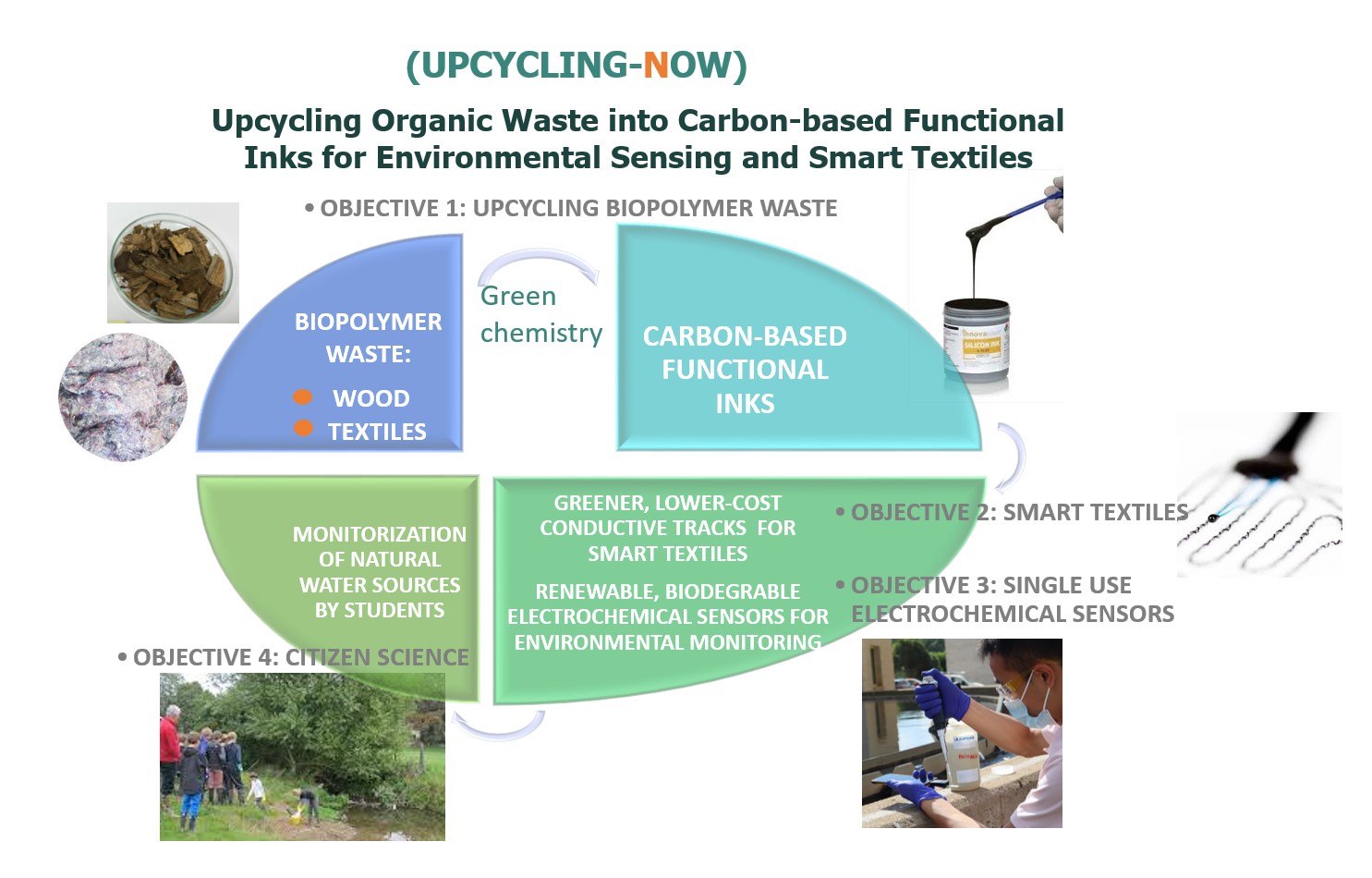 Objectives of the UPCYCLING-NOW project | NN group, ICMAB-CSIC
Using green chemistry strategies like hydrothermal/solvothermal treatment and catalytic carbonization, combined with pyrolysis, the project aimed to create innovative, eco-friendly inks with reduced energy demands. These inks were tested for applications in smart textiles and as biodegradable electrodes for simple onsite water contamination monitoring. Additionally, the sensors supported educational activities on water eutrophication, such as the one described here, laying the groundwork for future outreach initiatives.P
Project TED2021-130819B-I00 funded by: