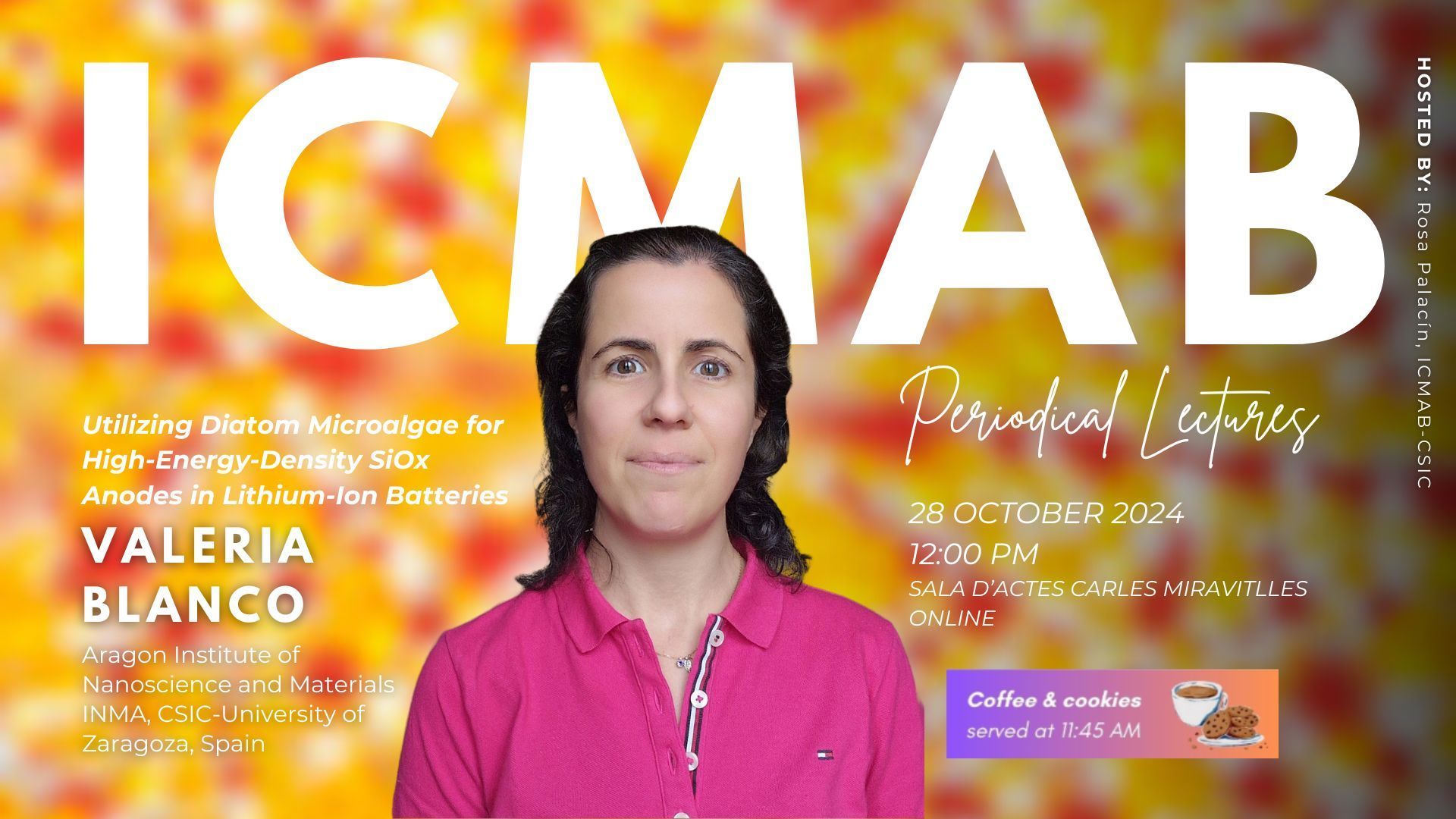
Utilizing Diatom Microalgae for High-Energy-Density SiOx Anodes in Lithium-Ion Batteries
Maria Valeria Blanco, Aragon Institute of Nanoscience and Materials (INMA, CSIC-University of Zaragoza), Spain
Monday 28th October 2024, 12.00 PM
ICMAB - Sala d'Actes Carles Miravitlles
ONLINE (Register here: https://zoom.us/webinar/register/WN_yBoyIjONQQSLCy_oLxMFPQ)
Abstract
Lithium-ion batteries (LIBs) are the dominant technology for powering portable electronics and electric vehicles and are therefore considered a key technological pathway to climate change mitigation and energy security. Hence, the expected increase in demand for LIBs along with the need for a climate neutral economy makes the supply of battery raw materials a strategic challenge at a global level and evidences the need for incorporating low carbon-footprint high-performance sustainably sourced battery components.
Si-based materials offer the possibility of enhancing the energy density of LIB anodes, with a theoretical capacity of 3579 mAhg-1, which is ten times higher than that of conventional graphite used in commercial cells (372 mAhg-1). Nevertheless, its practical application in LIBs faces significant challenges due to the substantial volume changes that occur during lithiation and delithiation, which induce mechanical stress, electrode degradation and rapid capacity fading. Alternatively, nanostructures of SiOx (0<x<2) offer enhanced cycling performance along with specific capacities exceeding 1600 mAhg-1. Importantly, these materials can be produced from the nanoporous shells (frustules) of diatom microalgae.
In this talk, strategies towards the effective implementation of nanostructured SiO2 from single-species industrially cultured diatom microalgae as a sustainable precursor for SiOx anodes are analyzed. Insights on the synthesis of SiOx through SiO2 magnesiothermic reduction by in situ synchrotron X-ray diffraction analysis is provided, and the performance of SiOx materials in SiOx/graphite blended anodes is evaluated.
Short bio
Valeria Blanco earned her PhD in Materials Sciences and Engineering from Balseiro Institute (Argentina), focusing on the development of hydrogen storage alloys for practical applications. In 2016, she joined the ID31 High Energy Diffraction beamline of the European Synchrotron Radiation Facility (ESRF, France) as a postdoctoral fellow, where she specialized in the in-situ characterization of energy storage
devices using X-ray techniques. During her time at ESRF, she established new research initiatives on Li-ion batteries and CO2 solid sorbents.
In 2018, Valeria joined the Norwegian University of Science and Technology (NTNU, Norway) as a postdoctoral fellow, advancing her work on high-capacity silica anodes for Lithium-ion batteries, employing both electrochemical techniques and advanced synchrotron X-ray characterization. By 2020, she became an Adjunct Associate Professor at NTNU and was awarded a “Research Project for Young Talents” to lead a small group for the study SiO2 anodes reaction mechanisms and for developing strategies for its effective implementation in electrochemical cells using state-of-the-art scattering techniques. In 2021, she secured a European project as Principal Investigator, leading an international consortium of six academic and industrial partners to develop sustainable SiOx materials from the exoskeletons of diatom microalgae for high-energy density Lithium-ion batteries.
In 2022, Valeria joined the Aragon Institute of Nanoscience and Materials (INMA, CSIC-University of Zaragoza) with a “Maria Zambrano Grant for the Attraction of International Talents” to further investigate the structure-performance interplay of sustainable anode materials for Lithium-ion batteries. Recently, she was selected as a Ramon y Cajal researcher, and she plans to join ICMAB in 2025 to continue her scientific career.
Valeria has authored over 35 peer-reviewed publications and delivered numerous invited talks at international conferences. She has supervised six Master’s theses and one PhD thesis, and has organized international workshops focused on advanced X-ray techniques for energy storage.