

Núria Garriga [NG], Anna Solé [AS], and Ana Vila [AV] are three scientists working in the Nanoparticles & Nanocomposites group at ICMAB. The three of them are at different stages of their careers.
Núria is a biotechnologist who is doing a Master’s Degree in bioinformatics; she is at the ICMAB, thanks to a JAE Intro scholarship, working on data analysis of work done in C. elegans. Anna Solé first came to the ICMAB thanks to a JAE Intro, too, after studying Physics & Chemistry and a Master’s Degree in Nanoscience & Nanotechnology, but she is now in a later stage: “I am halfway through my PhD. Maybe a little bit over the half.” On the other hand, Ana Vila finished her PhD in Physics in 2022 – previously, though, she had been working in a company, but she preferred to come back to academia: “I'm more of a hands-on, lab person, and I felt I couldn't do as much in the private sector.”
They are three different, complementary profiles working together, showing some of the diverse paths that can lead to a career in science. Their paths reflect some challenges and motivations women find in science. On 11 February, the International Day of Women and Girls in Science, we share their stories.
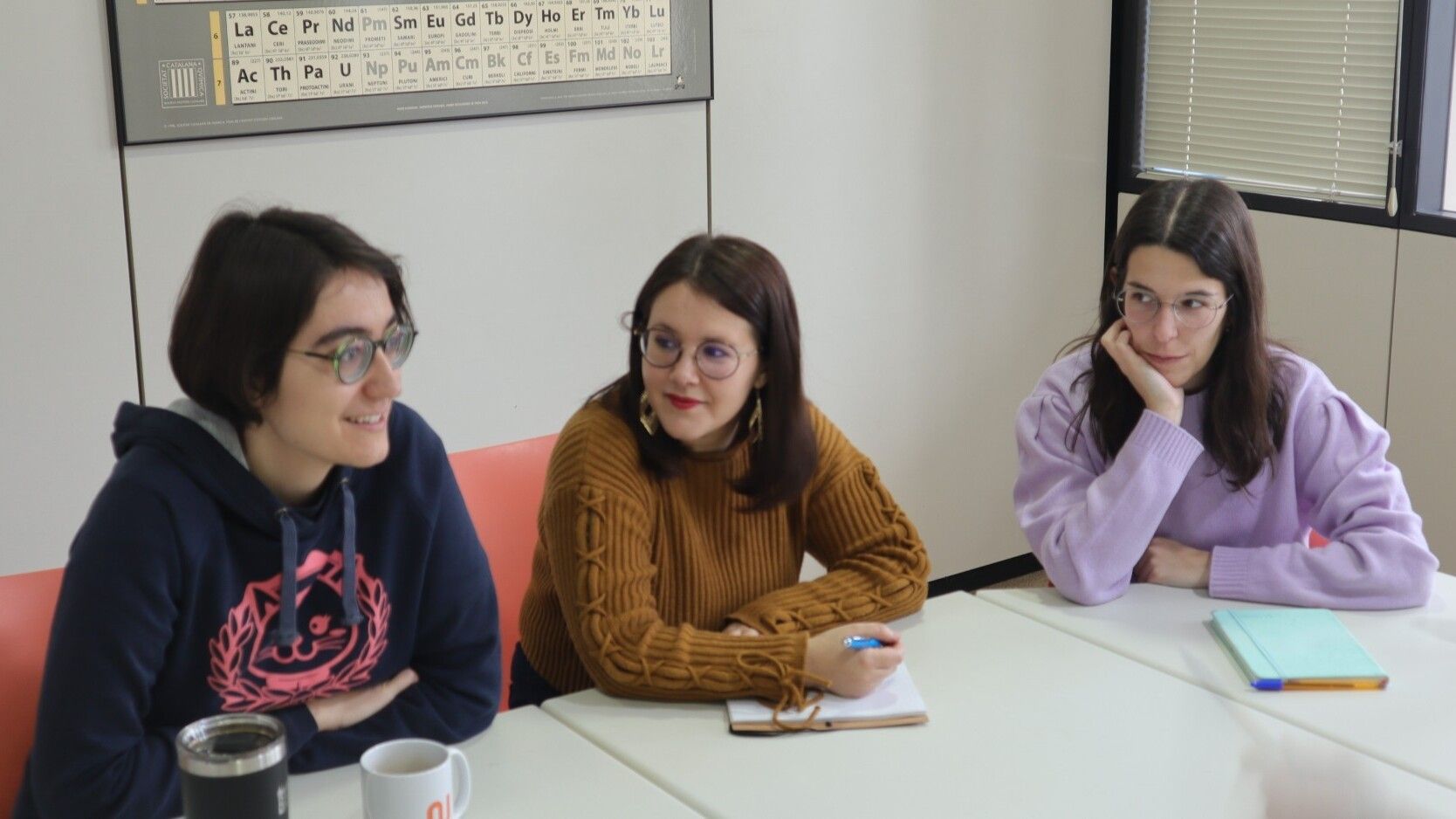 Núria Garriga, Ana Vila and Anna Solé from the NN group at ICMAB during the interview | Oriol Roig, ICMAB-CSIC
¿Did you already like science when you were children, or did you discover it along the way?
NG: I come from a scientific family. Both my parents are physicists, and my brother also leaned toward science. So, in a way, growing up in such a scientific environment, it wasn’t hard for me to like science. Plus, I did well in school, so I just kept going. I think it also depends a lot on the teachers you have during high school.
I found myself leaning more toward biology, but later, I chose bioinformatics. I felt attracted to it partly because it’s a relatively new field, and I thought there would be opportunities; also, because I find it entertaining, and while I like the lab, it can be very demanding. In a biological lab, for example, sometimes you’re very tied to your work. If you’re working with bacteria, it’s fine because you can put them in the fridge and they stop. With C. elegans, it’s not a big deal either, but you might have to catch them at a specific life stage for experiments. I thought, “I like science, but I don’t want to dedicate my entire personal life to it.” With computers, you can leave them running all weekend, and they don’t complain [laughs].
AV: Unlike Núria, I didn’t have anyone scientific at home. No one in my family pursued higher education in general because I’m from Eivissa, and in Eivissa, tourism has always been the main industry. So, almost everyone in my family... Well, my dad did have a computer company, so you could say he was a bit more involved, but it was more commercial than anything else. My mom also worked in tourism. At home, only one of my cousins had gone to university when I started mine.
However, I’ve always been curious and liked science. What first caught my attention was probably space, and that’s partly why I ended up in physics. And I’ve always liked stepping out of my comfort zone. It might sound a bit masochistic, but it’s true. That’s what I enjoy—it’s what pushes me to say, “Oh, I want to study this, I want to explore it. Why not?” I think that’s what has always kept me interested in science and ultimately led me to pursue it as a career.
AS: I also come from a somewhat scientific family–my grandfather is a chemist, and my mom is a biologist. I remember as a kid, I’d get lab kits for Christmas or my birthday and play with them at home with my grandfather, and I was fascinated when we heated a test tube, and the cork would pop off because something was happening inside.
I was also very curious as a kid, and I always liked science more in school. I think I also had many teachers who motivated me to follow this path. I also remember doing maths, physics, or chemistry homework and having a great time. After lunch, I’d think, “Great, time to do maths exercises!” When I finished maths or whatever and then had to switch to Catalan or Spanish homework, I used to feel so lazier, though. But I remember having a lot of fun solving problems and practising things related to numbers. Basically, I think I’ve always been interested in science throughout my childhood and adolescence.
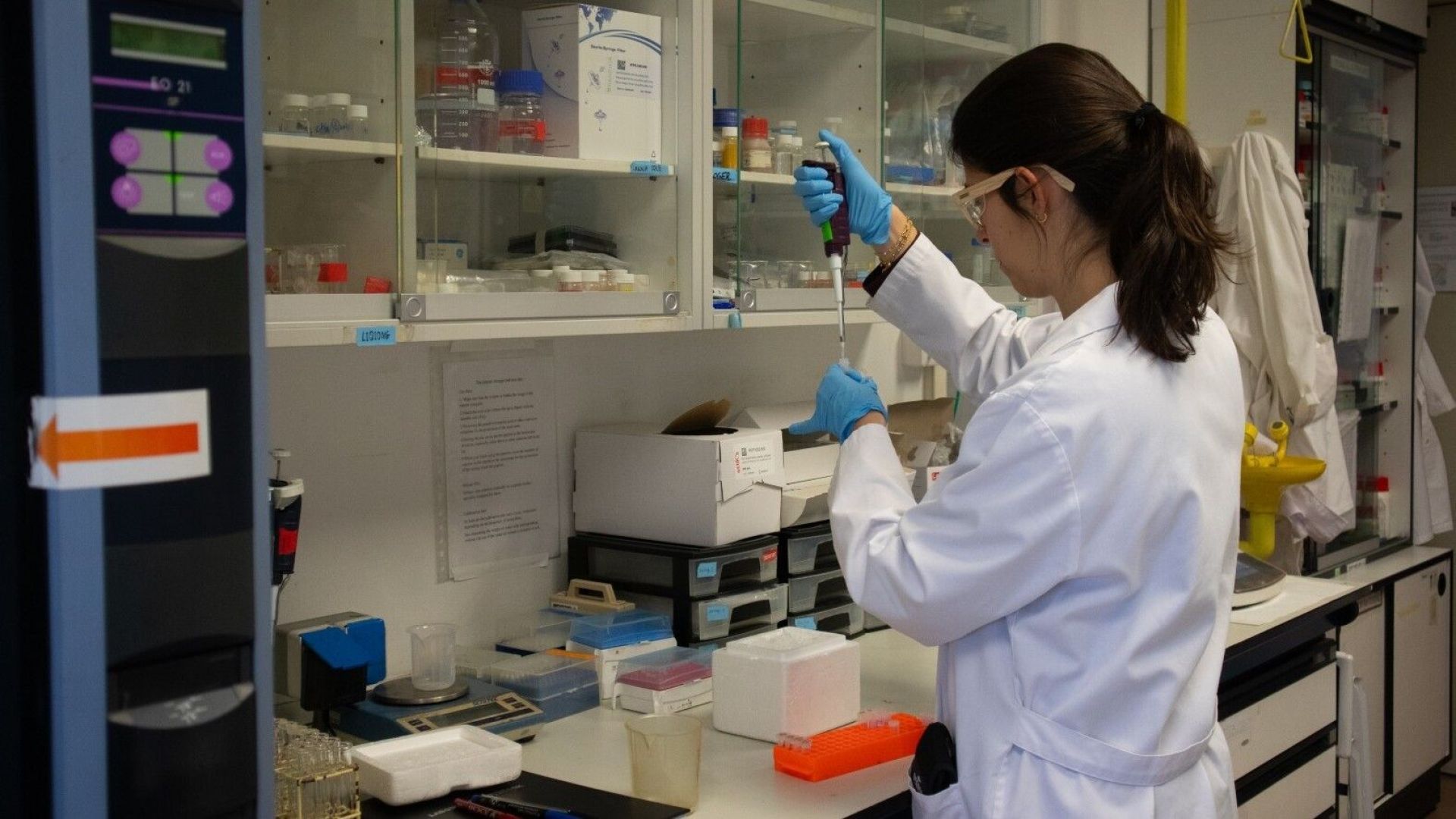
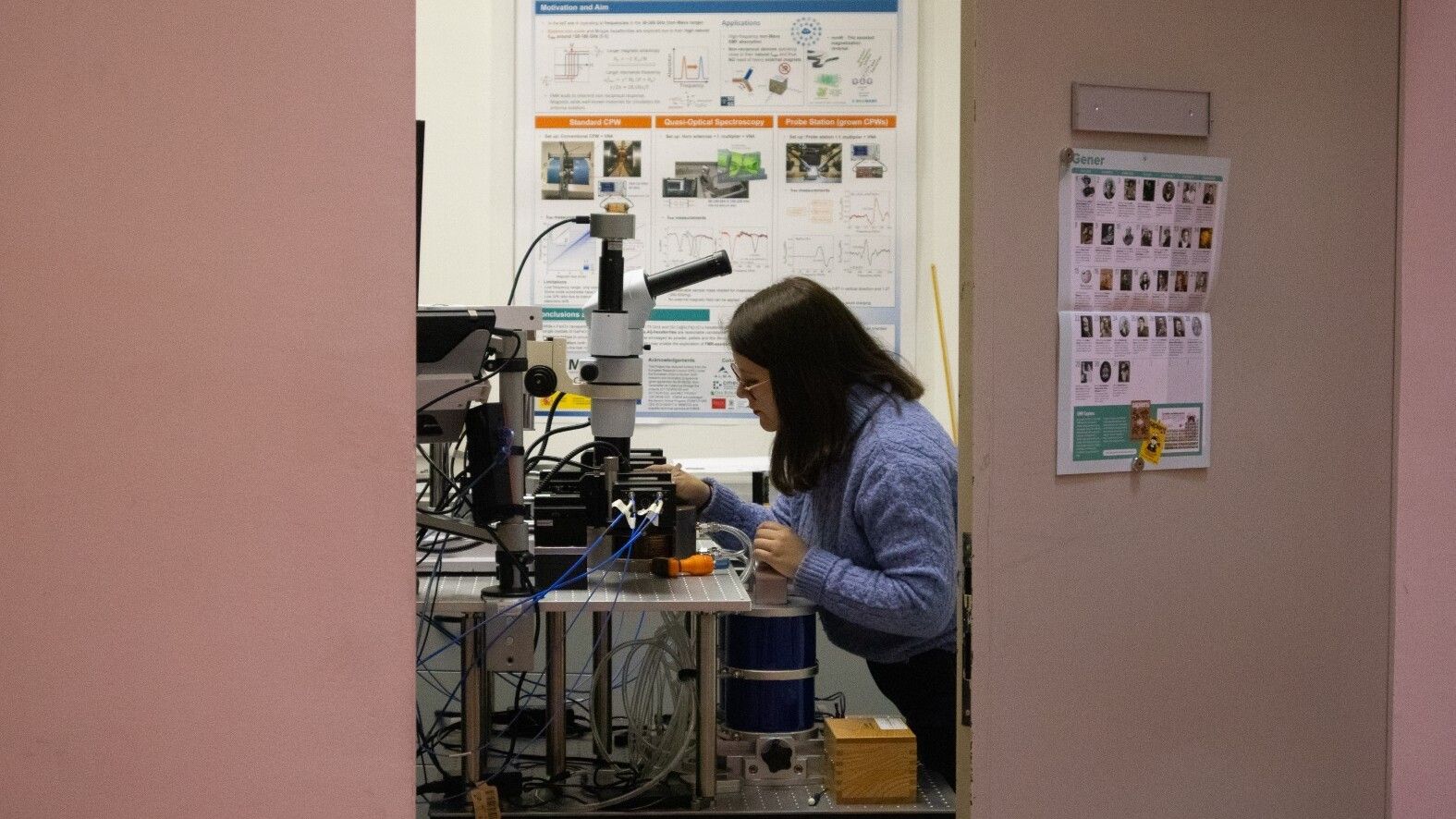 Ana Vila, postdoc at the NN group, in the lab | Daniel Rodríguez, ICMAB-CSIC
And now, years later, you are here, at the Nanoparticles and Nanocomposites Group of the ICMAB. What’s the advantage in being in such a multidisciplinary team?
NG: I haven’t been here long, but I’ve really noticed how interdisciplinary it is. There are so many different backgrounds, we even have a journalist! At first, I felt lost in talks about chemistry or physics, but I see how working with experts from different fields makes research stronger. Everyone contributes their own knowledge, and that combination moves science forward.
I’m the only one doing bioinformatics in the group, and that might seem a little bit isolating, but that’s also an opportunity. These tools might be useful beyond C. elegans, and being here allows me to develop them while learning from others.
AV: My previous group was tiny—I was the only PhD fellow. Here, it’s completely different. There are biologists, chemists, physicists, people working with C. elegans, others working with cellulose, and then, the people working on nanoparticles. In smaller groups, you learn just about your world and don’t even look anywhere else. Here, you feed from your colleagues just by being around because you see different techniques that might not seem useful now but might be in the future.
When I first joined, I changed topics, so I had to start from scratch. However, learning from colleagues has made that transition much easier. In a small group, you figure everything out alone. Here, if you need help with a technique, someone probably knows it, and that speeds things up.
AS: I agree. At first, it was a bit overwhelming, but now I see the benefits. You gradually start understanding what others are working on, and that broadens your perspective. If I were in a group focused only on my topic—polymeric nanocapsules—I wouldn’t know what’s happening in other areas. This allows me to know the state of the art of other fields, and that allows me to have a wider knowledge.
It is especially obvious in conferences and presentations. When you follow what’s happening in different fields, you can compare your research with a wider scientific landscape, not just your niche. That adds a lot of value to our research group.
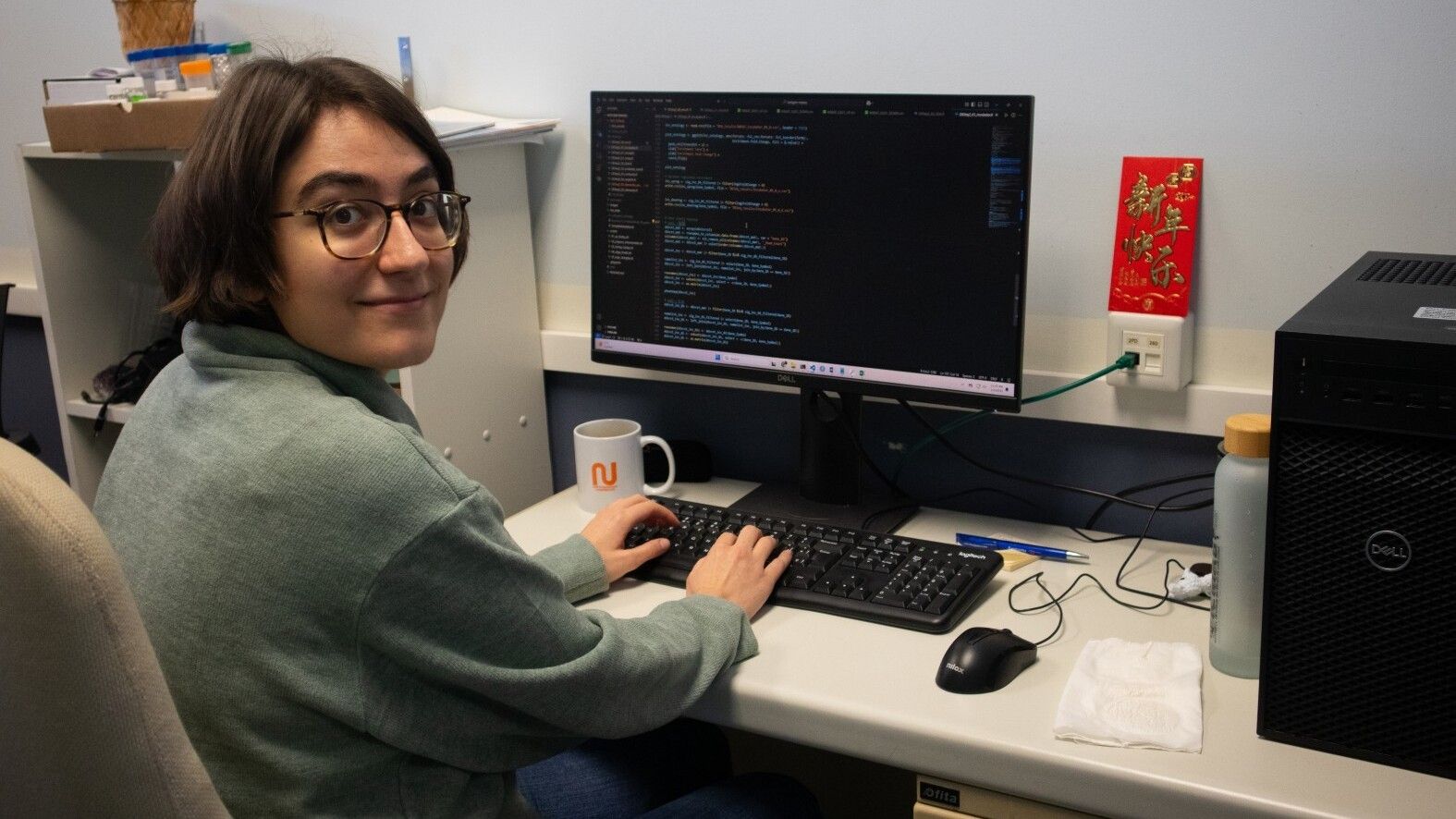 Núria Garriga, MSc Student from the NN group, at her computer | Daniel Rodríguez, ICMAB-CSIC
February 11 is the International Women and Girls in Science Day. A day that, as the UN says, “pursues gender equality in STEM fields by breaking stereotypes and fostering inclusive environments”, among others. Which difficulties have you encountered during your career?
NG: Personally, none. I know these issues exist, but my research career is still short. In bioinformatics, especially in tool development, most researchers are men. That’s changing, though. I started my master’s degree in Sweden, and there was a better balance between male and female professors, probably because they actively pushed for gender parity. Studies show that diversity leads to better productivity and ideas, so I think many research groups are trying to improve.
The fact that I haven’t faced issues might mean things are being done well where I’ve been.
AV: I haven’t experienced strong discrimination either, but in physics, almost all my professors were men, and in a class of fifty, we were only five women. Some professors made sexist jokes, and the male students laughed. I never took it personally, but it was there. There were moments that stood out. I remember a professor comparing Brownian motion to "women shopping at a mall." It wasn’t the worst thing that’s ever happened, but it made you think, "Was that necessary?"
Harassment is a bigger issue. It hasn’t happened to me, but I know women who have experienced it. Universities don’t always act unless there’s clear proof, which is frustrating, especially when it involves senior researchers. The good news is that awareness is growing, and we are getting better. Slowly, but better.
AS: I haven’t had any of the worst experiences either, but I’ve heard sexist comments during my studies. My class was somewhat unusual—half men, half women—which I think helped. At the ICMAB, I’ve never felt treated differently. But at some scientific conferences, outside ICMAB, I’ve noticed some older men questioning my research in a way that felt more like dismissal. I don’t know if it’s because I’m young and just getting started, or maybe it’s also gender. Maybe both. There have been some intonations I didn’t feel they were necessary.
AV: I’ve seen that happen. Some people ask questions just to undermine your work. I’ve sat in talks where the tone was so aggressive that it made me uncomfortable. Some questions are not for you to give an explanation but to undermine your research. Some have straight-up said, "This study is useless." As a person listening to them, I thought “I am ashamed of listening to these people.” It’s not always about gender, though: some researchers just struggle to accept different perspectives.
NG: And if they already see your work as different—and you’re a woman—they might dismiss it even more easily.
Does this happen just outside, in conferences, or inside the ICMAB, too?
AS: I’ve never felt that here at ICMAB. I think we’re lucky, at least in our group.
NG: Maybe it’s also because we have women leading our group—Anna Roig and Anna Laromaine. That probably makes a difference.
AV: Yes. The access of women to leading positions is not only a good sign of evolution in terms of gender equality, but it also helps maintaining a positive atmosphere where women can feel more welcome.
Interview by Daniel Rodríguez Urbano, Communication Manager at the Nanoparticles and Nanocomposites (NN) group at ICMAB