


A new article has been published at the journal ACS Energy Letters:
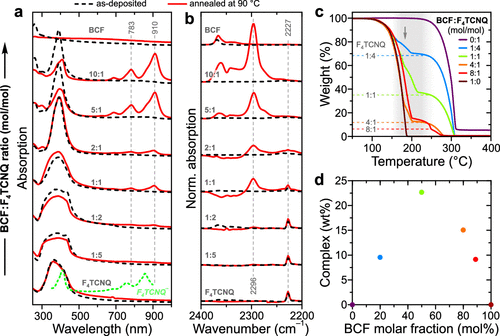
Chemical doping of organic semiconductors is an essential enabler for applications in electronic and energy-conversion devices such as thermoelectrics. Here, Lewis-paired complexes are advanced as high-performance dopants that address all the principal drawbacks of conventional dopants in terms of limited electrical conductivity, thermal stability, and generality. The study focuses on the Lewis acid B(C6F5)3 (BCF) and 2,3,5,6-tetrafluoro-7,7,8,8-tetracyanoquinodimethane (F4TCNQ) bearing Lewis-basic −CN groups. Due to its high electron affinity, BCF:F4TCNQ dopes an exceptionally wide range of organic semiconductors, over 20 of which are investigated. Complex activation and microstructure control lead to conductivities for poly(3-hexylthiophene) (P3HT) exceeding 300 and 900 S cm–1 for isotropic and chain-oriented films, respectively, resulting in a 10 to 50 times larger thermoelectric power factor compared to those obtained with neat dopants. Moreover, BCF:F4TCNQ-doped P3HT exhibits a 3-fold higher thermal dedoping activation energy compared to that obtained with neat dopants and at least a factor of 10 better operational stability.
M4ELC Sustainable Electronics
A Universal, Highly Stable Dopant System for Organic Semiconductors Based on Lewis-Paired Dopant Complexes
Osnat Zapata-Arteaga, Aleksandr Perevedentsev, Michela Prete, Stephan Busato, Paolo Sebastiano Floris, Jesika Asatryan, Riccardo Rurali, Jaime Martín, and Mariano Campoy-Quiles
ACS Energy Lett. 2024, 9, 7, 3567–3577

