


A new paper has been published in the journal Acta Materialia:
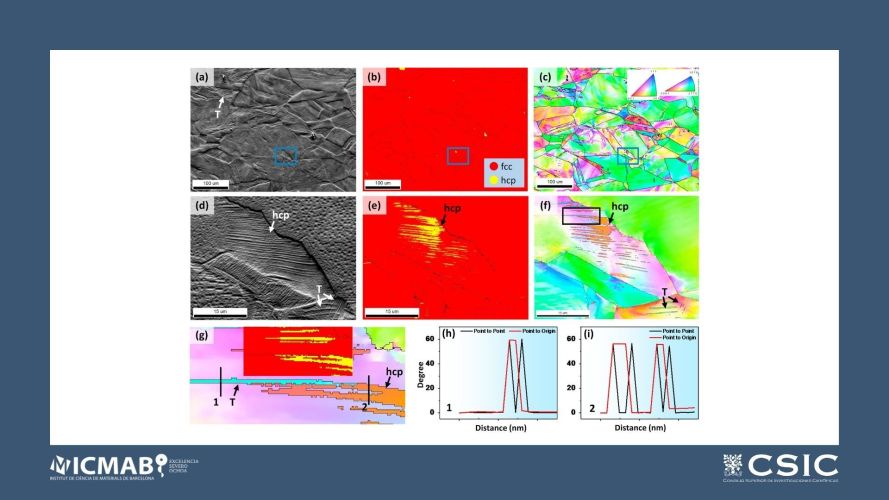
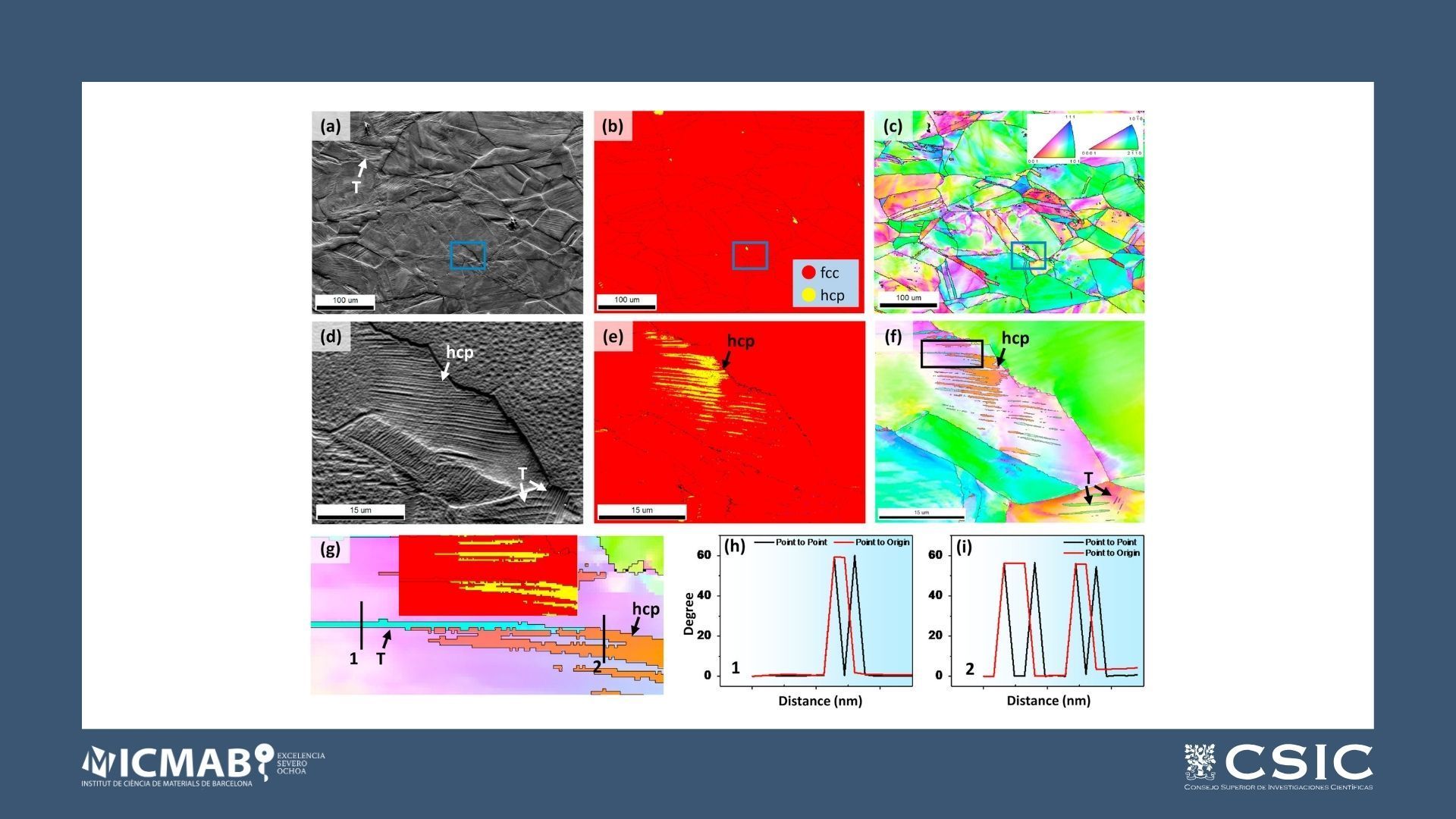
The microstructural evolution of a Co-based high-entropy alloy (HEA) was examined using electron microscopies, confirming the prominent presence of stacking faults (SFs) and deformation twins during compression. A novel twinning mechanism involving a local fcc → hcp transformation at the medium deformation stage was discovered, which had not been hitherto reported in HEAs. High-resolution scanning transmission electron microscopy revealed the conversion of a pre-twinned ε-martensite-like phase, featuring a local hcp structure, into a stable three-layer twin lamella through the nucleation of new SFs in between pre-existing ones. Additionally, as deformation progressed, the Niewzcas and Saada's pole mechanism of twinning was simultaneously activated, resulting in the formation of nano-twins within the HEA structure at higher deformation stages. The activation of both twinning mechanisms was analyzed by considering the concept of effective stacking fault energy, and stacking fault and twin fault probabilities, calculated through X-ray diffraction analysis at each deformation stage. Finally, the activation energy associated with dislocation-SFs and twin boundary interactions, as well as their respective influences on the strain-hardening behavior of the HEA at each deformation stage, were thoroughly investigated using thermally activated parameters obtained from cyclic stress relaxation experiments.
M4ELC Sustainable Electronics
Activation of different twinning mechanisms and their contributions to mechanical behavior of a face-centered cubic Co-based high-entropy alloy
Mehrdad Ghiasabadi Farahani, Mohammadhossein Barati Rizi, Mahdi Aghaahmadi, Joo-Hee Kang, Sakari Pallaspuro, Leo Pentti Karjalainen & Jeoung Han Kim
Acta Materialia, Volume 285, 15 February 2025, 120665

