


A new paper has been published in the journal Chemical Science:
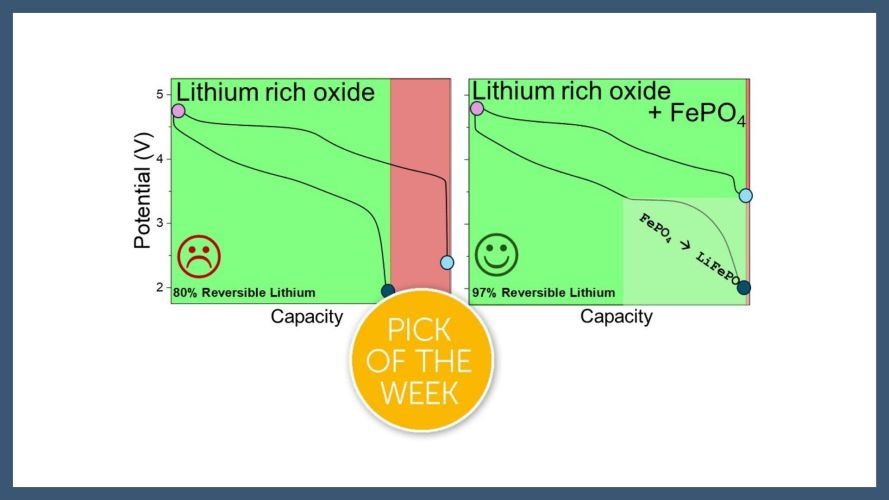
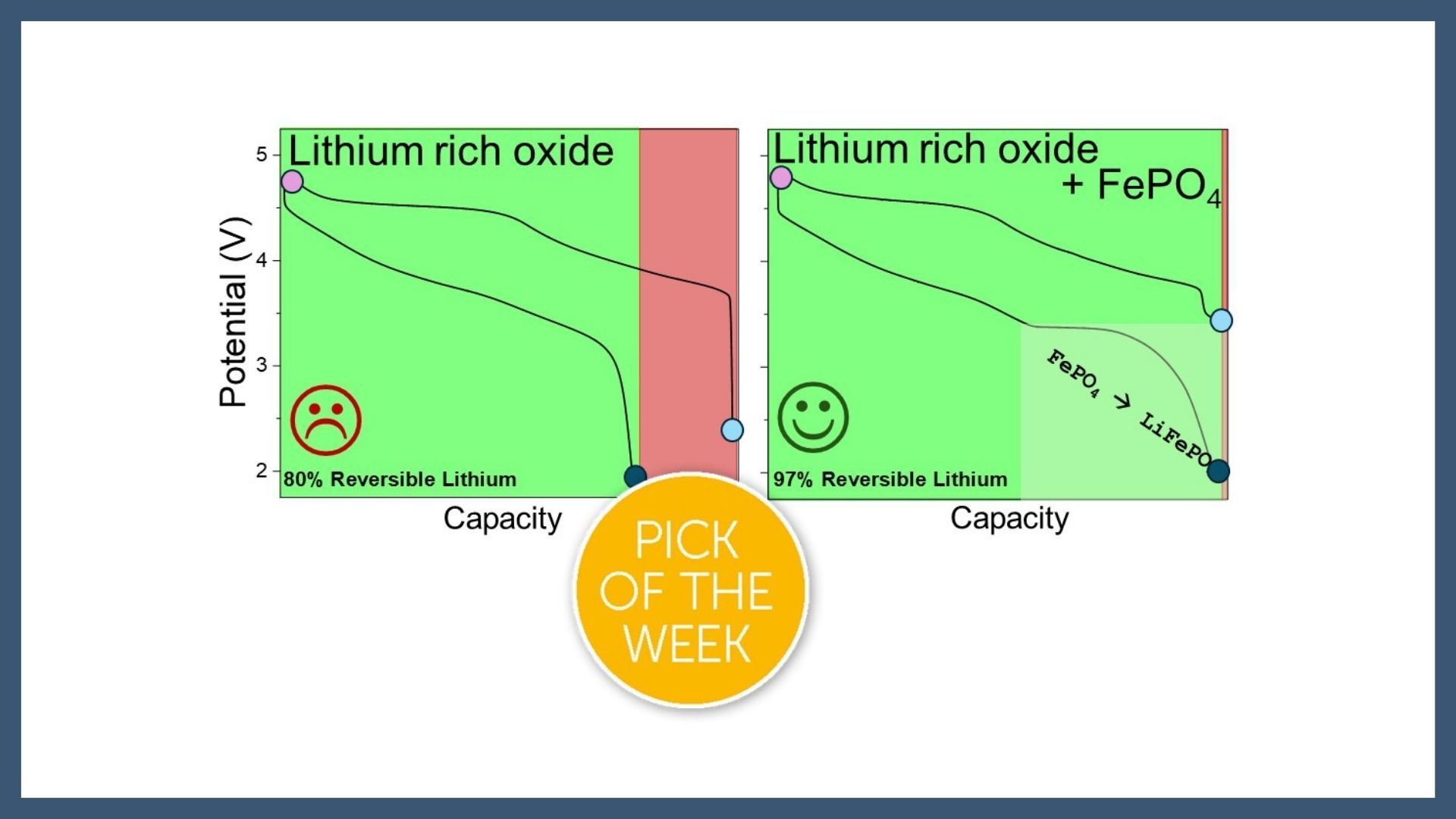
Lithium-rich oxides (LRO), derived from NMC-type materials, are among the most promising next-generation positive electrode candidates for lithium-ion batteries. Despite their potential, their practical application is hinderend by inherently low first-cycle coulombic efficency, caused by the irreversible loss of lithium. In this work, we address this drawback by chemically delithiating secondary active materials – LiMn2O4 (LMO) or LiFePO4− and subsequentyly blending them with the cobalt-free lithium rich oxide Li1.15Ni0.3Mn0.55O2. The incorporation of these delithiated components improves not only first-cycle efficiency but also capacity retention, with the degree of enhancement proportional to the fraction of added material. Differential scanning calorimetry (DSC) further reveals improved thermal stability for LRO:FePO4 blends evidenced by a higher decomposition temperature and lower overall heat released. In contrast, blending LRO with λ-MnO2 blends results in a detrimental effect related to increased moisture sensitivity. Operando synchrotron X-ray diffraction on blended electrodes confirms that the secondary active material actively participates in the electrochemical processes. Our findings demonstrate a simple and industry-compatible strategy to mitigate one of the major drawbacks of LROs, paving the way for more sustainable and high performance lithium-ion batteries.
M4NRG Clean Energy
Addressing first cycle irreversible capacity in lithium-rich layered oxides by blending with delithiated active materials
Chatzogiannakis, Dimitrios; Arszelewska, Violetta; Cabelguen, Pierre-Etienne; Palacin, M. Rosa; Casas-Cabanas, Montse
DOI: 10.1039/D5SC06660C

