


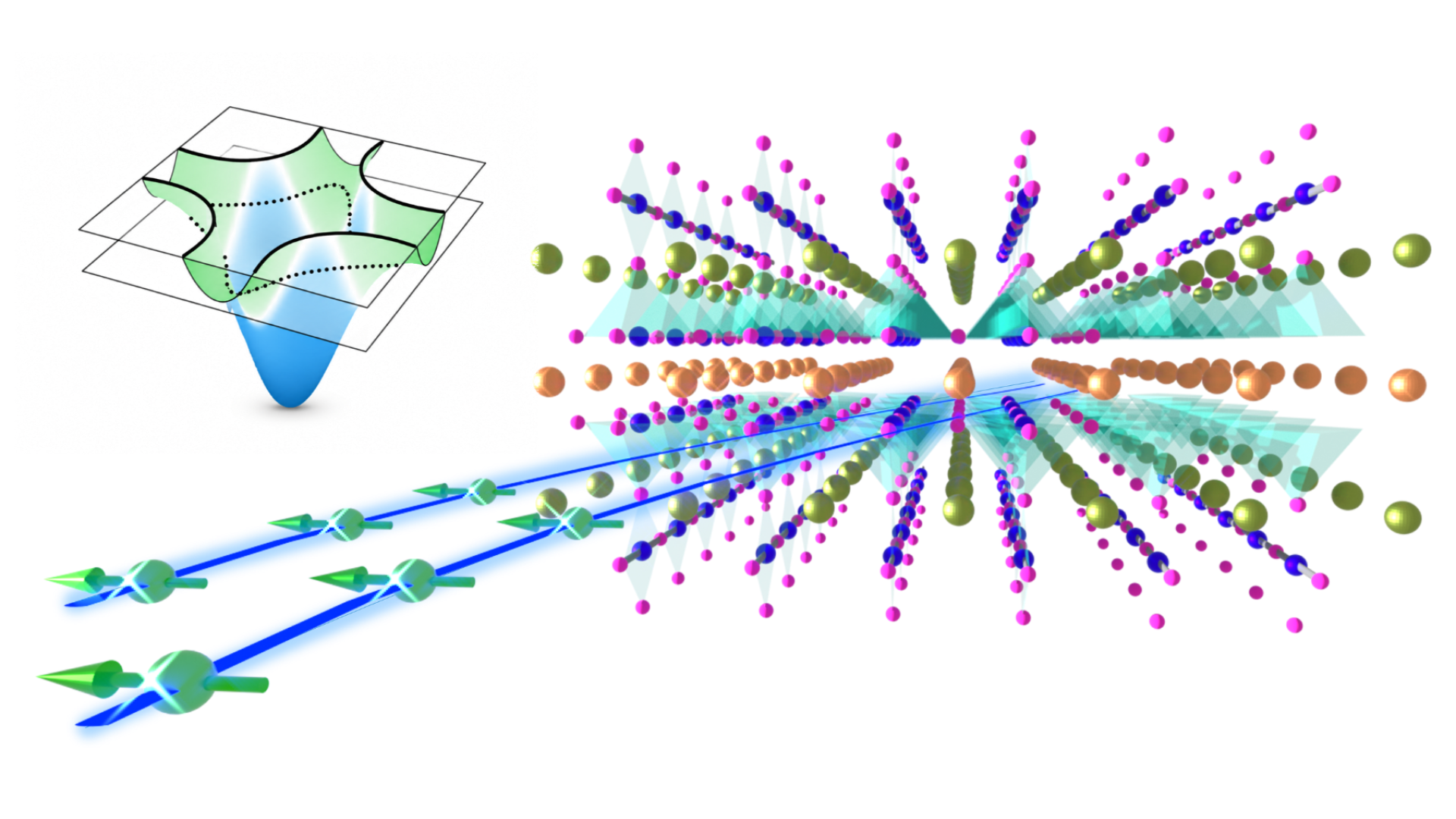
High-temperature superconductors (HTSC) could help make future technologies more energy efficient, but scientists still do not fully understand how they work. Now, researchers at the Institute of Materials Science of Barcelona (ICMAB-CSIC) have found direct evidence of an effect that had long been considered irrelevant in one of the world's best-known superconductors. The finding could provide a new way to study these complex materials and may open new opportunities for future low-energy electronic devices.
Spintronic and superconducting materials do not tend to get along. In a nutshell, superconductivity is a property that allows electricity to flow through the material without energy loss; and spintronics is a field that uses the orientation in which electron spins to carry information. Spin-orbit coupling (SOC) is a quantum effect that links an electron's spin (that acts like a tiny compass), to the way it moves through a material. In HTSC, however, electrons usually travel in pairs (known as Cooper pairs) with opposite spin orientations, cancelling each other’s information, hence the SOC effect was not considered to be relevant.
The team, led by Anna Palau and Can Onur Avci, found evidence of spin-orbit coupling in YBCO, a copper oxide material where this interaction had largely been neglected.
An overlooked interaction
For researchers in spintronics, SOC is nothing new. It is one of the key phenomena that allows spin information to be generated, manipulated and transported. Yet in these materials, the interaction was largely left out of the picture. “Spin-orbit coupling is something we use very commonly in spintronics,” says Can Onur Avci, “but it was surprising to see that it exists also in a superconductor.”
The reason is that these materials are quite difficult to understand. Scientists still do not fully agree on the mechanisms that make them superconducting. As a result, many studies focused on the interactions known to play a major role, while treating spin-orbit coupling as negligible.
“This interaction was not considered in the picture of these materials because they are so complex,” says Anna Palau. “They considered that this was not doing anything.”
Hidden in a narrow temperature window
One reason why this interaction had remained unnoticed is that it only becomes visible under very specific conditions. The team detected it during a brief moment when the material is changing from a conventional conductor into a superconductor.
“This offers a fresh perspective to study the electronic structure in this material in a very narrow temperature window that was probably missed by various researchers,” says Can Onur Avci. The phenomenon disappears both before and after that point, making it particularly difficult to detect. According to the researchers, this could explain why spin-orbit coupling remained largely overlooked in HTSC for so long.
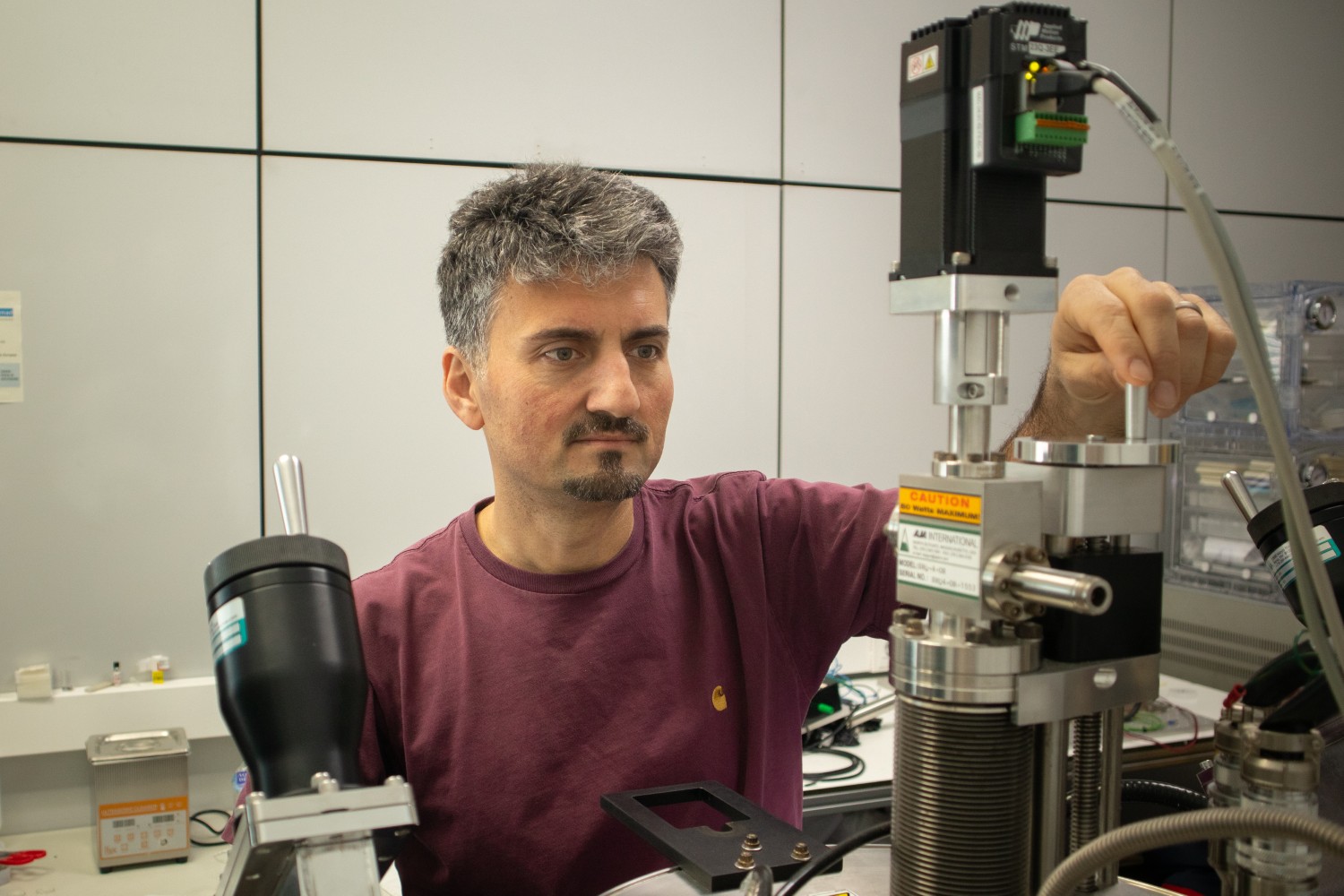
The researcher Can Onur Avci working in his lab | ICMAB-CSIC
Why it matters
The findings could open new possibilities for superconducting spintronics, a field that aims to combine the energy efficiency of loss-free electrical transport with the information-processing capabilities of spintronic devices. The effect could be exploited in future cryogenic technologies operating at liquid-nitrogen temperatures, enabling more efficient signal transmission, data manipulation and memory devices than those currently possible with conventional spintronic materials. The discovery may also offer researchers a new way to investigate the complex behaviour of HTSC, a question that remains unresolved despite decades of research.
Research carried out at ICMAB-CSIC
The study was carried out entirely at the Institute of Materials Science of Barcelona (ICMAB-CSIC) through a collaboration between the groups SuperQMat (Anna Palau) and Mulfox (Can Onur Avci). They brought together expertise in high-temperature superconductors and spintronics. All the stages of the research were made in-house, from materials preparation to device fabrication and experimental measurements, conducted at the institute.
Reference article
Magnetotransport Signatures of Spin–Orbit Coupling in High‐Temperature Cuprate Superconductors
Barrera, A., Li, H., Gunkel, T., Alcalá, J., Damerio, S., Avci, C. O., & Palau, A.
Advanced Science, 2026
DOI: 10.1002/advs.76166
> Read the press release in CAT, ENG, ESP
Related news
- Magnetic ‘microflowers’ enhance magnetic fields locally
- The ICMAB receives one ERC Starting Grant researcher who will explore magnetic insulators for future spintronics
- New Cover in Advanced Sensor Research on tuneable magnetoresistive sensors
- Superconductivity at room temperature: breaching a scientific barrier