

A new paper has been published in ACS Polymers Au:
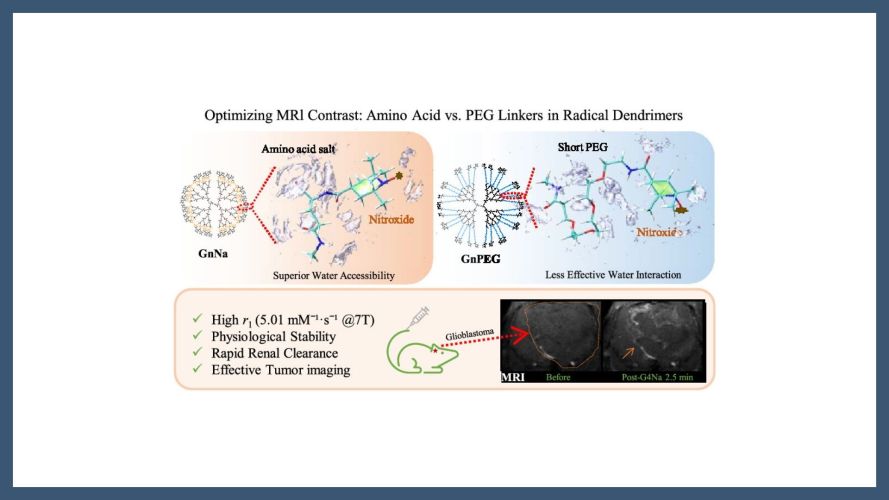
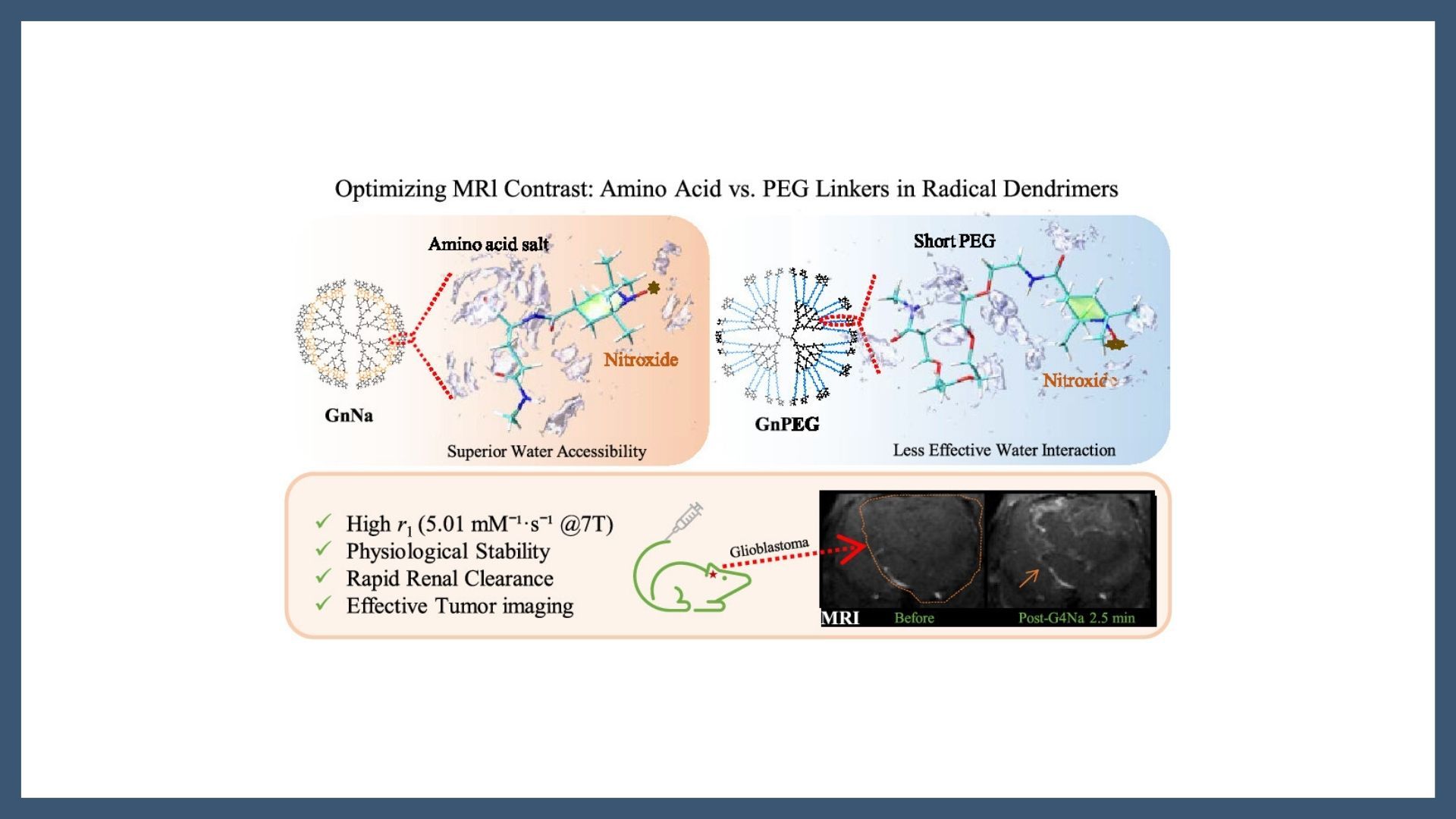
Understanding how macromolecular architecture and interfacial hydration govern magnetic relaxation is crucial for the rational design of next-generation Magnetic Resonance Imaging (MRI) contrast agents. Here, we compare two water-solubilization strategies for organic radical dendrimers: using short-chain poly(ethylene glycol) (PEG) linkers versus amino acid-derived carboxylate sodium salt linkers. By synthesizing third- and fourth-generation dendrimers functionalized with these respective groups (denoted as GnPEG and GnNa, where n = 3, 4), we achieved well-controlled branching and radical loading. This design enables a systematic investigation into how linker chemistry governs molecular flexibility, interfacial hydration, and spin exchange efficiency. In vitro MRI revealed that the GnNa series exhibits higher longitudinal relaxivity (r1) than the GnPEG counterparts. Electron paramagnetic resonance (EPR) spectroscopy and molecular dynamics (MD) simulations were employed to elucidate the factors underlying these differences. The combined experimental and computational analysis indicates that amino acid carboxylate linkers enhance hydration and hydrogen bonding at the dendrimer–solvent interface relative to PEG-linked analogues, correlating with improved relaxivity. In vitro and in vivo MRI studies demonstrated that G4Na achieves an r1 of 5.01 mM–1·s–1 per molecular entity at 7 T─comparable to or exceeding commercial Gd3+-based agents─while maintaining physiological stability, rapid renal clearance, and effective tumor imaging capability. These findings demonstrate that fine-tuning dendrimer–solvent interface interactions through amino acid carboxylate linkers provides a robust strategy for optimizing water accessibility and relaxation efficiency in macromolecular MRI agents. This work establishes a clear structure–interface–function relationship that can guide the future design of biomacromolecules or biocolloidal architectures for biomedical imaging.
M4HTH Smart Nanomedicine
Designing Water-Soluble Macromolecules for Biomedical Use: PEG Chains versus Amino Acids─A Case Study in MRI Contrast Agents
Wu, Yufei; Caro, Carlos; Matamoros, Esther; Urbano-Gamez, Jesus David; Lope-Piedrafita, Silvia; Vida, Yolanda; Garcia-Martin, Maria Luisa; Vidal-Gancedo, Jose; Lloveras, Vega
DOI: 10.1021/acspolymersau.5c00162

