

Muthumuni Elizabeth Managa was born in Limpopo, the northernmost province in South Africa. She became a Doctor in Chemistry at Rhodes University (Makhanda , Eastern Cape) in 2019, where she did a postdoc for two more years. After this period, she moved to the University of South Africa in Johannesburg.
There, she now works at the Institute for Nanotechnology and Water Sustainability (iNanoWS). In 2025, she obtained a Science by Women fellowship from the Women for Africa Foundation. Thanks to this fellowship, she was able to stay at the ICMAB from January to April 2025 and will return for three more months in 2026.
Why did you apply for the Science by Women program?
Science by Women is a fellowship call that comes out every year. It is open to any woman in Africa who is in the STEM field and offers the opportunity to join a Spanish Institute or University. It is a very competitive program, but if your application goes through, you will be taken up with those with whom you have chosen to collaborate. You look for someone who shares your interests, write a proposal together, and submit it with your application. So, it's somehow to advance women in Africa to collaborate with Spanish women scientists.
Personally, I was looking for growth and international collaboration. I do research in South Africa, but one needs different international perspectives, too. Your research cannot only concentrate on Africa or South Africa specifically, but you also want to know what other researchers internationally are doing and where their research is going. How can you also have an input into the knowledge base of scientific research? That is why I applied for it.

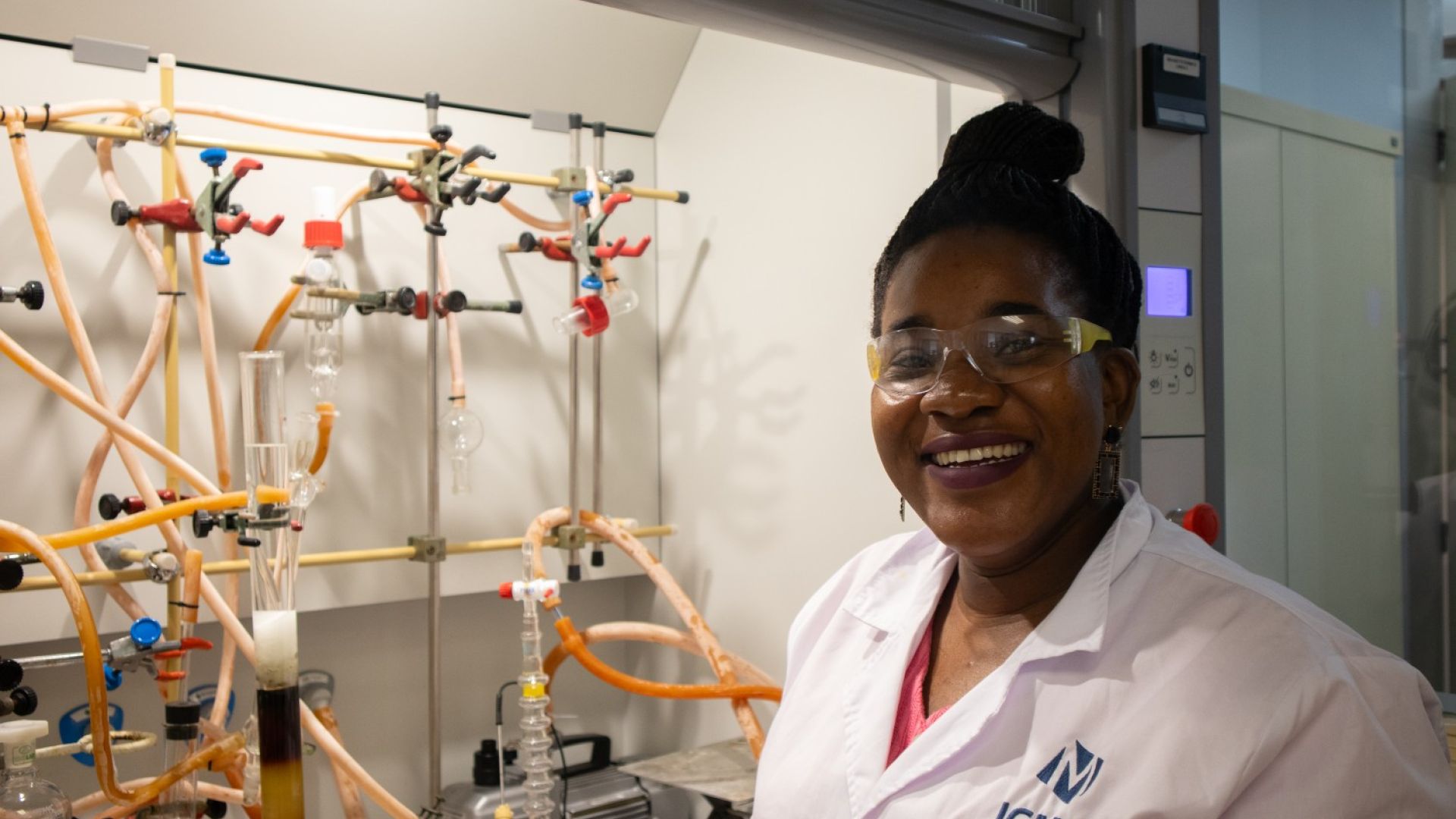
Muthumuni Managa performs an experiment at the lab | ICMAB-CSIC
What was your field of study before coming here?
I did my PhD on drug-delivering agents for breast cancer cell lines. I designed molecules with anti-cancer activity, specifically concentrating on MCF-7 breast cancer cell lines. Afterwards, I did a postdoc for two years, which also included many different applications of the synthesised macrocyclic compounds known as porphyrins. Now, at iNanoWS, we mainly focus on anything involving nanotechnology or water sustainability. Since I had a bit of background in material synthesis, I applied it to antibacterial activity in water.
What does your project at ICMAB consist of?
In brief, my focus is now on synthesising nanomaterials that, when activated by light, respond in a way that enables them to inactivate bacteria. Bacteria can be in water or in any environmental place. However, the proposal that ICMAB researcher Rosario Nuñez and I proposed with this Science by Women program was based on my knowledge of porphyrin synthesis and her knowledge of boron cluster synthesis. We asked ourselves: “If we combine these two molecules, will we have a better response for other antibacterial or anti-cancer activity?” Hence, my visit here.
So far, I have been concentrating more on the synthesis of combining the porphyrin brought from South Africa with the boron cluster they have here. We are conjugating the two and trying to see if there is a response regarding photophysical properties. Additionally, when I came here, I was also trained to use Nuclear Magnetic Resonance (NMR) 300 MHz and 400 MHz because, since we mostly deal with synthesis, I have to use the instruments.
After the synthesis of the porphyrins together with the boron clusters, you have to characterise them to ensure that you have the molecule you say you have synthesised. We have done that using NMR, and we are still in the process of synthesising more so that I can take them back to South Africa, do further characterisation, and then do the application. We have also agreed that we need to synthesise more porphyrins, which I should bring back for my second visit so that we can incorporate different boron clusters for other antibacterial or anti-cancer activity.
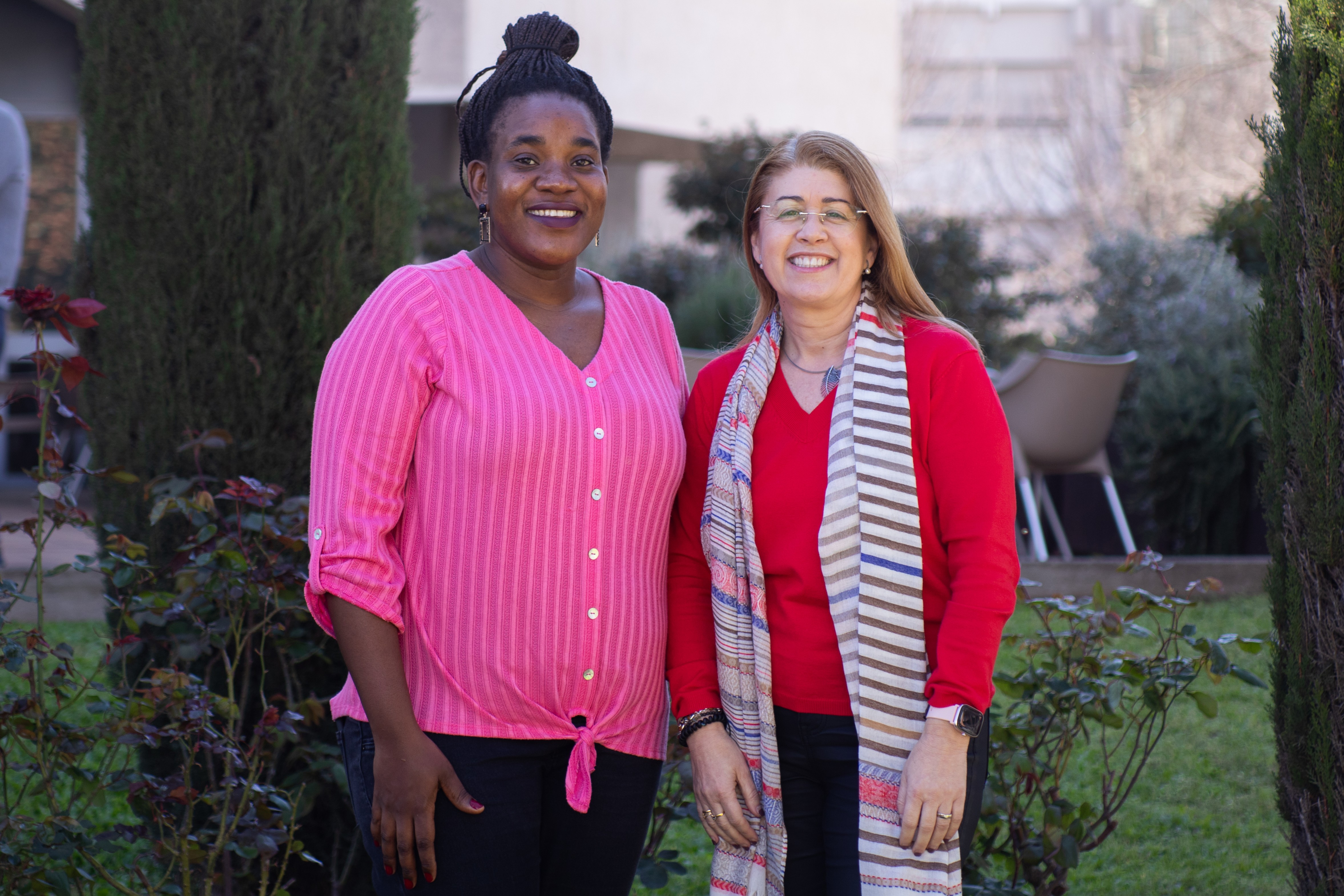
Muthumuni Managa (L) poses with Rosario Nuñez (R) at the ICMAB Garden | ICMAB-CSIC
You are now returning to South Africa until next year. What will you bring to your home institution from this collaboration?
Mostly, the relationship I have built with ICMAB researcher Rosario Nuñez and the students and postdocs in the lab, which I believe will be a continuous relationship and collaboration. Hopefully, one day, we can even continue applying for grants together. We could even go further in student exchange programs, because I have students in South Africa. These students could also come here, and some ICMAB students could come to South Africa and really see the type of research that we also do.
Collaboration between institutions is very important because it enhances one’s knowledge and scope in terms of research. When one collaborates to share ideas, one shares different perspectives in a way that also will improve their own career growth. That's how I view it.
More information: