


A new paper has been published in Inorganic Chemistry:
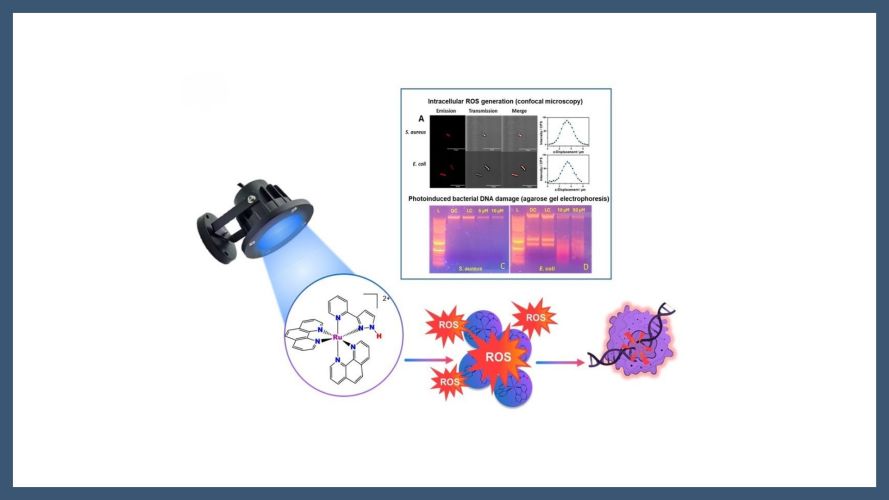
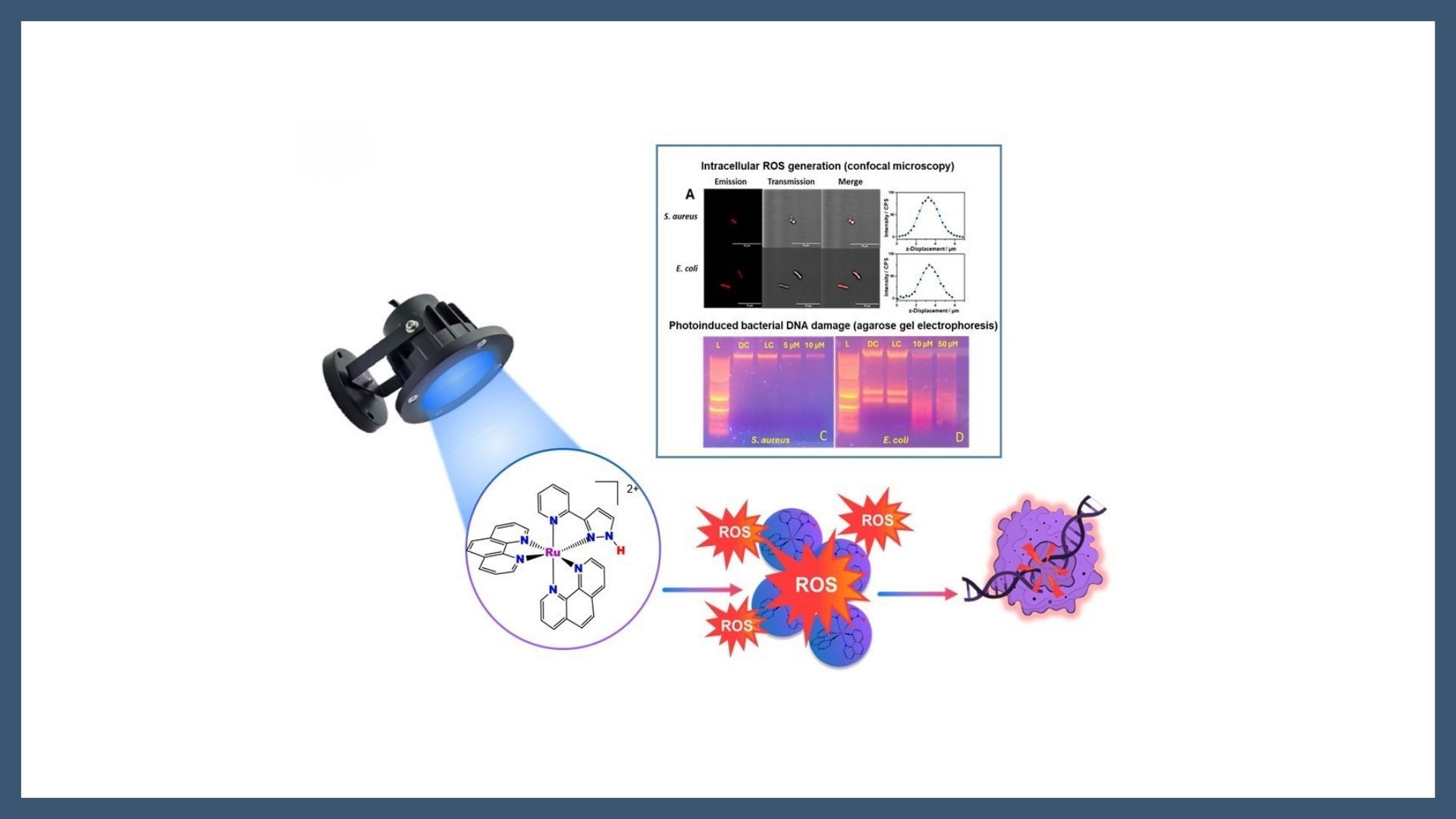
With their highly stability and tunable photophysical properties, Ru(II) complexes are excellent photosensitizer candidates for antimicrobial photodynamic therapy (aPDT), offering selective bacterial targeting without driving resistance. A series of heteroleptic Ru(II) N-donor complexes, incorporating symmetric N-bidentate ligands such as 1,10-phenanthroline and 4,4′-diphenyl-2,2′-bipyridine, together with asymmetric N-bidentate ligands including pyridine–pyrazole, iminopyridines, and iminoquinoline, have been successfully synthesized to assess their potential as photosensitizers for aPDT. All Ru(II) complexes exhibited distorted octahedral coordination, unique ligand arrangements, and hydrophobicity, which influenced their electronic properties and photodynamic activity. TDDFT calculations reliably reproduced experimental trends. All complexes produce singlet oxygen and superoxide radical anion upon exposure to visible light and are capable of photoinactivating S. aureus bacteria at micromolar concentrations. Complex 2, containing two phenanthrolines and a pyridine–pyrazole ligand, displays the highest potential for aPDT due to its optimized ligand structure, which enhances its physicochemical and optical properties and singlet oxygen production. It penetrates the bacterial cytoplasm and damages genomic DNA, efficiently neutralizing both Gram-positive and Gram-negative strains, as well as Candida albicans yeasts to a lesser extent. Meanwhile, it shows no toxicity toward human fibroblasts within therapeutic dose ranges. By bridging the gap between molecular structure and biological function, these results establish novel design criteria for choosing ligands to develop effective, selective Ru(II) aPDT agents.
M4HTH Smart Nanomedicine
Enhancing the Antimicrobial Photodynamic Activity of Heteroleptic Ruthenium(II) Complexes: Role of Asymmetric N-Donor-Based Ligands
Mesra-Brahmi, Abir; Martinez-Olmo, Sofia; Guerrero, Isabel; Fontrodona, Xavier; Poater, Jordi; Verdaguer, Ariadna; Auset Vallejo, Maria; Bresoli-Obach, Roger; Nonell, Santi; Nunez, Rosario; Romero, Isabel
DOI: 10.1021/acs.inorgchem.6c00420

