

The four Materials Science and Technology institutes belonging to the Spanish National Research Council (CSIC) – two of which are also joint institutes with the University of Zaragoza and the University of Seville – will celebrate their 40th anniversary with the launch of a campaign aimed at highlighting scientific advances in the fields of health, the environment and information technologies.
The celebration brings together the Institute of Materials Science of Barcelona (ICMAB-CSIC), the Institute of Materials Science of Madrid (ICMM-CSIC), the Institute of Nanoscience and Materials of Aragón (INMA-CSIC-Unizar), and the Institute of Materials Science of Seville (ICMS-CSIC-US), the CSIC’s four major institutes dedicated to materials science and technology.
Although the current INMA began its activities on 24 May 1985, the establishment of the other three centres was completed during 1986: ICMAB on 26 June, ICMS on 22 July, and ICMM on 1 December. For this reason, 2026 marks the 40th anniversary of the establishment of the group of institutes which, since then, have helped make Spain an international benchmark in materials research.
Four videos on health, energy, electronics and young talent
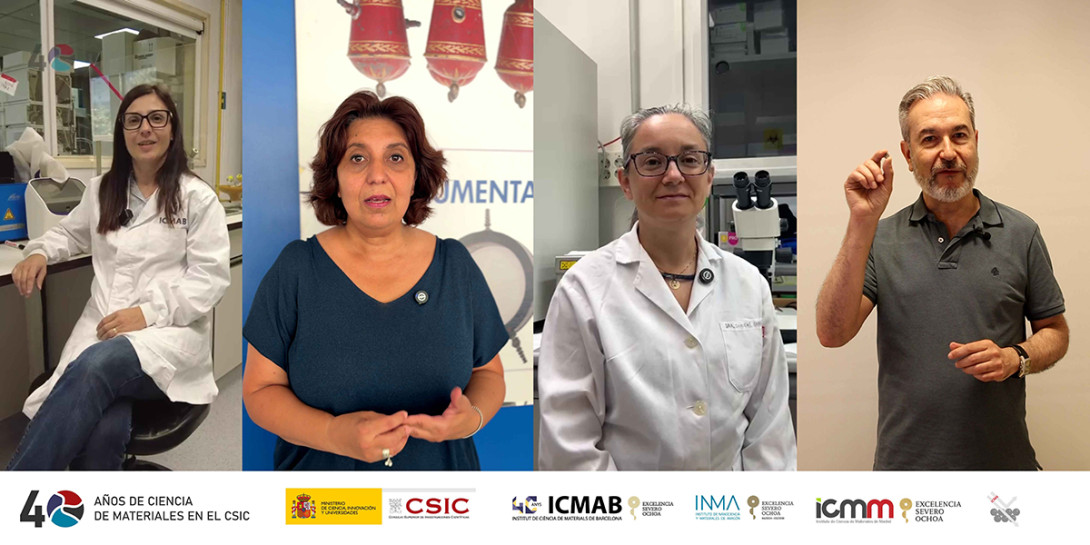
As part of the campaign, a series of four videos will be released on social media, showcasing the major advances made in each of these fields. The campaign will culminate in a video highlighting the young talent driving scientific progress in the field of materials science.
The campaign, which begins today, on the eve of World Materials Day, coincides with Science and Technology Week, celebrated this month. The videos feature researchers from all four institutes, and from ICMAB, the researchers that participated in them are:
- In the Materials for HEALTH video (released on 3 Nov), Judith Guasch, from the Dynamic Biomimetics for Cancer Immunotherapy group, who works on hydrogels and artificial tissues for cancer treatment.
- In the Materials for ENERGY video, Mariano Campoy, from the Nanostructured Materials for Optoelectronics and Energy group, who works on organic and hybrid materials for photovoltaics.
- In the Materials for ELECTRONICS video, Elena Bartolomé, from the Inorganic Materials & Catalysis group, who works on multifunctional molecular magnetic materials for Quantum technologies.
- In the YOUNG RESEARCHERS video, Willy Menacho, from the Softmatter Theory group, who works on computational biophysics and molecular simulations.
Four decades of developing the materials of the future
Since their establishment, the CSIC’s Materials Science and Technology institutes have become the leading force in Spain’s public research in this field. Their work has enabled the development of new advanced materials and the transfer of this knowledge to industry, contributing to economic growth, industrial competitiveness and societal well-being. Their cutting-edge research places these centres—and Spain as a whole—at the forefront of scientific advances that have underpinned some of the latest Nobel Prizes in Physics and Chemistry, including the development of metal-organic frameworks (MOFs), ultrafast physics, quantum bits and graphene.
Research conducted at these centres has a direct impact on some of the major challenges of the 21st century, particularly in three key areas: energy, health and computing.
In the field of the energy transition, for example, researchers are developing materials for more efficient solar cells, technologies that harvest ambient energy to power smart devices, advanced energy storage systems, next-generation batteries and superconducting materials capable of reducing losses in the electricity grid. Their research also helps address sustainability and environmental challenges through the development of materials for advanced recycling, sustainable aviation, water purification and sensors capable of detecting pollutants at the nanoscale (one billionth of a metre), as well as disruptive technologies for producing biofuels.
Another rapidly growing area is digital technologies, information and computing. Here, researchers are working to develop devices for quantum technologies and future quantum computers, as well as sensors, storage and signalling systems, next-generation processors and faster, more energy-efficient magnetic memories, among many other applications.
In healthcare and nanomedicine, the work of these scientists is helping to curb the progression of diseases such as cancer, improve the effectiveness of treatments such as radiotherapy, address neurodegenerative and movement disorders, tackle antibiotic resistance and enhance recovery from spinal cord injuries. These advances, among others, are being made possible by the design of nanoparticles and biomaterials for targeted drug delivery, early diagnosis and the development of new bioimaging techniques. Research teams are also making progress in designing biocompatible materials for various types of prostheses, improving patients’ quality of life through greater durability.
The collective efforts of these institutes have also become a powerful driving force for attracting national and international talent and fostering the development of world-class scientific careers.
A programme to bring materials science closer to society
Throughout 2026, the four institutes have celebrated this milestone with different activities and will continue doing so during this month during the Science Week, with activities aimed at encouraging scientific vocations through materials science and raising awareness of the role this field plays in providing technological solutions to societal challenges related to climate change, medicine and information technologies.
At ICMAB we prepared a commemorative programme combining activities for its scientific community with public outreach initiatives. In May we celebrated our 40th anniversary with a special anniversary week that included meetings between different generations of researchers, initiatives to preserve the institute’s history—such as an exhibition at the building’s entrance—and activities designed to strengthen the bonds between those who have helped shape its four-decade scientific journey. On November 12th, we will hold a joint activity with other research centers at the Campus UAB to explore materials science with highschool students that will visit our research center laboratories.
The other three institutes have held other 40th-anniversary celebrations, with the aim to recognise the contributions of the thousands of people who have been part of these institutes since their establishment and to highlight the strategic role of materials science in addressing the global challenges of our time. Some highlights include The 40 Materials (INMA-CSIC-Unizar), a catalogue compiled by the institute's researchers featuring forty materials that have been, are and will continue to be essential to scientific and technological progress, and a Science Museum at ICMM-CSIC.
Read more
ICMAB - 40 Years of Materials Science
World Materials Day 2026: Share Your Society’s Activities - FEMS